This manual is for PSY FPX 6730 Assessment 1, start to submission. Assessment 1 of PSY FPX 6730, Consultation Psychology, is where an engagement gets entered rather than opined about: a request received in the client's own words, a client system named by role, a scope with access and data ownership written into it, and an agreement somebody could sign. Graduate credit here rewards professional conduct as much as analysis. Below is the working order our psychology desk uses, a structure that answers the criteria, and an annotated excerpt of a contracting section. Want it taken off your desk? A premium original sample for this exact deliverable returns inside 24 to 48 hours, reworked at no cost until every descriptor is met. Capella's catalog lists the course as PSY-FPX6730, and some courserooms print PSY6730; both point to this same Assessment 1.
One honesty note before the manual: Capella revises courses and scoring guides over time, so always write to the exact scoring guide attached to your assessment in the courseroom. The course identity above is verified on capella.edu; the method and structure below are our tutors' approach to it, not Capella's official rubric text.
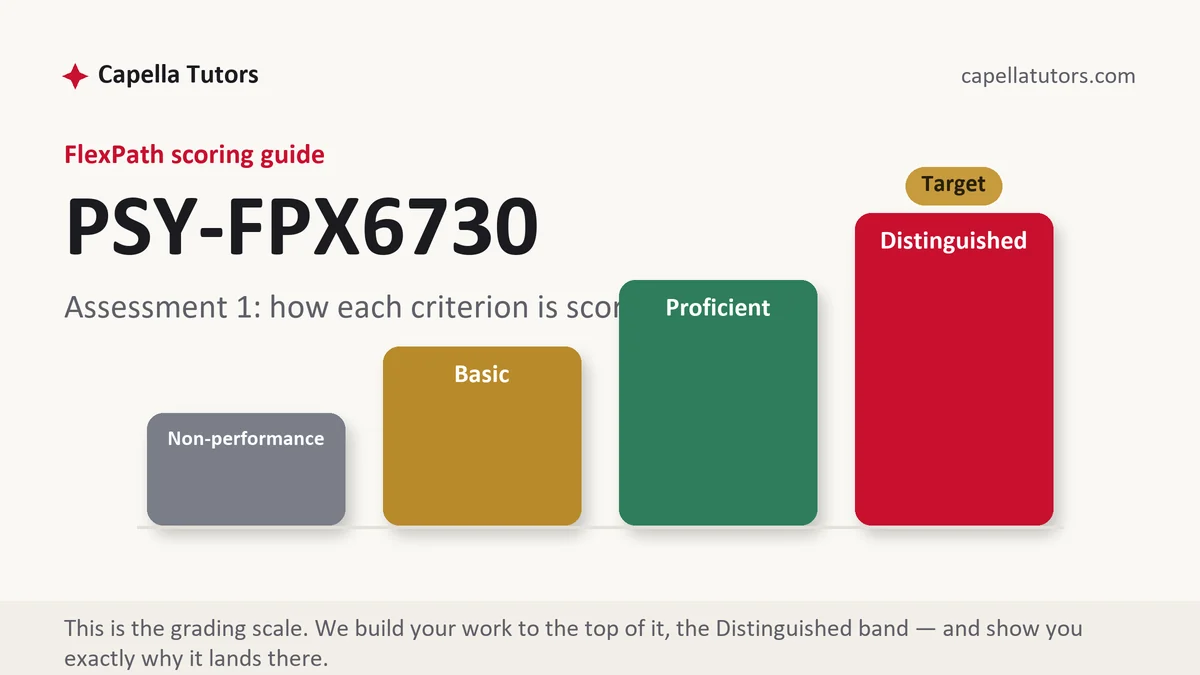
How PSY FPX 6730 Assessment 1 is scored
FlexPath awards no letter grade. Your guide resolves each criterion to one of four levels, and the wording of that level is the brief:
| Level | What it means on an entry and contracting deliverable |
|---|---|
| Distinguished | Every client type is named by role, the presenting request and the diagnostic question are held apart, and the agreement anticipates a conflict between clients before it happens. The extra move is written into the criterion wording, and locating it is the work. |
| Proficient | The engagement is scoped completely and the client is identified. Competent, and still one anticipated conflict short of the top level. |
| Basic | A description of what the consultant plans to do, with the client left as the organization and confidentiality promised in general terms. Where a first attempt usually lands. |
| Non-performance | A required element is absent, most often data ownership or the exit condition. An absent element floors a criterion faster than a thin one. |
Read the boundary criterion carefully if your guide carries one. The MS in Psychology is a non-licensure degree, so an entry document describes educational and organizational work and routes anything clinical to a referral.
The PSY FPX 6730 Assessment 1 method, step by step
-
Turn the criteria into the document outline
The prompt describes a scenario; the criteria decide the score. Make each criterion a heading, park its Distinguished sentence underneath while you draft, and let nothing into the file that does not answer one of them.
-
Write the request down before you interpret it
Record the presenting request in the language the client used, including the solution they have already decided on. A consultant who opens by correcting the client has lost the reader who commissioned the work, and the criteria reward a document that quotes the request and then tests it.
-
Name the client system by role, using Schein
Schein separated the contact client who calls you, the intermediate clients you must work through, the primary client whose problem it is, and the ultimate clients who bear the consequences. Name all four for your scenario, cite Schein for the taxonomy, then write one sentence on the conflict you expect between them, because that conflict is where entry usually fails.
-
Choose a consulting stance and defend the choice
Schein's purchase of expertise, doctor-patient and process consultation models each fit a different problem rather than a preference. Pick one, say what makes it right for this request, and name the condition under which you would switch. A stance asserted without a condition reads as a habit rather than a judgment.
-
Put the mechanics in writing: scope, access, ownership, exit
Deliverables, what access you need and from whom, who owns the data you collect, who receives the report and in what form, how confidentiality works when a department has six people in it, and what event ends the engagement. Vague confidentiality is the promise most likely to be broken by your own findings.
-
Self-score, then submit early in the week
Grade your own draft criterion by criterion, marking each one D, P, B or N without flattery, and rewrite anything below the top level. Faculty take up to two business days per attempt and a flat 12-week session does not stretch, so a Thursday submission can cost you the following week.
A structure that maps to the criteria
Lengths below are planning targets our psychology desk uses for an entry document, not Capella requirements; expand where your own guide asks for more.
| Section | What it must do | Guide word target |
|---|---|---|
| The organization and the request | The setting in concrete terms, the presenting request quoted, and who made contact and why now. | ~200 words |
| The client system | Contact, intermediate, primary and ultimate clients named by role, with authority and access mapped to each. | ~250 words |
| Consulting stance | The model chosen, the reason it fits this request, and the condition that would make you change it. | ~250 words |
| Scope and agreement | Deliverables, access, data ownership, reporting, timeline, and the event that ends the engagement. | ~300 words |
| Ethics and boundaries | Consent, what participants will be told, the limits of confidentiality, multiple relationships, and referral scope. | ~250 words |
| References | Current APA, models cited to their primary sources, conduct standards cited as documents. | as needed |
Annotated sample excerpt
An original model excerpt from our team, showing the register these criteria reward. Learn the moves, then write your own.
A regional credit union with 340 employees has asked for a culture assessment nine months after two branches were merged into one, and the request came from the chief executive, who initiated the engagement and controls whether I am allowed to speak to anyone.1 Her stated problem is that morale has not recovered; the question this engagement will actually test is whether the merged reporting lines left forty tellers and lending officers answering to two supervisors with one set of targets.2 Branch managers are the intermediate clients and their cooperation decides whether anybody responds at all, the operations director is the primary client because only that role can authorize a change to reporting structure, and the branch staff are the ultimate clients, who will live with the outcome and whose answers will therefore be reported only in groups of eight or larger.3
- 1Names the contact client in the first sentence and says what that role actually controls. Access, not seniority, is what makes the distinction worth writing.
- 2Holds the presenting request and the diagnostic question apart in one sentence, without dismissing the client's version. This single move separates Proficient from Distinguished on most entry criteria.
- 3Runs the remaining client types by role rather than by name, then attaches a confidentiality rule with a number in it, so the promise is one the report can keep.
The full premium sample for your exact assessment, written fresh to your scoring guide and issue, is free to request. Study it, revise it into your own voice, and submit work you understand.
The five mistakes that cost Distinguished
- The client is "the organization." An organization cannot authorize anything, and a document that never separates contact from primary client cannot say whose problem is being solved.
- The presenting request accepted whole. Writing a scope around the solution the client already chose forfeits the diagnostic work the later criteria are waiting for.
- Confidentiality promised in the abstract. Anonymity that cannot survive a six-person department is a promise you should not have made in writing.
- No exit condition. An engagement with no stated end has no way to be judged finished, and the criterion that pays for it goes unanswered.
- Data ownership left unmentioned. Who keeps the interview notes, and who may quote them afterwards, is the question a real client raises first.
Pre-submission checklist
- Each criterion in the guide answered under its own heading
- All four client types named by role, with authority and access mapped
- The presenting request quoted, and the diagnostic question stated separately
- Scope, access, data ownership, reporting route and exit condition all in writing
- Consent, the limits of confidentiality and the referral boundary stated plainly
- Primary sources cited under their own dates, and every criterion self-scored D
Contracting document due this week?
Send the scoring guide, the scenario, and who asked for the work. A team of eight, including a research analyst and two quality reviewers, returns a premium original sample written to the Distinguished column inside 24 to 48 hours, with revisions until it lands there.