This manual is for PSY-FPX6720 Assessment 3, start to submission. The closing deliverable in this course is a development plan: a diagnosis from evidence, a small number of behaviors targeted, a practice and feedback loop built out of what the organization already runs, and a measure that would move if the plan worked. Your scoring guide decides the form, and the assessment usually asks for the cost and the measure rather than for an inspiring narrative. Below is the method our tutors apply, a structure aligned to the criteria, and an annotated excerpt. Want it built with support? A premium original sample arrives inside 24 to 48 hours, revised free until the criteria clear. Your courseroom may print this as PSY FPX 6720 Assessment 3 or PSY6720 Assessment 3; it is the same deliverable, and PSY-FPX6720 Assessment 3 is what this manual walks through.
One honesty note before the manual: Capella revises courses and scoring guides over time, so always write to the exact scoring guide attached to your assessment in the courseroom. The course identity above is verified on capella.edu; the method and structure below are our tutors' approach to it, not Capella's official rubric text.
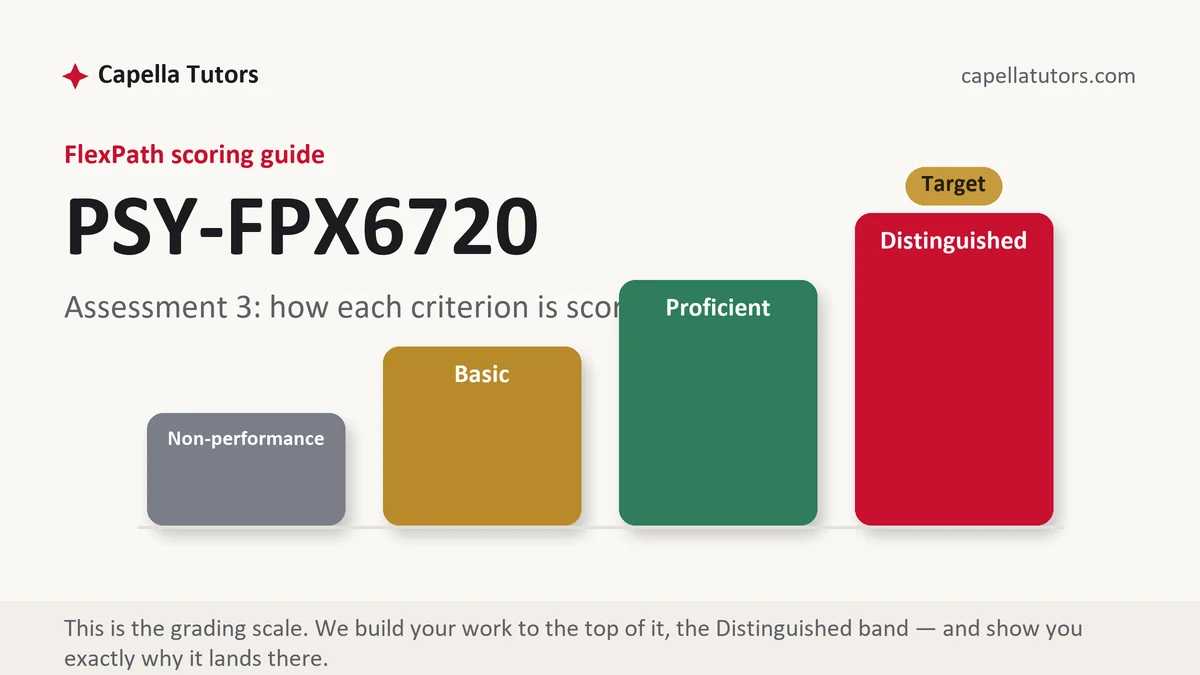
How PSY-FPX6720 Assessment 3 is scored
Four descriptors per criterion, and on a development plan the ladder comes out like this:
| Level | What it means on a leadership development plan |
|---|---|
| Distinguished | The diagnosis rests on more than one rating source with its reliability considered, the plan is costed against a measure, and the writer attacks their own key assumption. Volunteering the sensitivity analysis is what lifts this deliverable out of the second column. |
| Proficient | A complete plan with behaviors, practice, feedback and a metric. Everything a reviewer needs, and no test of its own arithmetic. |
| Basic | A development narrative with courses attached and no measure. It reads as helpful and answers neither the evidence row nor the evaluation row. |
| Non-performance | The criterion names something the document lacks, most often the measure or the cost. A date with no metric attached is not an evaluation plan. |
Start from the reliability of what you are diagnosing on, because it constrains everything downstream. Two people rating the same leader typically agree only moderately, so a single rater carries limited reliability and aggregating is not optional. The Spearman-Brown formula gives the reliability of an average, and four raters at .38 each produce four times .38 over one plus three times .38, which is 1.52 over 2.14, or about .71. That is defensible for a development conversation and not for a decision with pay attached, and the sentence saying so belongs in the paper.
The PSY-FPX6720 Assessment 3 method, step by step
-
Break the criteria out and decide who the plan is for
One named leader, or a composite assembled from several, and say which you are doing in a sentence. A plan for a whole management tier is a programme, and the criteria for this deliverable are written around an individual with an identifiable unit behind them.
-
Diagnose from more than one source, then report the reliability
Bring together what the leader says about themselves, what direct reports and peers report, and any behavior you observed, and keep those sources separate on the page. The gap between the self-ratings and everyone else's is usually the single most useful thing in the diagnosis, and it disappears the moment the scores are averaged together.
-
Name the gap that matters, not the one that is easy
Rank the candidate gaps against the outcome the unit is measured on and choose the one with the largest link to it. Then state in a sentence why the easier gap was set aside, because that judgment is exactly what the criteria mean by prioritizing on evidence.
-
Target at most two behaviors, described so they can be counted
Not increase communication but hold a ten-minute changeover briefing at the start of each shift that states the reason for any change to the plan. Two behaviors, each placed in the situations where it applies, gives an observer something to record and gives the leader something to actually do.
-
Cost the plan and attach a measure
Fees, backfill and time away from the unit, then the outcome you expect to move, its current level with a denominator, and the size of change you are assuming. Specific and difficult goals with feedback outperform general encouragement, the pattern Locke and Latham (2002) draw from decades of studies, so state the goal and its difficulty rather than an aspiration.
-
Attack your own assumption, then self-score
Say what else moves your outcome, admit that a handful of leaders with no comparison group is not a design, and show what the case looks like if the assumed improvement is halved. Then grade each criterion yourself, fix what falls short, and submit early rather than into a Friday queue.
A structure that maps to the criteria
Lengths are the planning targets our tutors use for a plan of this scope rather than Capella rules; follow your own guide where it differs.
| Section | What it must do | Guide word target |
|---|---|---|
| The leader and the unit | Role, unit size, reporting structure, and the outcome the organization measures, anonymized. | ~200 words |
| The diagnosis | Evidence by source, kept separate, with the reliability of the aggregate stated. | ~300 words |
| The gap selected | The gap chosen, its link to the unit outcome, and why the easier gap was set aside. | ~200 words |
| Behaviors and practice loop | At most two countable behaviors, where each applies, and the practice built from existing routines. | ~300 words |
| Cost, measure and dates | Full cost, the outcome measure with its denominator, the assumed change, and the review date. | ~300 words |
| Sensitivity, limits, references | What else moves the outcome, the halved-assumption case, and current APA in text and list. | ~250 words |
Annotated sample excerpt
An original model excerpt from our team, showing the arithmetic and the honesty the top column pays for. Study the pattern and run it on your own numbers.
The plan covers five store managers in a garden centre chain reporting to one district manager, and the coaching programme costs $1,850 in fees per manager plus two days away from the floor valued at $260 a day, so $2,370 each and $11,850 in total.1 Those five stores employ 132 hourly staff, voluntary turnover ran at 34 percent last year, which is about 45 departures, and replacing one costs roughly 30 percent of a $34,000 salary, or $10,200; a four-point reduction in the turnover rate is 5.3 fewer departures, worth about $54,000 against an $11,850 programme.2 That case has to be attacked before an evaluator does it, because turnover in these stores also moves with the seasonal hiring peak, the two dollar spread against the distribution centre down the road, and the schedule changes introduced in the same quarter; five managers with no comparison group is not a design, the four points are an assumption rather than a finding, and at two points the return is about $27,000, which is still favorable, so the decision does not rest on the optimistic figure.3
- 1Every component of the cost is visible, including the time away from the unit that most student plans omit.
- 2The benefit is built from a rate with its denominator, and each step of the arithmetic is one a reader can reproduce.
- 3Rival explanations, the design limit, and the halved-assumption case, which is how a costed plan survives review.
The full premium sample for your exact assessment, written fresh to your scoring guide and issue, is free to request. Study it, revise it into your own voice, and submit work you understand.
The five mistakes that cost Distinguished
- A diagnosis from one perspective. Self-report alone measures self-image, and a plan built on it is developing whichever leader the leader believes they are.
- Ratings averaged without any reliability statement. Aggregating two raters produces a figure too soft to carry a development decision, let alone a pay one.
- Six behaviors targeted at once. A list that long is a wish, and nobody, including the reviewer, can tell whether any of it happened.
- A plan with no cost. Time away from the unit is the largest line in most development budgets, and leaving it out makes the return meaningless.
- An assumption defended rather than tested. If the case only works at the optimistic figure, say so, because an evaluator will find that out either way.
Pre-submission checklist
- Evidence is reported by source, with self-ratings kept separate from others
- The reliability of any aggregated rating is stated and justified for its use
- At most two target behaviors, each written so an observer could count them
- The practice and feedback loop is built from routines the organization already runs
- Costs include fees, backfill and time away from the unit
- The outcome measure carries a denominator, a review date and a halved-assumption case
Development plan that has to survive review?
Send the guide, the unit size, and what the leader is judged on. Our eight-person pipeline delivers a premium original sample in 24 to 48 hours, with one pass devoted to recomputing every cost and rate in the document and adding the sensitivity case faculty will ask for. Revisions are free until each criterion is met.