This manual is for PSY-FPX6720 Assessment 2, start to submission. The second deliverable in this course is an appraisal rather than an application: a popular leadership model, or a claim made for one, weighed against the studies behind it. Your scoring guide decides the shape, and the assessment usually asks who rated what, over what interval, and whether the leader and the outcome were described by the same person. Below sits the method we use, a structure that follows the criteria, and an annotated excerpt from a model appraisal. Prefer to hand this one over? A premium original sample lands inside 24 to 48 hours, revised free until the guide is satisfied. Your courseroom may print this as PSY FPX 6720 Assessment 2 or PSY6720 Assessment 2; it is the same deliverable, and PSY-FPX6720 Assessment 2 is what this manual walks through.
One honesty note before the manual: Capella revises courses and scoring guides over time, so always write to the exact scoring guide attached to your assessment in the courseroom. The course identity above is verified on capella.edu; the method and structure below are our tutors' approach to it, not Capella's official rubric text.
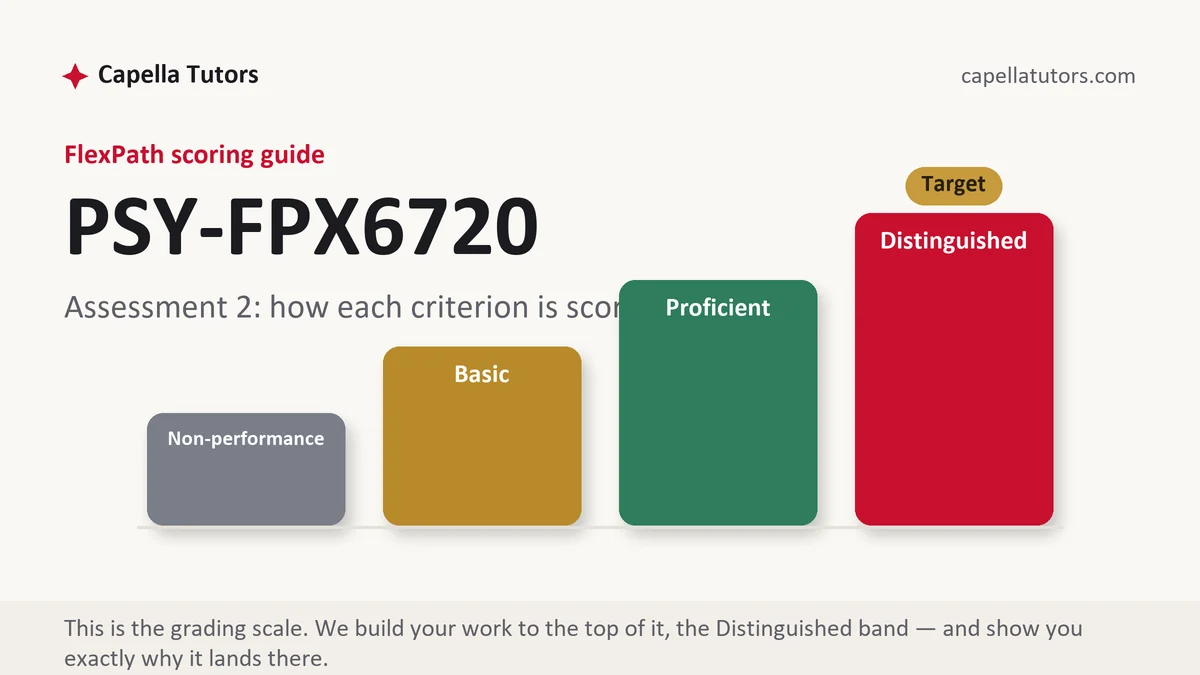
How PSY-FPX6720 Assessment 2 is scored
Each criterion lands on one of four levels, and on an appraisal of a leadership model they mean this:
| Level | What it means on a leadership evidence appraisal |
|---|---|
| Distinguished | The design behind each claim is described before the claim, the rating source and interval are named, and the paper says which study would settle the question. Specifying the study that would settle it is what the top descriptor is fishing for. |
| Proficient | The evidence is summarized fairly and one weakness is identified. Accurate work that leaves the design analysis at the level of a caveat. |
| Basic | Support and criticism listed in turn, with popularity treated as a form of evidence. The commonest submission on this deliverable. |
| Non-performance | An element the criterion requires is missing, most often the appraisal of the measurement itself. Naming a limitation is not the same as analyzing one. |
One methodological fact governs most of this literature. When a single follower rates the leader's behavior and then rates their own commitment on the same form at the same sitting, part of the correlation belongs to the method rather than to the leader, the problem Podsakoff and colleagues (2003) set out in detail. Ratings also reflect the rater's own prototype of a leader, the implicit theory finding in Lord and colleagues (1984), and causality can run backwards, since a unit that performed well makes its manager look inspiring to anyone filling in a survey afterwards.
The PSY-FPX6720 Assessment 2 method, step by step
-
Set out the criteria and state the claim you are appraising
Write the claim in its strongest fair form, and say who is making it and for what purpose, since a training vendor's version and a research paper's version are rarely the same claim. An appraisal of a strawman fails the analysis row even when every citation is correct.
-
Trace the model to its originating publication
Burns (1978) described transforming leadership in a political study, Bass (1985) turned it into the transformational and transactional factors a questionnaire measures, Greenleaf's servant leadership arrived through an essay, and Hersey and Blanchard's situational model came out of practice rather than out of a research programme. Where a model began tells the reader what kind of evidence to expect from it.
-
Describe each study before you report what it found
Design, sample, who rated the leader, who supplied the outcome, and how much time separated the two. Order matters, because a reader who meets the correlation first will forgive the design, and the criteria are written to make you present them the other way round.
-
Audit the measurement rather than the conclusion
Ask whether the dimensions are separable or correlate so highly that they may not be, whether the instrument mixes described behaviors with attributions followers make about the leader, and whether the outcome came from an independent source. A model can be popular, well operationalized and still measured in a way that guarantees a positive result.
-
Say what would settle it
Specify the study: which behaviors, rated by whom, predicting which outcome measured how long afterwards, and reported by someone other than the person who described the leader. One design with a time lag and independent outcome data is worth several without either, and naming that design is the strongest move available on this deliverable.
-
Reach a verdict, then self-score against the guide
Refuse both slogans and commit to a scoped judgment: what the model is useful for, what it should not be used to justify, and what a buyer of the training is actually purchasing. Then mark every criterion, repair what falls short, and submit early in the week.
A structure that maps to the criteria
These lengths are the planning targets our tutors use on an appraisal of this size, not Capella requirements; your scoring guide sets the real shape.
| Section | What it must do | Guide word target |
|---|---|---|
| The claim and its source | The assertion stated fairly, who makes it, and what decision it is being used to support. | ~200 words |
| Origin of the model | The originating publication, what kind of work it was, and what it did and did not test. | ~250 words |
| The supporting evidence | Designs, samples, rating sources and intervals, given before the findings they produced. | ~300 words |
| Measurement audit | Dimension separability, behavior against attribution, and whether outcomes were independent. | ~300 words |
| The study that would settle it | The design you would want, specified concretely enough to be commissioned. | ~200 words |
| Verdict and references | A scoped judgment, what it should not license, and current APA in text and list. | ~250 words |
Annotated sample excerpt
An original model excerpt from our team showing how to weigh a popular model without either endorsing or dismissing it. Take the reasoning into your own appraisal.
A hotel group is being sold a two-day situational leadership programme for 41 front-desk managers on the claim that matching a directive or supportive approach to follower readiness raises guest satisfaction, and the claim in that form has never been the subject of the model's own research base, since the framework was developed in practice and its prescriptive matching hypothesis has fared poorly in the tests it has received.1 The studies the vendor supplies are three cross-sectional surveys in which the same employee rated the manager's flexibility and their own engagement on one instrument at one sitting, which means an unknown share of each reported correlation belongs to the method rather than to the manager, and the largest of the three had 74 respondents drawn from managers who volunteered their teams (Podsakoff and colleagues, 2003).2 What would settle the matching claim is a design in which observers rate manager behavior against the readiness of specific tasks, guest satisfaction is drawn from the property management system rather than from the same employees, and the outcome is measured at least a quarter later; absent that, the defensible verdict is that the programme teaches a usable vocabulary for talking about follower readiness and does not support a guest satisfaction promise.3
- 1The claim is stated in the vendor's own terms, then separated from what the model's research base has actually tested.
- 2Design, rating source, timing and sample all arrive before the correlations, and the method problem is named with its primary source.
- 3The settling study is specified concretely, then the verdict is scoped: useful for one thing, insufficient for the promise being sold.
The full premium sample for your exact assessment, written fresh to your scoring guide and issue, is free to request. Study it, revise it into your own voice, and submit work you understand.
The five mistakes that cost Distinguished
- Popularity offered as support. How many organizations bought the training is a fact about sales, and the evidence criterion cannot be answered with it.
- Findings reported before designs. A correlation quoted ahead of its rating source and interval has already been given more credit than it earned.
- One source for the leader and the outcome. When the same person supplies both, part of the relationship is the questionnaire talking to itself.
- Causal verbs over cross-sectional data. Raised, drove and produced all claim a direction that one survey administered once cannot deliver.
- A verdict with no scope. Endorsing or rejecting a model wholesale skips the useful judgment, which is what it supports and what it does not.
Pre-submission checklist
- The claim under appraisal is stated in its strongest fair form, with its source
- The model is traced to its originating publication and the kind of work that was
- Every finding is preceded by its design, sample, rating source and interval
- Common method variance and reverse causality are both addressed explicitly
- The study that would settle the question is specified concretely
- The verdict is scoped to what the evidence supports and what it does not
Appraisal of a leadership model due?
Send the guide and whichever model or vendor claim you have been handed. An eight-person pipeline returns a premium original sample in 24 to 48 hours, designs before findings, with one reader confirming that no verb outruns the study behind it. Revisions are free and there is no cap on them.