How to write PSY-FPX6720 Assessment 1

The short answer

This manual is for PSY-FPX6720 Assessment 1, start to submission. The opening deliverable in this course puts one leadership situation under a framework and asks the framework to do work: what the leader actually does, which theory the facts select, what that theory predicts next, and what it fails to explain here. Your scoring guide decides the form, and the assessment usually asks for behavior rather than for a style label. Below is our tutors' method for it, a structure that mirrors the criteria, and an annotated excerpt from a model paper. Would you rather have it built with you? A premium original sample comes back in 24 to 48 hours, rewritten free until every criterion clears. Your courseroom may print this as PSY FPX 6720 Assessment 1 or PSY6720 Assessment 1; it is the same deliverable, and PSY-FPX6720 Assessment 1 is what this manual walks through.

One honesty note before the manual: Capella revises courses and scoring guides over time, so always write to the exact scoring guide attached to your assessment in the courseroom. The course identity above is verified on capella.edu; the method and structure below are our tutors' approach to it, not Capella's official rubric text.
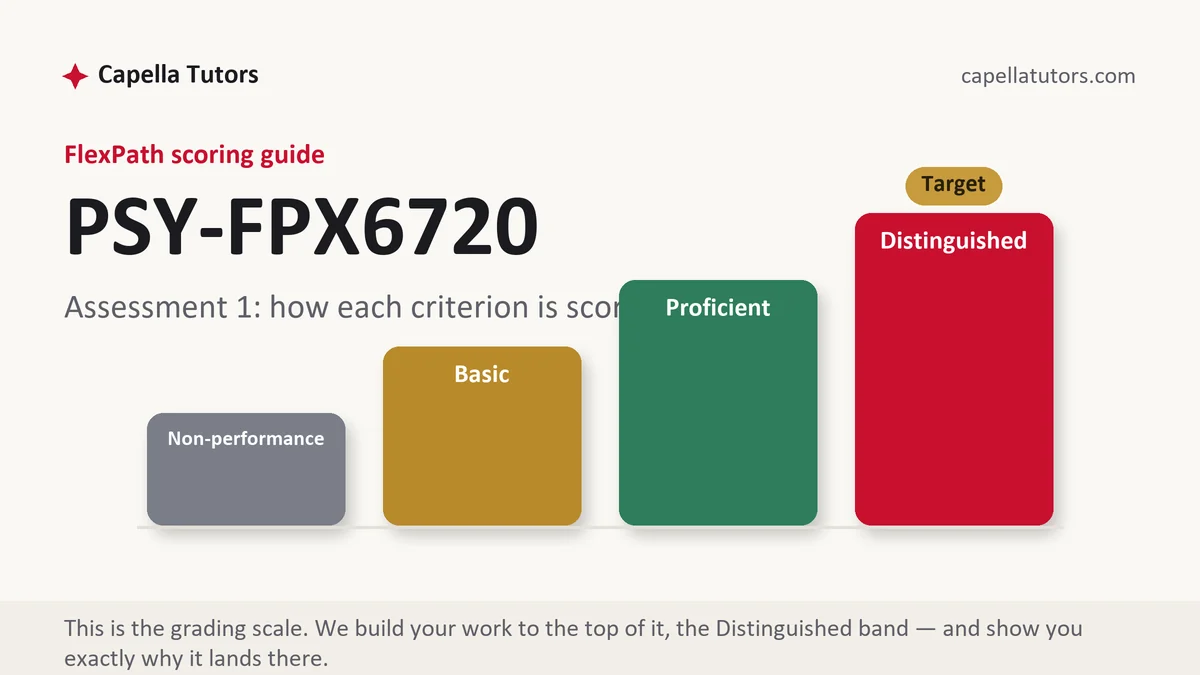
PSY-FPX6720 Assessment 1 grading scale at Capella FlexPath, the criterion levels this assessment is scored on, from Capella Tutors
How Capella FlexPath grades PSY-FPX6720 Assessment 1, visualized by Capella Tutors.

How PSY-FPX6720 Assessment 1 is scored

FlexPath judges each criterion against four descriptors rather than against a mark, and on a leadership analysis they read as follows:

LevelWhat it means on a leadership situation analysis
DistinguishedBehavior is separated from inference, the framework is credited to the researcher who built it, the analysis predicts something, and the case detail the framework cannot handle is named. That last item is the sentence most submissions never write.
ProficientA framework applied correctly and consistently to a well-described situation. Competent, and it never puts the framework under strain.
BasicA style label applied to a manager and then illustrated. This is the standard first attempt, and it leaves the application row empty.
Non-performanceA required element does not appear at all, most often the behavioral evidence or the professional boundary. Reviewers score what is on the page.

Two distinctions decide most of the credit in this course. Leader emergence, meaning who ends up in the role, is a different question from leader effectiveness, meaning what happens to the unit afterwards, and the predictors are not the same. Leadership as observed behavior is also a different object from leadership as a rating somebody supplied, since almost every published finding here rests on a questionnaire completed by a follower, a peer or the leader. Say which of those you have before you build an argument on it.

The PSY-FPX6720 Assessment 1 method, step by step

  1. Turn the guide into headings before you pick a theory

    Theory selection is itself scored in this course, so choosing early means defending the choice later with whatever the case happens to contain. Set the criteria out first, note the verbs, and let the situation decide the framework once you have described it.

  2. Write what the leader does, not what the leader is

    Record observable conduct with its frequency: how the shift meeting runs, who speaks, how decisions are announced, what gets recognized, what gets ignored. Keep inference in a separate column at this stage, because the analysis rows are built on the gap between conduct and interpretation.

  3. Specify the context tightly enough to make it testable

    Contingency arguments need the variables named: how structured the task is, how much authority the leader actually holds, how strained the relationships are, and what outcome the organization measures. A vague context makes every framework fit, which is another way of saying none of them is doing work.

  4. Select the framework from what varies in the case

    If followers cannot see how effort connects to anything they value, House's (1971) path-goal reasoning gives you obstacles to remove. If the manager runs visibly different relationships with different people, Graen's leader-member exchange work predicts the consequence. If the task is highly structured and relations are poor, Fiedler's (1967) contingency model asks the question the case is already raising.

  5. Make the framework predict, then find what it misses

    State what should happen next if your account is right, in terms somebody could check within a month. Then name the detail the framework does not explain, and reach for a second construct to cover it rather than pretending the first one is complete. Doing both is the graduate move.

  6. Keep the boundary visible, then self-score and submit

    Write about conduct rather than character, anonymize as you draft, and note that a non-licensure master's does not authorize any conclusion about the person's psychology. Then grade yourself criterion by criterion, and submit early in the week given the two business day evaluation window.

A structure that maps to the criteria

Word targets are our tutors' planning shape for an analysis of this size rather than Capella rules; your guide decides the sections and their weight.

SectionWhat it must doGuide word target
The unit and the outcomeSize, task, reporting structure, and the result the organization actually measures.~200 words
Observed behaviorWhat the leader does, how often, and who supplied each observation.~300 words
Context specifiedTask structure, position power and relationship quality, described so a contingency claim is checkable.~250 words
Framework appliedThe theory, its originator, its constructs, and the fit between each construct and an observed behavior.~350 words
Prediction and shortfallWhat follows if the account holds, and the case detail the framework cannot explain.~250 words
Boundaries and referencesConfidentiality, the limits of a non-licensure analysis, and current APA in text and list.~150 words

Annotated sample excerpt

A model excerpt written by our team to show what applying a framework looks like when it is doing real work. Study the moves, then write your own unit.

Sample excerpt: framework applied Original model · Capella Tutors

On the packaging line at a craft brewery, a shift lead promoted six weeks ago runs a four-minute stand-up in which she reads the day's case target and the previous day's variance, assigns positions, and takes no questions; across nine observed shifts she praised output four times and never explained why a changeover order had been altered.1 The task is highly structured, her position power is limited to assigning positions rather than to pay or schedule, and the outcome the plant measures is cases packaged per hour against a changeover allowance, which is the combination that makes path-goal reasoning the productive frame here, since the operators can see the target and cannot see how their effort connects to anything they value (House, 1971).2 The account predicts that clarifying the route, meaning explaining the changeover logic and tying the allowance to the finish time the crew cares about, should raise voluntary effort during the unmonitored second half of the shift within four weeks; it does not explain why one of the three crews sustains output without any of that clarification, and leader-member exchange is the better lens on that crew, because its two senior operators receive information from her that the other crews do not.3

  • 1Conduct with counts and an observation window, and no adjective describing the leader as a person.
  • 2The context variables are specified first and then select the framework, which is credited to its originator under its own date.
  • 3A checkable prediction, then the case detail the framework fails on, then a second construct brought in to cover it.

The full premium sample for your exact assessment, written fresh to your scoring guide and issue, is free to request. Study it, revise it into your own voice, and submit work you understand.

Get the full sample free

The five mistakes that cost Distinguished

  • A label instead of an analysis. Calling the shift lead autocratic names an impression, and the criterion is asking for the behaviors that produced it.
  • Context left generic. If the task structure and the leader's real authority are never specified, no contingency argument in the paper can be checked.
  • Frameworks credited to textbooks. Path-goal, contingency and leader-member exchange each belong to identifiable researchers, and faculty notice when the citation is a chapter.
  • An analysis that predicts nothing. A framework that only reinterprets the past has not been applied in the sense the criterion means.
  • Character inferred from conduct. A non-licensure degree licenses no claim about the person's psychology, and the sentence that oversteps costs the ethics row.

Pre-submission checklist

  • Observed behavior is reported with counts and an observation window
  • Inference is kept visibly separate from what was observed
  • Task structure, position power and relationship quality are all specified
  • The framework is credited to its originator under its original date
  • One checkable prediction follows from the analysis
  • The case detail the framework cannot explain is named by the writer

Leadership analysis with a real unit behind it?

Send the guide plus what you can actually see the leader do and what the unit is measured on. Our eight-person pipeline returns a premium original sample in 24 to 48 hours, with one reader checking every framework attribution against the source it names. Revisions are free until each criterion is answered.

Keep going

Online now