This manual is for PSY-FPX6710 Assessment 3, start to submission. The closing deliverable in this course asks for synthesis, and in practice that means a performance system diagnosed and rebuilt: what performance means here, how it is currently measured, what that measure gets wrong, and what should replace it. Your scoring guide decides the exact deliverable, and the assessment usually asks for the criterion problem to be named before anything is correlated or recommended. Below is the approach our tutors take, a structure built out of the criteria, and an annotated excerpt. Prefer to hand the build over? A premium original sample returns inside 24 to 48 hours, revised free until the guide is met. Your courseroom may print this as PSY FPX 6710 Assessment 3 or PSY6710 Assessment 3; it is the same deliverable, and PSY-FPX6710 Assessment 3 is what this manual walks through.
One honesty note before the manual: Capella revises courses and scoring guides over time, so always write to the exact scoring guide attached to your assessment in the courseroom. The course identity above is verified on capella.edu; the method and structure below are our tutors' approach to it, not Capella's official rubric text.
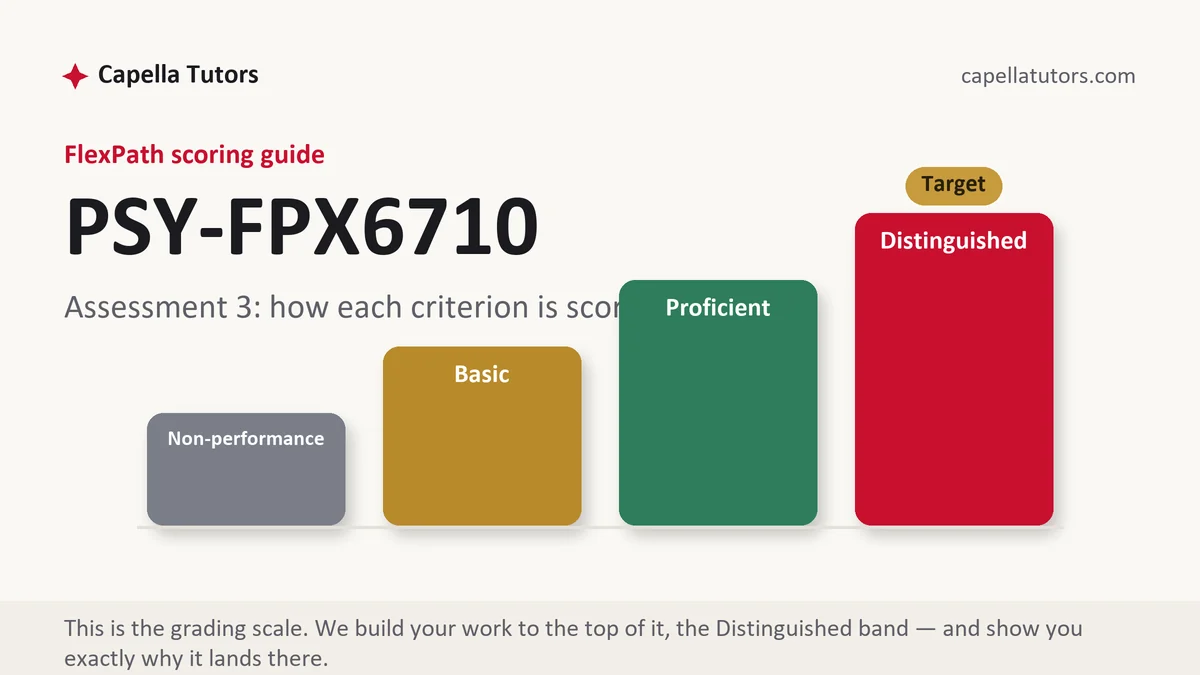
How PSY-FPX6710 Assessment 3 is scored
The guide places each criterion on one of four levels, and on a performance-management deliverable they mean this:
| Level | What it means on a performance-management redesign |
|---|---|
| Distinguished | The existing measure is diagnosed for deficiency and contamination, the replacement is anchored in observable behavior, and the paper states what the new system will still fail to capture. The admission of residual deficiency is where the top descriptor usually lives. |
| Proficient | A coherent redesign with rating format, frequency and training all specified. Professional work that treats its own measure as adequate. |
| Basic | A recommendation to hold more frequent conversations, with the measurement problem untouched. It reads well and answers none of the measurement criteria. |
| Non-performance | An element the criterion requires is absent, most often the analysis of the current criterion measure. A redesign proposed without a diagnosis has skipped the graded part. |
The vocabulary here is worth getting exactly right, because it is what the criteria are testing. Performance is what you want to capture, and everything you can actually obtain is a proxy. Criterion deficiency is the part of performance your measure misses. Criterion contamination is the movement in your measure that has nothing to do with the person, such as queue composition inflating a throughput figure. Criterion relevance is the overlap you genuinely have. Naming which of the three afflicts the current measure costs a paragraph and buys a criterion.
The PSY-FPX6710 Assessment 3 method, step by step
-
Turn the criteria into headings and set the boundary
Decide which population the system covers, because a redesign for one team of thirty is defensible in one deliverable and a company-wide programme is not. Then paste the top descriptors under each heading so that every element the guide counts has a visible home.
-
Describe the current system as it is actually operated
Not the policy, the practice: who rates, how often, on what scale, what happens to the rating afterwards, and what the distribution of last year's ratings looked like. A distribution clustered at the top is data about the raters, and it is the most useful evidence you have.
-
Diagnose deficiency and contamination with examples
For each existing measure, name the part of performance it misses and the influence on it that has nothing to do with the individual. Do this before any recommendation, because the shape of the diagnosis determines whether you need a new measure, a new rating format, or trained raters rather than another form.
-
Anchor the replacement in behavior
Move from adjectives to observable performance, which is what behaviorally anchored rating scales were designed for in Smith and Kendall's (1963) work: each scale point is illustrated by an incident somebody could recognize. Build those anchors from the critical incidents in your own setting rather than from a generic competency list.
-
Handle rater error as a design problem, not a character flaw
Leniency, halo, central tendency and recency all have known remedies: frame-of-reference training, documented incidents collected across the period rather than recalled at the end, and more than one rating source where the criterion warrants it. Say how you would check agreement between raters, since an unreliable rating cannot support any decision built on it.
-
Attach goals, feedback and a review, then self-score
Specific and difficult goals with feedback outperform vague encouragement, the finding Locke and Latham (2002) summarize from three decades of studies, so state the goal, its difficulty and how progress becomes visible. Then say what the redesigned system still cannot capture, mark each criterion yourself, and submit early in the week.
A structure that maps to the criteria
The lengths are our planning targets for a redesign of this scope, not Capella instructions; where your guide differs, your guide wins.
| Section | What it must do | Guide word target |
|---|---|---|
| The unit and the problem | The team, its size, the decision the ratings feed, and why the system is being examined now. | ~200 words |
| The current system in practice | Raters, frequency, format, uses, and the actual distribution of recent ratings. | ~250 words |
| Criterion diagnosis | Deficiency, contamination and relevance for each existing measure, with concrete examples. | ~300 words |
| The redesigned measure | Dimensions, behavioral anchors, sources, frequency, and who is trained on what. | ~350 words |
| Goals, feedback and reliability | Goal specificity and difficulty, feedback cadence, and how rater agreement will be checked. | ~250 words |
| Residual limits and references | What the new system still misses, the risks it introduces, and current APA in text and list. | ~200 words |
Annotated sample excerpt
An original model excerpt from our team, written at the level the diagnosis criteria pay for. Take the reasoning and apply it to the system you have in front of you.
The customer support team at a print-and-mail services firm has 34 representatives, and performance is currently one annual rating from one supervisor on a five-point scale, with tickets closed per day used as the supporting number; last year 24 of 34 representatives were rated four or five, so the scale is doing very little work and cannot support the merit decision it feeds.1 Tickets closed per day is deficient because it captures no part of resolution quality, which is the part customers experience, and it is contaminated because queue composition varies systematically, with the two representatives assigned to enterprise accounts handling longer cases and closing roughly 40 percent fewer tickets than the general queue while receiving the fewest repeat contacts.2 The redesign therefore replaces the single global rating with four behaviorally anchored dimensions built from incidents the supervisors already recorded, adds first-contact resolution as a rate with its queue as the denominator, and requires two raters on the dimension used for merit so that agreement can be checked; it does not solve everything, since customer sentiment on a case is still measured by an optional survey with a response rate near 20 percent, and that residual deficiency is stated rather than hidden behind the new form.3
- 1The rating distribution is reported with counts, which turns a suspicion about leniency into evidence the redesign can act on.
- 2Deficiency and contamination are each named with a concrete mechanism and a number, rather than defined in the abstract.
- 3The replacement carries denominators, a reliability provision, and an honest statement of what it still cannot capture.
The full premium sample for your exact assessment, written fresh to your scoring guide and issue, is free to request. Study it, revise it into your own voice, and submit work you understand.
The five mistakes that cost Distinguished
- A new form offered as a new system. Changing the layout of a rating sheet does nothing about the measure, the raters or the uses the ratings feed.
- Throughput accepted as performance. A count of units handled misses quality and moves with workload mix, and both problems have to be stated, not just one.
- Ratings used without any reliability provision. If nobody ever checks agreement, a single rater's judgment is carrying a pay decision on its own.
- Forced distribution adopted as a fix for leniency. It compresses the symptom and imports a new problem, and the criteria expect the trade-off argued rather than assumed away.
- Satisfaction survey results applied to individuals. Unit-level attitude data supports claims about the unit, and reading it onto one person misuses the measure.
Pre-submission checklist
- The current system is described as operated, including last year's rating distribution
- Deficiency and contamination are each named with a specific mechanism
- Every rate in the document carries its denominator and its window
- Rating dimensions are anchored to incidents from this setting
- A rater training and agreement provision is written into the design
- One paragraph states what the redesigned system still fails to capture
Performance system to rebuild on a deadline?
Send the guide, the team size, and how people are rated today, anonymized however you need. Our eight-person pipeline returns a premium original sample in 24 to 48 hours, diagnosis before recommendation, with one reader confirming that every rate has a denominator and every anchor has a behavior behind it. Revisions are free.