How to write PSY-FPX6710 Assessment 2

The short answer

This manual is for PSY-FPX6710 Assessment 2, start to submission. The second deliverable takes the measurement question head on: a selection procedure proposed for a named use, with the evidence that supports the inference, the arithmetic that shows what the procedure buys, and the fairness analysis computed rather than described. Your scoring guide sets the form, and the assessment usually asks for validity to be argued for a use instead of claimed as a property of a test. Below is the method our tutors work to, a structure keyed to the criteria, and an annotated excerpt. Want a second pair of hands on the numbers? A premium original sample comes back in 24 to 48 hours with free revision until every criterion clears. Your courseroom may print this as PSY FPX 6710 Assessment 2 or PSY6710 Assessment 2; it is the same deliverable, and PSY-FPX6710 Assessment 2 is what this manual walks through.

One honesty note before the manual: Capella revises courses and scoring guides over time, so always write to the exact scoring guide attached to your assessment in the courseroom. The course identity above is verified on capella.edu; the method and structure below are our tutors' approach to it, not Capella's official rubric text.
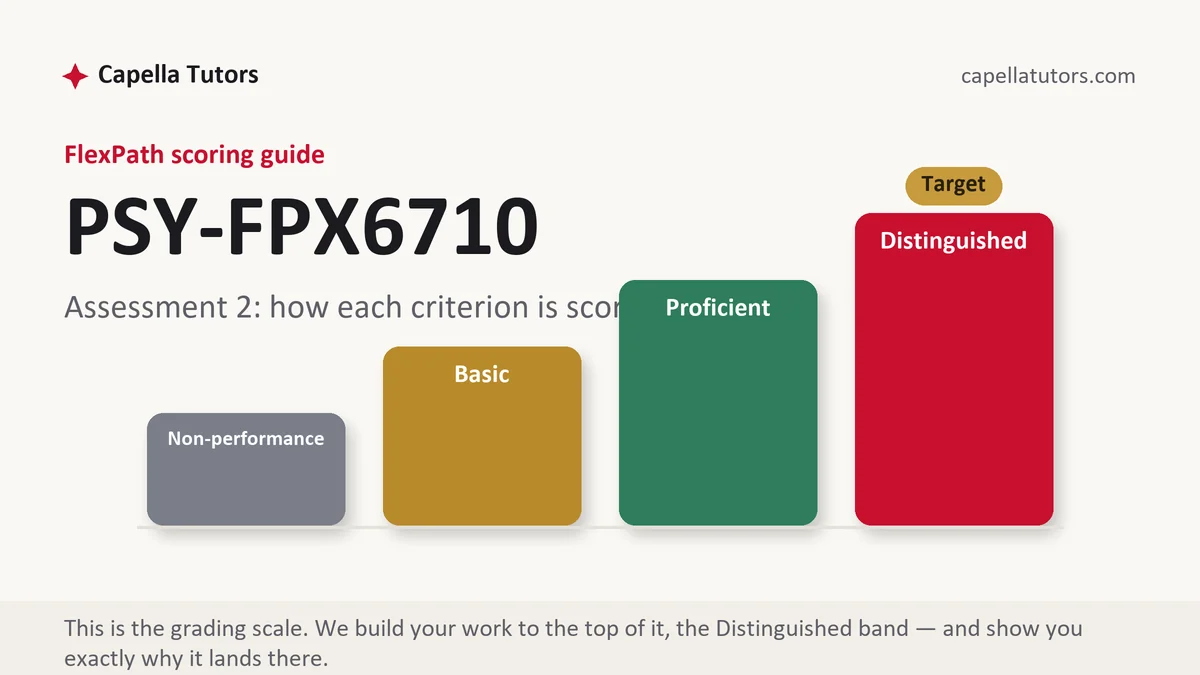
PSY-FPX6710 Assessment 2 grading scale at Capella FlexPath, the criterion levels this assessment is scored on, from Capella Tutors
How Capella FlexPath grades PSY-FPX6710 Assessment 2, visualized by Capella Tutors.

How PSY-FPX6710 Assessment 2 is scored

Four descriptors per criterion, and on a selection proposal the ladder translates as follows:

LevelWhat it means on a selection proposal
DistinguishedValidity is argued for this use with the samples behind the numbers, the coefficients are translated into what they do and do not deliver, and the impact ratio is computed and interpreted. Doing the arithmetic in the document is usually the difference between the top two columns.
ProficientA defensible procedure with appropriate evidence cited for it. Solid, and it reports coefficients without saying what they mean for the employer.
BasicA recommendation supported by adjectives, with validity treated as a label the instrument carries. Frequent, and it forfeits the measurement rows entirely.
Non-performanceThe criterion names an element the paper does not contain, most often the adverse impact analysis. Discussing fairness without computing anything counts as absent.

Keep the evidence types distinct while you draft. Criterion-related evidence comes in predictive form, where applicants are measured and performance data arrives later, and in concurrent form, where current employees are measured and you accept that they already survived the process under study. Content evidence rests on the job analysis showing the procedure samples the work domain. The accumulated meta-analytic work associated with Schmidt and Hunter (1998) is the right citation for the general ordering of methods, and it is also where the corrections live, since restriction of range and criterion unreliability both depress an observed coefficient and a corrected value answers a different question from an uncorrected one.

The PSY-FPX6710 Assessment 2 method, step by step

  1. Convert the criteria into sections and pin down the use

    Write the decision the procedure will serve in one sentence: which role, which stage of the process, and what will be done with the score. Validity evidence supports an inference for a use, so a paper that never fixes the use cannot argue for anything, however many coefficients it quotes.

  2. Anchor the proposal in the job analysis

    Point back to the tasks and attributes and say which of them each component of your procedure is meant to assess. Anything in the procedure that assesses nothing in the analysis comes out, and anything critical in the analysis that nothing assesses gets flagged as a gap you are choosing to leave.

  3. Assemble evidence types rather than a single number

    Give the content argument from the job analysis, then the criterion-related evidence with the design and sample that produced it, then the construct argument if your procedure claims to measure an attribute. Note for each source whether it is a single study or an accumulation across settings, because those support different claims.

  4. Translate the coefficient into something a manager can use

    Square it and say what proportion of variation in the criterion it accounts for, then say what the rest belongs to. Then ask what the procedure adds to the process already in place, because two methods that overlap heavily deliver far less together than the gap between their coefficients suggests.

  5. Compute the impact ratio, then interpret it

    Selection rate by group, then the lower rate divided by the higher, compared against the four-fifths benchmark the Uniform Guidelines on Employee Selection Procedures describe. Say what the number is, say that small pools make it unstable, and say plainly that a validated procedure can still show impact, which is where the job analysis earns its keep.

  6. Give the recommendation an owner and a review date

    Name who implements each component, what it costs in interviewer hours, and the measure that would show the procedure worked, with the window over which it will be checked. Then self-score every criterion, and submit early enough that a two business day evaluation does not eat your week.

A structure that maps to the criteria

Lengths below are planning targets our tutors use for a proposal of this size rather than Capella rules; expand wherever your guide asks for more.

SectionWhat it must doGuide word target
The decision and the roleThe use in one sentence, the role, the pool size, and how hiring is done today.~200 words
Basis in the job analysisWhich attributes each component assesses, and which critical attributes remain unassessed.~250 words
The procedure proposedComponents in order, what each one asks candidates to do, and how each is scored.~250 words
Validity evidenceContent, criterion-related and construct evidence, with designs, samples and correction status.~350 words
Utility and fairnessVariance accounted for, incremental gain over current practice, selection rates and the impact ratio.~300 words
Implementation and referencesOwner, cost, review measure and date, professional boundaries, and current APA.~200 words

Annotated sample excerpt

A model excerpt from our team showing how the numbers should appear and how far they should be allowed to reach. Study it, then run your own arithmetic.

Sample excerpt: utility and impact Original model · Capella Tutors

The proposed procedure adds a structured interview with behaviorally anchored scoring to the branch service representative process at a regional bank hiring roughly 90 people a year, and it is proposed for the second stage, after screening and before the offer decision.1 Accumulated evidence across many employers places structured interviews well ahead of unstructured ones, and at a coefficient in the mid .4 range with supervisory ratings as the criterion, squaring that value accounts for about 20 percent of the variation in those ratings, which leaves roughly four fifths of the variation to everything the interview does not touch; the value is also a corrected estimate drawn from validity generalization work, so the figure an employer should expect from a single local sample is lower (Schmidt and Hunter, 1998).2 Fairness has to be computed rather than asserted, so on last year's pool 84 of 210 applicants in the majority group were hired, a rate of 40 percent, against 27 of 96 in the minority group, a rate of 28.1 percent; dividing 28.1 by 40 gives 0.70, below the four-fifths benchmark in the Uniform Guidelines, which raises the job-relatedness question rather than settling anything, and with 96 applicants in the smaller group the ratio moves substantially on a handful of decisions.3

  • 1The use is fixed before any evidence appears: which role, which stage, what the score decides.
  • 2The coefficient is squared and translated, the remaining variation is acknowledged, and the correction status of the estimate is stated rather than hidden.
  • 3The impact ratio is computed from real counts, compared to the benchmark, and immediately qualified for small-sample instability.

The full premium sample for your exact assessment, written fresh to your scoring guide and issue, is free to request. Study it, revise it into your own voice, and submit work you understand.

Get the full sample free

The five mistakes that cost Distinguished

  • Validity treated as a property of the instrument. Evidence supports an interpretation for a use, so calling a test valid skips the argument the criterion is asking for.
  • A coefficient quoted with no correction status. Corrected and observed values answer different questions, and mixing them makes the utility claim unauditable.
  • Fairness described without arithmetic. Two divisions produce the impact ratio, and a paragraph about equity with no ratio in it reads as avoidance.
  • Incremental value ignored. A new method that overlaps heavily with the existing one adds far less than the difference between their coefficients implies.
  • Vendor claims used as evidence. A supplier's validity statement is marketing until an independent sample with a described criterion supports it.

Pre-submission checklist

  • The use is stated in one sentence: role, stage, and what the score decides
  • Each component of the procedure traces to an attribute from the job analysis
  • Every coefficient carries its criterion, its sample and its correction status
  • Variance accounted for is computed, with the remainder acknowledged
  • Selection rates and the impact ratio are computed and interpreted in the text
  • The recommendation names an owner, a cost and a review measure with a date

Selection proposal with numbers in it?

Send the guide, the role, the pool sizes and how hiring runs today. An eight-person pipeline delivers a premium original sample inside 24 to 48 hours, with one pass whose sole job is recomputing every rate, ratio and squared coefficient in the document. Revisions cost nothing and are uncapped.

Keep going

Online now