How to write PSY-FPX6710 Assessment 1

The short answer

This manual is for PSY-FPX6710 Assessment 1, start to submission. The first deliverable in this course starts where the field starts, with the work itself: a job documented, the attributes it demands identified, and the two linked so that every later decision about hiring or appraisal has something to stand on. Your scoring guide decides the exact form, and the assessment usually asks for the method you used to be named rather than assumed. Below is the method our tutors follow, a structure keyed to the criteria, and an annotated excerpt. Rather have it built with you? A premium original sample reaches you within 24 to 48 hours, revised at no charge until the guide is satisfied. Your courseroom may print this as PSY FPX 6710 Assessment 1 or PSY6710 Assessment 1; it is the same deliverable, and PSY-FPX6710 Assessment 1 is what this manual walks through.

One honesty note before the manual: Capella revises courses and scoring guides over time, so always write to the exact scoring guide attached to your assessment in the courseroom. The course identity above is verified on capella.edu; the method and structure below are our tutors' approach to it, not Capella's official rubric text.
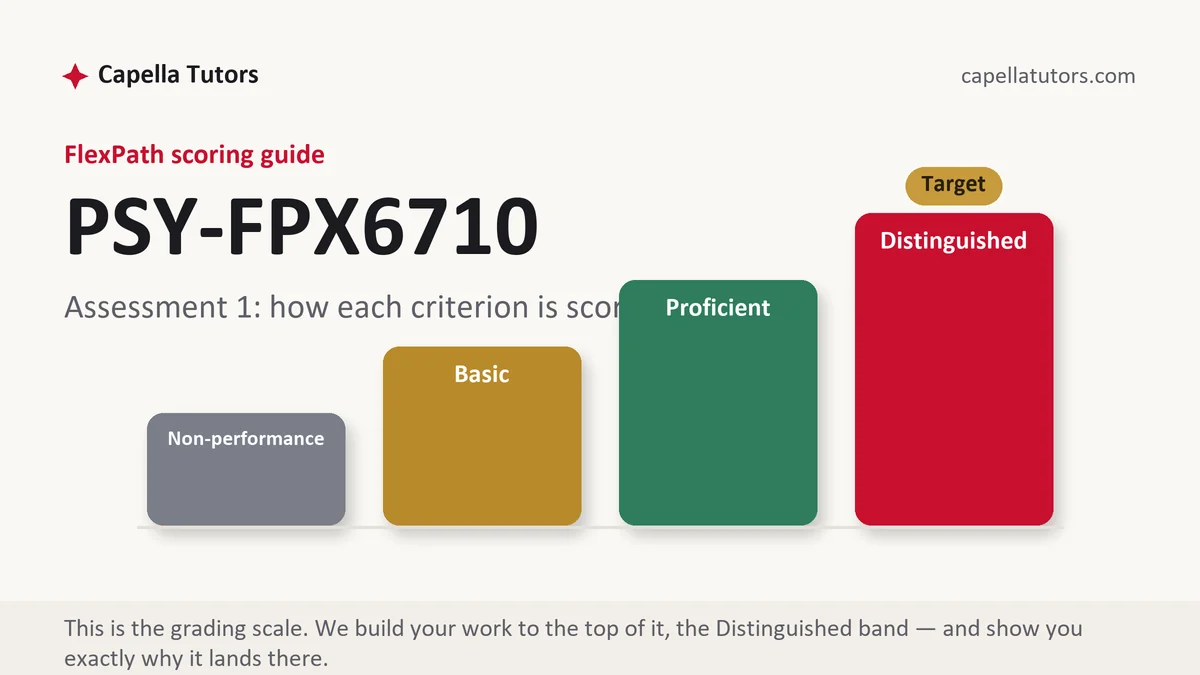
PSY-FPX6710 Assessment 1 grading scale at Capella FlexPath, the criterion levels this assessment is scored on, from Capella Tutors
How Capella FlexPath grades PSY-FPX6710 Assessment 1, visualized by Capella Tutors.

How PSY-FPX6710 Assessment 1 is scored

There is no curve and no letter grade. Each criterion is judged against four descriptors, and on a job analysis they read like this:

LevelWhat it means on a job analysis deliverable
DistinguishedThe method is named and defended, tasks link to attributes and attributes link to measurement methods, and the paper marks which tasks were inferred rather than observed. That last admission is what the top descriptor is normally reaching for.
ProficientA complete and accurate analysis with tasks and attributes both documented. Everything a reader needs, and no account of where the information came from.
BasicA job description rewritten in longer sentences. It looks like the deliverable and contains no analysis, which is why it is the most common submission here.
Non-performanceA required component is missing outright, usually the linkage from attributes to methods. A table of tasks on its own is a list rather than an analysis.

Two traditions sit behind whatever your guide asks for, and naming yours is worth a sentence. Task-oriented analysis inventories what gets done, in what order, with what tools, at what frequency and criticality. Worker-oriented analysis, the line running through McCormick's Position Analysis Questionnaire (1972), describes the human attributes the work demands. Flanagan's critical incident technique (1954) supplies the behaviors that separate effective from ineffective performance, and it is the cheapest way to put real content into a linkage table.

The PSY-FPX6710 Assessment 1 method, step by step

  1. Build the document from the criteria, then fix the scope

    Each criterion becomes a heading with its top descriptor pasted underneath. Then decide how much of the job you are analyzing, because one role at one site is a deliverable and a job family across an organization is a consulting engagement nobody asked you for.

  2. Name your method before you produce a single task

    Say whether the tasks came from observation, incumbent interview, a structured questionnaire, published occupational data, or a combination, and say how many people or documents were involved. Evaluators accept an archival analysis that admits what it is, and they penalize a confident one that never says where its content came from.

  3. Write tasks as behavior with frequency and criticality

    A task statement carries an action, an object, a purpose and a tool: retrieves cases from pick locations using a voice-directed headset in order to assemble a pallet to a customer order. Then rate each task on how often it occurs and how badly it hurts when done wrong, since those two ratings decide what any later measure has to cover.

  4. Derive attributes from the tasks rather than from the job title

    For each task, ask what a person has to know, be able to do, be able to sustain, or be like in order to perform it. Keep those four categories separate, because knowledge can be trained after hire and a physical or dispositional requirement usually cannot, and that difference determines whether the attribute belongs in selection or in onboarding.

  5. Link every attribute to a measurement method

    This column is where the analysis becomes usable. Each attribute names the method that could assess it: a work sample, a structured interview question, a physical demands review, a documented certification. If an attribute has no defensible measure, say so rather than inventing one, and note what evidence would be needed to justify measuring it.

  6. Mark the inferences, then self-score against the guide

    Flag every task or attribute you inferred from published data rather than observed, and put the next step in the limitations section, which is usually an incumbent panel or a structured questionnaire. Then grade yourself on each criterion, repair anything below the top level, and submit early, since faculty have two business days per attempt.

A structure that maps to the criteria

Word targets are our tutors' planning figures for a single-role analysis, offered as a shape rather than a rule; your scoring guide governs the sections.

SectionWhat it must doGuide word target
The role and the organizationThe job, the site, the headcount, and why this role is worth analyzing now, all anonymized.~200 words
Method and sourcesHow the content was gathered, from how many sources, and what each source can and cannot supply.~250 words
Task inventoryTask statements with frequency and criticality, grouped into duty areas a reader can scan.~350 words
Attributes requiredKnowledge, skills, abilities and other characteristics, each traced to the tasks that demand it.~300 words
Linkage to measurementAttribute by attribute, the method that could assess it, and the ones with no defensible measure.~250 words
Limits and referencesWhat was inferred, what would strengthen the analysis, and current APA in text and list.~200 words

Annotated sample excerpt

An original model excerpt from our team, showing the register that earns the method and linkage rows. Learn the moves and then document your own role.

Sample excerpt: method and linkage Original model · Capella Tutors

The role analyzed is order selector at a grocery distribution centre with 240 warehouse staff across two shifts, and the content comes from three sources: two hours of observation across one afternoon shift, the occupational data published for the laborers and freight handlers group, and eleven critical incidents supplied by two supervisors using Flanagan's (1954) prompt for what an effective and an ineffective selector had recently done.1 Frequency and criticality diverge in a way that matters here, since scanning a pick label occurs several hundred times a shift and carries a moderate cost per error, while securing a pallet before transport occurs perhaps forty times and carries the highest cost in the inventory, so a selection measure that covers only the frequent task leaves the expensive one unassessed.2 Pallet stability therefore links to a specific ability, which is estimating load distribution and applying wrap under time pressure, and the defensible measure is a scored work sample built from the same task rather than an interview question about attention to detail; the frequency and criticality ratings themselves come from two supervisors rather than from an incumbent panel, which is an inference the analysis marks and a structured questionnaire would replace.3

  • 1The method is declared with counts and sources on the first line, and the critical incident technique is credited to its originator rather than paraphrased.
  • 2Frequency and criticality are used to reach a conclusion about coverage, which is what turns an inventory into an analysis.
  • 3One attribute is linked to one measurement method, the weak alternative is named, and the inference in the ratings is admitted with its remedy.

The full premium sample for your exact assessment, written fresh to your scoring guide and issue, is free to request. Study it, revise it into your own voice, and submit work you understand.

Get the full sample free

The five mistakes that cost Distinguished

  • The job description recycled. Marketing copy about a dynamic team member is not task content, and no criterion in this deliverable can be answered from it.
  • Attributes invented from the title. Leadership potential appears in a warehouse analysis only if a documented task demands it, and otherwise it is padding that invites a challenge.
  • Tasks with no frequency or criticality. Without those ratings there is no way to argue that a measure covers what matters.
  • The linkage column left off. Tasks on one page and attributes on another is two lists, and the criteria pay for the connection between them.
  • Sources left unstated. An analysis that never says where its tasks came from cannot be evaluated, and evaluators treat that silence as a defect rather than as polish.

Pre-submission checklist

  • The method is named, with the number of sources and observations stated
  • Task statements carry an action, an object, a purpose and a tool
  • Each task has a frequency rating and a criticality rating
  • Every attribute is traced to at least one documented task
  • Each attribute names a measurement method, or is marked as having none
  • Inferred content is flagged, with the next step stated in the limitations

Job analysis due and nobody to interview?

Send the guide and the job title, plus anything you can see about how the work runs. Our eight-person pipeline returns a premium original sample in 24 to 48 hours, built from published occupational data and critical incidents, with every inference marked as one. Revisions are free until the criteria clear.

Keep going

Online now