How to write PSY-FPX6100 Assessment 3

The short answer

This manual is for PSY-FPX6100 Assessment 3, start to submission. The final deliverable in this course is usually the appraisal one: a published or commercial claim about learning is put in front of you, and the criteria ask what evidence would license it, what the evidence actually shows, and what supported practice you would put in its place. Retiring a popular claim and replacing it with one that has research behind it is the clearest signal of master's level reading in educational psychology. It is master's work in a non-licensure MS in Psychology, and the guide printed in your courseroom decides every level. The method, a criterion-shaped structure and an annotated sample excerpt come next. Rather have it done for you? A premium original sample for the appraisal you have been set comes back in 24 to 48 hours, with revision free until the guide is met. Your courseroom may print this as PSY FPX 6100 Assessment 3 or PSY6100 Assessment 3; it is the same deliverable, and PSY-FPX6100 Assessment 3 is what this manual walks through.

One honesty note before the manual: Capella revises courses and scoring guides over time, so always write to the exact scoring guide attached to your assessment in the courseroom. The course identity above is verified on capella.edu; the method and structure below are our tutors' approach to it, not Capella's official rubric text.
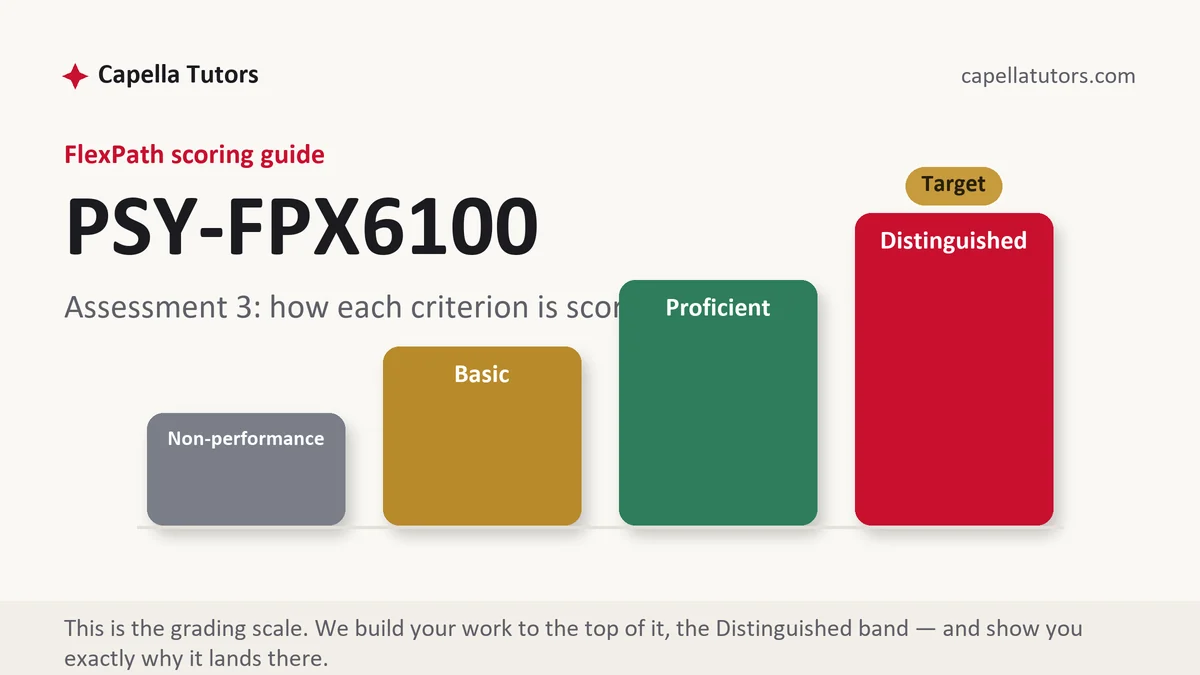
PSY-FPX6100 Assessment 3 grading scale at Capella FlexPath, the criterion levels this assessment is scored on, from Capella Tutors
How Capella FlexPath grades PSY-FPX6100 Assessment 3, visualized by Capella Tutors.

How PSY-FPX6100 Assessment 3 is scored

One level per criterion, chosen from four written descriptions. Treat the top one as the specification for your draft:

LevelWhat it means on an evidence appraisal
DistinguishedThe claim is restated as a testable proposition, the design capable of testing it is specified, the vendor's own figures are read for confounds and denominators, the review evidence is reported at its published strength, and a supported alternative is proposed for the same goal.
ProficientA well argued critique with sound sourcing. Complete, and short of the column that names the design the claim would require.
BasicScepticism without machinery. The claim is doubted, the doubt is asserted, and nothing in the paper shows what would settle the question.
Non-performanceThe appraisal or the alternative recommendation is absent, and a criterion cannot be scored on material that is not there.

This assessment is also where a validity vocabulary earns its keep. A test used to assign training and a test used to screen applicants are two different uses of one instrument, and each use needs its own evidence.

The PSY-FPX6100 Assessment 3 method, step by step

  1. Restate the claim as something that could be false

    Take a vendor telling a 300-seat call centre that its learning-styles inventory raised first-call resolution and should now be used to screen applicants. Write the claim precisely: assigning agents to training that matches their inventory profile improves resolution more than assigning them to the same training regardless of profile. Now it can be tested rather than admired.

  2. Specify the design the claim requires

    A matching claim needs a crossover: learners of each profile taught in each style, so that matched and mismatched pairings can be compared. The review by Pashler and colleagues sets out exactly that requirement and reports that studies meeting it largely fail to support the practice. Say what the design is, then say whether the vendor's evidence is anywhere near it.

  3. Examine the criterion measure before the result

    First-call resolution is a definition, not a fact. Ask what counts as resolved, who codes it, how repeat contacts within a window are treated, and what the denominator is. Then check the range of the measure, because a criterion recorded only for agents who survived probation is restricted, and restriction alone will change any correlation the vendor computes.

  4. Read the vendor's own numbers for rival explanations

    A pre-post rise with no comparison group is consistent with the training, with a new supervisor, with seasonal call mix, with a cohort hired in a tighter labour market, and with agents simply getting a month older in the job. Name each rival and say which the data can rule out. Usually the answer is none of them, and stating that is the appraisal.

  5. Separate the selection use from the training use

    Using the inventory to hire is a claim about criterion-related validity that requires its own evidence: scores collected before hire, performance measured later, a defensible criterion, and attention to whether the instrument produces different outcomes across applicant groups. A tool with no such evidence should not be gating employment, and saying so is a professional judgment the criteria reward.

  6. Propose the supported replacement, then self-score

    Preferences are real; the benefit of matching to them is not established. For the same goal, the practices with support are dual coding of words with relevant images, spacing, retrieval practice and explained worked examples, and each one can be scheduled into the centre's existing training week. Then mark yourself against every criterion and submit with the two business days faculty need for evaluation in mind.

A structure that maps to the criteria

These figures fit an appraisal with a replacement recommendation attached; redistribute them if your guide splits the critique and the recommendation into separate criteria.

SectionWhat it must doGuide word target
The claim restatedThe proposition in testable form, the setting, and the decision riding on it.~180 words
The design it would requireWhat study could support the claim, and how far the available evidence sits from it.~250 words
The measure examinedThe criterion's definition, coder, window, denominator, and any restriction of range.~250 words
Rival explanationsEvery alternative account of the reported rise, and which ones the data can exclude.~300 words
The selection use appraisedWhat validity evidence a hiring use demands, and the consequences of using an instrument without it.~250 words
Replacement and referencesSupported practices for the same goal, how they fit the schedule, and current APA both ways.~250 words

Annotated sample excerpt

Below is our own model passage, written at the height the highest descriptor describes. Follow how the claim is dismantled, then do the same to whichever claim your assessment handed you.

Sample excerpt: the claim and the design it needs Original model · Capella Tutors

The proposition to be tested is that agents trained in the delivery mode matching their inventory profile resolve more calls on first contact than agents given the same training without regard to profile.1 Testing it requires each profile taught in each mode, so that matched and mismatched combinations can be compared; the vendor supplies a single cohort of 46 agents trained one way, with resolution rates rising from 61 percent to 68 percent over the quarter and no comparison group, which cannot separate the training from a new team leader, a lighter seasonal call mix, or three months of ordinary experience.2 Reviews that applied the crossover requirement to this literature have found little support for matching, so the honest reading is that the inventory describes preferences the agents genuinely report and does not license either the training assignment or the proposed use in hiring.3

  • 1The claim is written as a comparison that could come out either way. Nothing can be appraised until this sentence exists.
  • 2Names the required design, then reports the vendor's actual numbers with the denominator and lists three rival explanations the data leaves standing.
  • 3Concedes what is real about the instrument, refuses both uses on separate grounds, and keeps the verb at licenses rather than proves. The concession is what makes the refusal credible.

The full premium sample for your exact assessment, written fresh to your scoring guide and issue, is free to request. Study it, revise it into your own voice, and submit work you understand.

Get the full sample free

The five mistakes that cost Distinguished

  • Learning styles asserted as settled practice. The preference is real, the matching benefit is not established, and the criteria are written by people who know the difference.
  • A pre-post rise accepted as an effect. With no comparison group, any competent reader can name four other explanations in a minute, and the appraisal criterion expects you to name them first.
  • The criterion measure taken at face value. Resolution, retention and performance are all definitions with coders and windows behind them, and the definition can produce the result.
  • One use of a test justifying another. Evidence for grouping learners is not evidence for screening applicants, and the second use carries obligations the first does not.
  • A critique with nothing offered instead. Naming what does have support for the same goal is half the criterion, and a paper that only demolishes has answered the easier half.

Pre-submission checklist

  • The claim is restated in a form that could turn out false
  • The design capable of testing it is specified explicitly
  • The criterion measure's definition, coder, window and denominator are examined
  • Rival explanations are listed, with a verdict on which the data can exclude
  • Any selection use is appraised against the validity evidence it would require
  • A supported alternative is proposed and fitted to the existing schedule

Evidence appraisal to write?

Send the guide and the claim or article you have been given. A research analyst reconstructs the design the claim needs, two reviewers check every figure against its source, and a premium original sample lands in 24 to 48 hours with free revision until the criteria are met.

Keep going

Online now