How to write PSY-FPX6100 Assessment 2

The short answer

This manual is for PSY-FPX6100 Assessment 2, start to submission. The middle deliverable in this course usually asks for an instructional or motivational plan defended from research, which means diagnosing why a particular group of learners is not doing the thing before prescribing anything, then building a sequence in which every element points back at a named principle. Motivation is the section that separates the columns, because low expectancy and low value look identical from the front of a room and need opposite responses. Master's level from the first attempt, in a non-licensure MS in Psychology, with every criterion graded on its own. Below sit the method, the structure and an annotated sample excerpt. Prefer to outsource the draft? A premium original sample built to your guide arrives in 24 to 48 hours, revised at no cost until every criterion is answered. Your courseroom may print this as PSY FPX 6100 Assessment 2 or PSY6100 Assessment 2; it is the same deliverable, and PSY-FPX6100 Assessment 2 is what this manual walks through.

One honesty note before the manual: Capella revises courses and scoring guides over time, so always write to the exact scoring guide attached to your assessment in the courseroom. The course identity above is verified on capella.edu; the method and structure below are our tutors' approach to it, not Capella's official rubric text.
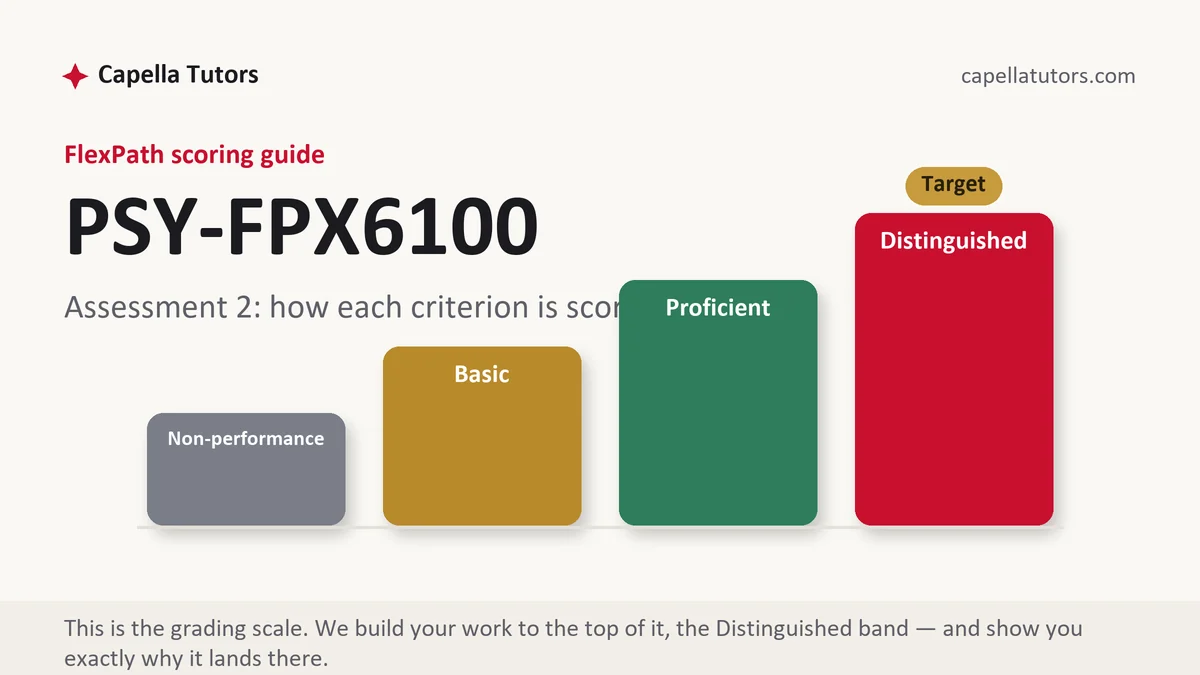
PSY-FPX6100 Assessment 2 grading scale at Capella FlexPath, the criterion levels this assessment is scored on, from Capella Tutors
How Capella FlexPath grades PSY-FPX6100 Assessment 2, visualized by Capella Tutors.

How PSY-FPX6100 Assessment 2 is scored

Criteria are graded independently, at one of four levels each, by somebody reading your headings against the guide's:

LevelWhat it means on an instructional and motivational plan
DistinguishedOne motivational cause is diagnosed rather than listed, the matched intervention follows from that diagnosis, the sequence names its modelling, practice schedule and feedback timing, the scaffold has an exit condition, and formative checks are designed to change the next session.
ProficientA defensible plan with research behind it. Everything present, with the motivational section describing several causes instead of choosing one.
BasicGood practice recommended in general. Engage learners, give feedback, make it relevant, with no evidence that any particular learner needed any particular thing.
Non-performanceThe plan, the defence or the assessment section is missing rather than thin, which puts that criterion at the bottom on its own.

The design does not have to be a school lesson. Corporate training, health education, onboarding and tutoring programmes all supply prior knowledge, capacity limits, practice scheduling and feedback in the exact form the criteria want.

The PSY-FPX6100 Assessment 2 method, step by step

  1. Build headings from the criteria, then name the audience and the constraint

    Criteria into headings, top descriptors underneath, then two lines of context: who the learners are and what limits you. Say twenty-two new loan processors at a credit union, four hours of release time across a fortnight. A plan that ignores the constraint gets marked down on feasibility no matter how well it reads.

  2. Establish what learners are actually doing

    Report the behaviour with numbers before you explain it. Nine of 22 opened the optional practice set once, 3 completed it, and error rates on the third document type stayed flat across the fortnight. That paragraph is what the diagnosis has to account for, and it stops the plan being written for an imaginary group.

  3. Diagnose expectancy, value and attribution as three separate questions

    Does the learner believe effort will produce success? Does the learner value the outcome at all? And what does the learner think caused the last failure? Expectancy-value reasoning gives you the first two, and Weiner's work on attributions sorted by locus, stability and controllability gives you the third. The three failures look the same and take different responses, so name which one your data points at.

  4. Match the intervention to the diagnosis, and say why the others were rejected

    Low expectancy needs evidence of capability at a difficulty the learner can beat, which means a first task deliberately inside reach and feedback that names what the learner did rather than what they are. Low value needs a connection to something the learner already wants. Self-efficacy in Bandura's sense is a belief about capability for a specific task, so the intervention has to be specific too.

  5. Write the sequence with a fading rule and a feedback specification

    Give modelling, guided practice, independent practice and spacing across sessions rather than a single block. Then write the exit condition for the support, because scaffolding is temporary by definition and a plan that never removes it has misread the construct it cites. Feedback earns its keep when it names the gap and the next action, and stops earning it when it reports a score alone.

  6. Design formative checks that change the next session, then self-score

    Formative assessment is information collected while learning is still moving, used to alter what happens next, and Black and Wiliam's review is the citation faculty expect. Say what each check will collect, what result triggers which change, and how it is recorded. Then mark yourself against the guide and allow the two business days faculty have to evaluate an attempt.

A structure that maps to the criteria

The targets below assume a plan with a defence attached rather than an artifact alone; move the weight if your guide asks for a full training module.

SectionWhat it must doGuide word target
Learners and constraintWho they are, what they already know, the release time available, and the observable shortfall in counts.~200 words
Motivational diagnosisExpectancy, value and attribution treated separately, with the data that points at one of them.~300 words
Matched interventionThe response that fits that diagnosis, and the reason the alternatives were set aside.~250 words
Instructional sequenceModelling, guided and independent practice, spacing, and the fading rule for the support.~350 words
Feedback and formative checksWhat is collected, when, what it triggers, and how the next session changes as a result.~250 words
Evidence and referencesPrinciples traced to primary sources, the limits of the plan, and current APA both ways.~180 words

Annotated sample excerpt

An original model paragraph from our writers, cut at the level the top descriptor asks for. Learn the diagnostic sequence, then apply it to the learners in front of you.

Sample excerpt: the motivational diagnosis Original model · Capella Tutors

Nine of the 22 new processors opened the optional practice set once and 3 completed it, while every one of the 22 completed the mandatory compliance module on time.1 That pattern argues against low value for the job and toward low expectancy for this task specifically, and the exit interviews support it: four of the five who stopped described the third document type as something they were not going to get, which is an attribution to stable, uncontrollable ability rather than to effort.2 The plan therefore opens with a document set deliberately inside reach, feedback that names the step the processor completed correctly, and a stated criterion for moving to the harder set, since Bandura's construct concerns belief about capability on a particular task and only task-specific evidence will shift it.3

  • 1A contrast inside the same group does the diagnostic work. Compliance completed and practice skipped rules out a general engagement story before any theory is invoked.
  • 2Names the diagnosis, then supports it with what learners said, classified by locus, stability and controllability rather than paraphrased.
  • 3The intervention follows from the diagnosis and cites the construct precisely. Task-specific belief needs task-specific evidence, which is why a general pep talk is not the plan.

The full premium sample for your exact assessment, written fresh to your scoring guide and issue, is free to request. Study it, revise it into your own voice, and submit work you understand.

Get the full sample free

The five mistakes that cost Distinguished

  • Motivation treated as one problem. A learner who doubts they can and a learner who does not care read identically from the front and need opposite interventions.
  • Scaffolding with no exit. Support that never fades is not scaffolding, and the plan has to name the condition under which it is withdrawn.
  • Feedback as a score. A number tells a learner where they landed and nothing about what to do next, which is the half that changes performance.
  • Formative checks that change nothing. If no result alters the following session, the check is a summative test wearing the wrong label.
  • Praise for the person rather than the work. Attribution research is specific about this, and a plan that reinforces stable ability has undermined its own diagnosis.

Pre-submission checklist

  • The shortfall appears in counts against a denominator before any explanation
  • Expectancy, value and attribution are diagnosed separately, with one selected
  • The intervention is matched to that diagnosis, with alternatives explicitly rejected
  • The sequence states modelling, practice schedule, spacing and the fading rule
  • Each formative check names the result that triggers a change
  • Every principle is attributed to its originator, in current APA both ways

Instructional plan to defend?

Send the guide, the learners, the constraint you work under and any completion or error data. We diagnose before we prescribe, tie every element of the sequence to a named mechanism, and return a premium original sample in 24 to 48 hours with unlimited free revision.

Keep going

Online now