This manual is for PSY-FPX6100 Assessment 1, start to submission. The opening deliverable in Introduction to Educational Psychology usually asks you to take one theory of learning, attribute it to the researcher who established it, and put it to work on a learning problem you can describe in observable terms. The word introduction in the title misleads people; the criteria run at master's level from the first attempt, and a paper that defines four theories accurately and applies none has answered one criterion four times. Below are the method our tutors use, an outline drawn from the criteria, and an annotated sample excerpt. Want it written for you instead? A premium original sample for this exact brief returns inside 24 to 48 hours, with free revision until the criteria are satisfied. Your courseroom may print this as PSY FPX 6100 Assessment 1 or PSY6100 Assessment 1; it is the same deliverable, and PSY-FPX6100 Assessment 1 is what this manual walks through.
One honesty note before the manual: Capella revises courses and scoring guides over time, so always write to the exact scoring guide attached to your assessment in the courseroom. The course identity above is verified on capella.edu; the method and structure below are our tutors' approach to it, not Capella's official rubric text.
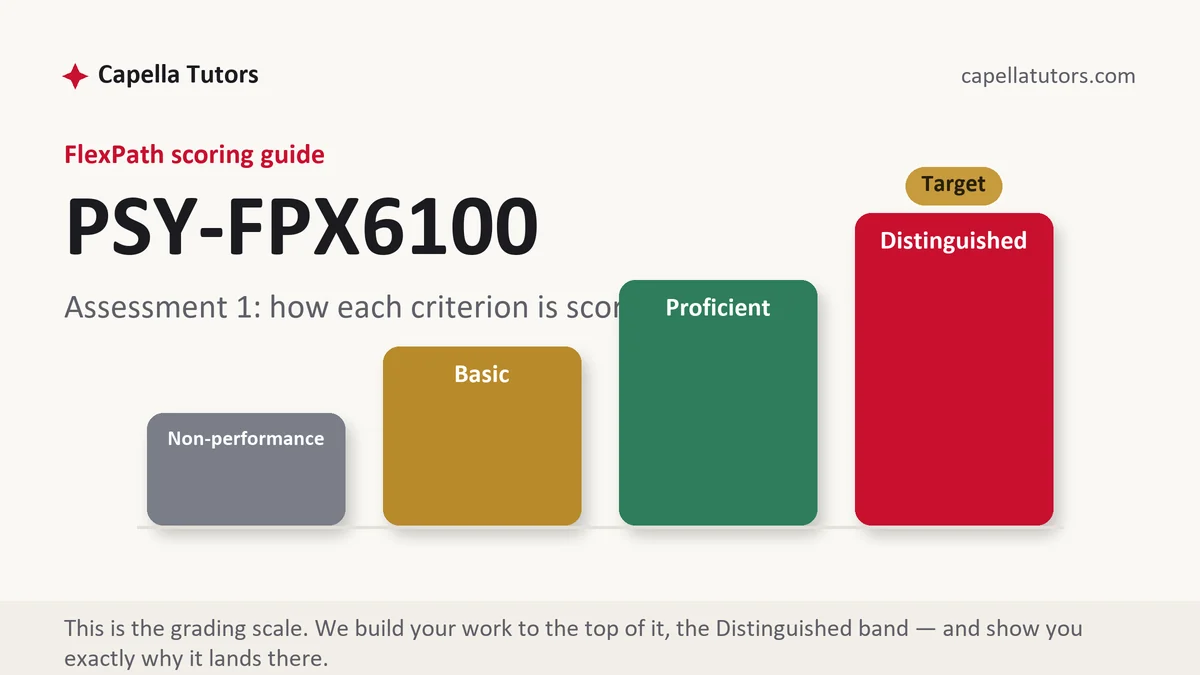
How PSY-FPX6100 Assessment 1 is scored
No letter grade is calculated anywhere in FlexPath. A criterion is read, one of four descriptions is chosen, and the description you want tells you exactly what to write:
| Level | What it means on an applied cognition brief |
|---|---|
| Distinguished | The gap is described as behaviour an instructor could watch, the cognitive account names its sources of load, every principle is traced to the researcher who established it, the instructional change follows from the account, and a measurement is proposed that could show it failed. |
| Proficient | Principles are correctly explained and sensibly applied. Solid, and one step short of the column that requires the change to follow from the mechanism. |
| Basic | A theory tour with a recommendation appended. Accurate definitions, a general endorsement of practice, and nothing an instructor could do differently on Monday. |
| Non-performance | The application or the sourcing is absent. A criterion with no matching section receives the lowest level available. |
Read the verbs on your guide before you read anything else. Explain wants a mechanism, apply wants the theory used on a case you describe, evaluate wants a judgment against a standard you name, and design wants an artifact somebody could teach from.
The PSY-FPX6100 Assessment 1 method, step by step
-
Outline from the criteria, then choose a setting you can describe
Every criterion becomes a heading with its highest descriptor underneath. Then pick a learning problem concrete enough to have details: a community college introductory statistics section where students can recite the steps of a hypothesis test and cannot plan one. You do not need a teaching licence for this course, only a setting you know well enough to quantify.
-
Describe the gap in observable behaviour
Struggling with statistics is not a gap. Nineteen of 31 students correctly stated all four steps on the quiz, and 6 of 31 produced a workable plan when handed an unfamiliar dataset, is a gap. Give the counts, the denominators and the task, because everything the cognitive section says afterward has to explain that specific pattern.
-
Count the load the task actually imposes
Work through what the student must hold in mind at once: the research question, the variable types, the assumption checks, the test that matches, the direction of the comparison, and the software syntax. Baddeley's account separates the verbal and visuospatial components of the working stage, and the capacity figures matter here. Miller's classic estimate of about seven items has been revised downward by later work toward roughly four chunks of novel material, and a six-part decision does not fit.
-
Attribute every principle to the person who established it
Cognitive load theory belongs to Sweller and the multimedia principles built on it to Mayer. The advantage of being tested over rereading is associated with Roediger and Karpicke, and the benefit of distributing practice across days traces back to Ebbinghaus. Citing a course reader for any of these tells an evaluator which document you opened, and the sourcing criterion is scored on it.
-
Design the change so it follows from the account
If the load is a six-part decision, the change is a partly worked example that supplies the first three parts and asks for the rest, then a second that supplies two, then none. Add spacing across three sessions rather than one, and a short retrieval check at the start of each. Each element points back at a named mechanism, which is what the application criterion is reading for.
-
Propose the measurement, then self-score
Say what you will collect, when, and what result would count as improvement, in the same units as the baseline. Since this is a statistics course, model the honesty you are teaching: report the difference with an interval, give the denominator, and state that a small p value would not by itself establish that the change worked. Then mark yourself against each criterion and submit with the two business days faculty have for evaluation in mind.
A structure that maps to the criteria
Word counts here are our planning defaults for a brief of this kind rather than Capella rules; follow your own guide wherever it asks for more.
| Section | What it must do | Guide word target |
|---|---|---|
| The learning problem | Learners, content, what they can already do, and the gap in counts against denominators. | ~200 words |
| Theory selected | The framework, its originator, its core constructs, and why it fits this gap better than the obvious alternative. | ~250 words |
| Cognitive account | What the task demands of attention, working memory and prior knowledge, load identified by source. | ~350 words |
| Instructional change | Worked examples, fading schedule, spacing, retrieval checks, each tied to its mechanism. | ~300 words |
| Measurement | What is collected, when, against which baseline, and what result would count as improvement. | ~250 words |
| Limits and references | What this plan cannot address, what would disconfirm it, and current APA in text and list. | ~180 words |
Annotated sample excerpt
The paragraph below is an original model from our team, written where the guide's top description points. Take the sequence of moves, then write your own around a setting you can describe.
On the quiz, 19 of 31 students listed all four steps of a hypothesis test correctly, and when handed an unfamiliar two-group dataset, 6 of 31 produced a workable plan.1 Planning requires holding the question, the variable types, the assumption checks, the matching test and the direction of comparison simultaneously, which is at least five novel elements for learners whose estimates of working memory capacity for unfamiliar material sit closer to four chunks than to Miller's original figure of about seven.2 The recitable steps are therefore not the bottleneck; the integration is, and Sweller's account predicts that a partly worked example supplying the first three elements will free the capacity the remaining two require.3
- 1Two counts, one denominator, two tasks. The gap is now something an instructor could watch happen rather than a description of a feeling.
- 2Enumerates the elements the task demands and matches that number against a capacity estimate, with the downward revision of the classic figure noted rather than the slogan repeated.
- 3Names the bottleneck, attributes the mechanism to its originator, and states a prediction the next section can test. Theory doing work, which is what the application criterion buys.
The full premium sample for your exact assessment, written fresh to your scoring guide and issue, is free to request. Study it, revise it into your own voice, and submit work you understand.
The five mistakes that cost Distinguished
- A theory defined and then dropped. Application usually carries the heaviest weight on these guides, and a definition paragraph does not touch it.
- Frameworks cited through a textbook. An older primary date is provenance rather than a lapse, and attributing a construct to a course reader costs the sourcing criterion on its own.
- A gap written as an adjective. Unmotivated, weak and struggling cannot be measured, so nothing in the plan can be shown to have worked.
- Load asserted rather than counted. Saying the task is cognitively demanding is a claim; listing what must be held at once is an analysis.
- A measurement with no failure condition. If no result would count as the plan not working, the evidence criterion has nothing to grade.
Pre-submission checklist
- The gap appears as counts against denominators on a named task
- Every principle is attributed to the researcher who established it
- The load analysis enumerates the elements the task requires at once
- Each instructional element points back to a stated mechanism
- The measurement names its baseline, its window and its improvement threshold
- One sentence says what a p value alone would not establish
Cognition brief due shortly?
Send the guide, the learners and any quiz or performance data you hold. Eight people build the load analysis, trace every principle to its primary source, and return a premium original sample in 24 to 48 hours, revised free until each criterion is satisfied.