How to write PSY-FPX6015 Assessment 2

The short answer

This manual is for PSY-FPX6015 Assessment 2, start to submission. The middle deliverable in Lifespan Development usually hands you a reported trajectory and asks what it supports: how the data were produced, which of age, cohort and period the design can separate, what the spread around the average does, and what a claim about change would require that this evidence may not have. Your scoring guide decides the sections. One distinction runs through every criterion, which is that a difference between age groups is not the same object as change inside a person, and most of what students have read is built from the first and written as though it described the second. Below is the method our tutors use for it, a structure that maps to the criteria, and an annotated sample excerpt. Prefer to hand it off? A premium original sample for this exact assessment comes back in 24 to 48 hours, revised free until it meets the guide. Your courseroom may print this as PSY FPX 6015 Assessment 2 or PSY6015 Assessment 2; it is the same deliverable, and PSY-FPX6015 Assessment 2 is what this manual walks through.

One honesty note before the manual: Capella revises courses and scoring guides over time, so always write to the exact scoring guide attached to your assessment in the courseroom. The course identity above is verified on capella.edu; the method and structure below are our tutors' approach to it, not Capella's official rubric text.
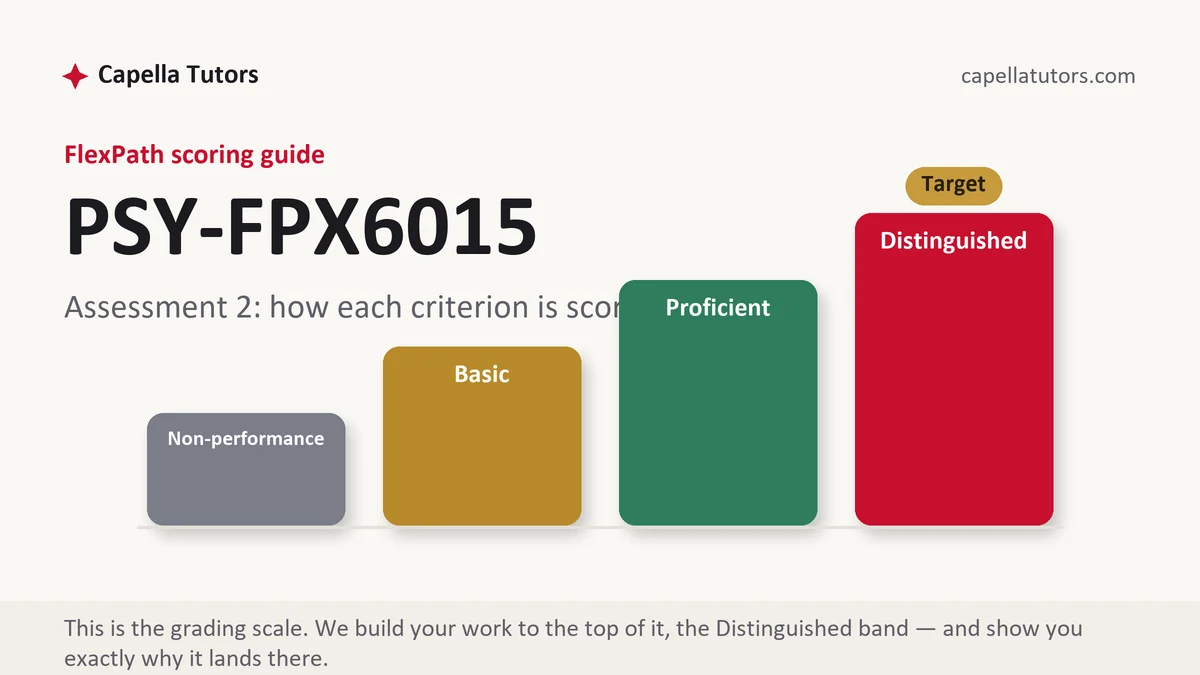
PSY-FPX6015 Assessment 2 grading scale at Capella FlexPath, the criterion levels this assessment is scored on, from Capella Tutors
How Capella FlexPath grades PSY-FPX6015 Assessment 2, visualized by Capella Tutors.

How PSY-FPX6015 Assessment 2 is scored

There are no letter grades in FlexPath. Each criterion on the scoring guide lands on one of four levels, and the level language is the writing brief:

LevelWhat it means on an appraisal of a reported trajectory
DistinguishedThe design is identified before the interpretation, age differences and within-person change stay in separate sentences with separate verbs, the spread is reported as a finding, and the biases of each design are shown running in opposite directions.
ProficientThe finding is summarized correctly and the design is named. Accurate, and letting the original interpretation stand unchallenged.
BasicDeclines and improves used on data from a single occasion, with a mean trajectory reported as though everyone were on it.
Non-performanceA required element is absent, most often the design appraisal or the account of variability. Missing, not weak, is what puts a criterion on the floor.

Three variables travel together in developmental data and any two of them fix the third: a person's age, the cohort they were born into, and the historical moment of measurement. Every design in this literature buys the separation of one pair and pays for it by confounding another, and saying which is the appraisal.

The PSY-FPX6015 Assessment 2 method, step by step

  1. Restate the finding exactly as it was handed to you

    Quote the numbers and the interpretation offered with them, without repair. An appraisal needs its object on the page, and paraphrasing a claim into something more defensible before evaluating it removes the thing the criterion asked you to evaluate.

  2. Ask how the data were produced before asking what they mean

    How many occasions, how many cohorts, how far apart, and who was in the sample. A single occasion across ages confounds age with birth cohort. One cohort followed forward confounds age with period. Designs following more than one cohort across the same interval separate more, and none separates everything.

  3. Split the finding by design and name what each buys

    If the data came from different people measured once, the number is a group difference and it contains everything that differs between those birth years, including schooling, health care and familiarity with the task format. If the same people were followed, the number is a within-person change and it inherits a different pair of problems.

  4. Report the spread as a finding, not as noise

    Variation between people grows across the adult years, so a mean trajectory describes fewer individuals the further along it runs. Give the dispersion, name one group the average misrepresents, and remember that any subgroups you cite came out of a model somebody specified rather than out of nature.

  5. Price the longitudinal biases too

    Participants who keep returning are healthier and more motivated than those who stop, which flatters later waves, and repeated testing on the same instrument teaches it. Those two push the estimate in the opposite direction from the cohort confound in cross-sectional work, which is why a conclusion surviving both reads as stronger than either study alone.

  6. Size the claim, then self-score

    Report magnitudes with intervals rather than direction alone, and keep verbs matched to the design: scored lower for a group comparison, changed for repeated measurement of the same people. A p value tells you how surprising the data would be if nothing were going on, and it cannot tell you the size of a difference or whether it matters. Then mark each criterion and submit early in the week.

A structure that maps to the criteria

Word counts are planning targets our tutors use for a typical appraisal deliverable, not Capella rules; expand wherever your scoring guide asks for more.

SectionWhat it must doGuide word target
The finding as givenThe reported numbers and the interpretation attached to them, quoted rather than improved.~200 words
How the data were producedOccasions, cohorts, intervals, sample and recruitment, plus which of age, cohort and period is confounded.~300 words
The finding split by designWhat a group comparison licenses, what repeated measurement licenses, and where the two literatures agree.~350 words
Variation around the meanDispersion over time, one group the average describes badly, and how subgroups were derived.~300 words
Biases in both directionsCohort differences on one side, attrition and retest effects on the other, and the conclusion that survives both.~250 words
What would settle it, and referencesThe occasion or cohort that would remove the confound, plus current APA matched both ways.~200 words

Annotated sample excerpt

An original model excerpt from our team, showing the register that scores at the top of the guide. It is study material: learn the moves, then write your own version.

Sample excerpt: the finding split by design Original model · Capella Tutors

The summary provided states that adults aged 70 to 79 recalled 2.1 of 10 recently learned names while adults aged 40 to 49 recalled 4.3, and offers the whole gap as evidence that memory for names declines with age.1 Those were different people tested on one afternoon, so the difference holds everything that separates two birth cohorts alongside any effect of aging, including years of schooling, practice with timed screen-based tasks, and who was well enough and free enough to attend a weekday community session.2 Studies that follow the same adults across occasions typically report within-person changes smaller than cross-sectional gaps of this size, and they carry the opposite pair of biases, since the participants who return are healthier than those who drop out and repeated testing teaches the task, so the reading this evidence supports is that recall was lower in the older group here, with the size of any within-person change beyond what one occasion can estimate.3

  • 1Puts the claim on the page as received, interpretation included, so the appraisal has something to work against rather than a tidied version of it.
  • 2Lists concretely what a single occasion cannot separate instead of naming cohort effects as a term and moving on. Specific confounds are what the analysis criterion rewards.
  • 3Brings in the second design with its own biases running the other way, then states a conclusion sized to what survives both. Two designs, two directions of error, one honest sentence.

The full premium sample for your exact assessment, written fresh to your scoring guide and issue, is free to request. Study it, revise it into your own voice, and submit work you understand.

Get the full sample free

The five mistakes that cost Distinguished

  • Within-person verbs on between-person data. Declines and improves describe one person over time, and a single occasion cannot license either of them.
  • The original interpretation left standing. Repeating the summary's conclusion in your own words is a paraphrase, and the criterion asked for an appraisal.
  • A mean with no spread. Variability is the finding this literature is most confident about in adulthood, not the noise around the finding.
  • Attrition and practice effects omitted. A longitudinal estimate without both caveats is being read more generously than its own authors would read it.
  • Subgroups treated as natural kinds. Trajectory classes came out of a model with decisions inside it, and citing them as discovered categories overstates what the analysis found.

Pre-submission checklist

  • Every scoring-guide criterion has its own clearly labeled section
  • The finding appears as it was given, with its original interpretation quoted
  • Occasions, cohorts and intervals stated, with the confounded pair named
  • Group differences and within-person change written in separate sentences with separate verbs
  • Dispersion reported, with one group the average misrepresents identified
  • Magnitudes carry intervals, and the design that would settle the question is named

Want this assessment done with backup?

Send the scoring guide and the trajectory you were handed. A team of eight returns a premium original sample built to the top descriptor in 24 to 48 hours, with every claim about change carrying the design that earned it, and revisions until each criterion clears. One reviewer reads the draft for verbs alone.

Keep going

Online now