How to write PSY-FPX6015 Assessment 1

The short answer

This manual is for PSY-FPX6015 Assessment 1, start to submission. The opening deliverable in Lifespan Development usually asks you to trace one process inside a period and connect it to what came before and what follows, often with a structured observation or a described case supplying the concrete material. Your scoring guide decides the sections and whether observation is required. Two habits carry most of the credit: writing an operational definition before you record anything, and keeping the verbs honest, since a single look at one child supports description rather than any claim about change. Below is the method our tutors use for it, a structure that maps to the criteria, and an annotated sample excerpt. Prefer to hand it off? A premium original sample for this exact assessment comes back in 24 to 48 hours, revised free until it meets the guide. Your courseroom may print this as PSY FPX 6015 Assessment 1 or PSY6015 Assessment 1; it is the same deliverable, and PSY-FPX6015 Assessment 1 is what this manual walks through.

One honesty note before the manual: Capella revises courses and scoring guides over time, so always write to the exact scoring guide attached to your assessment in the courseroom. The course identity above is verified on capella.edu; the method and structure below are our tutors' approach to it, not Capella's official rubric text.
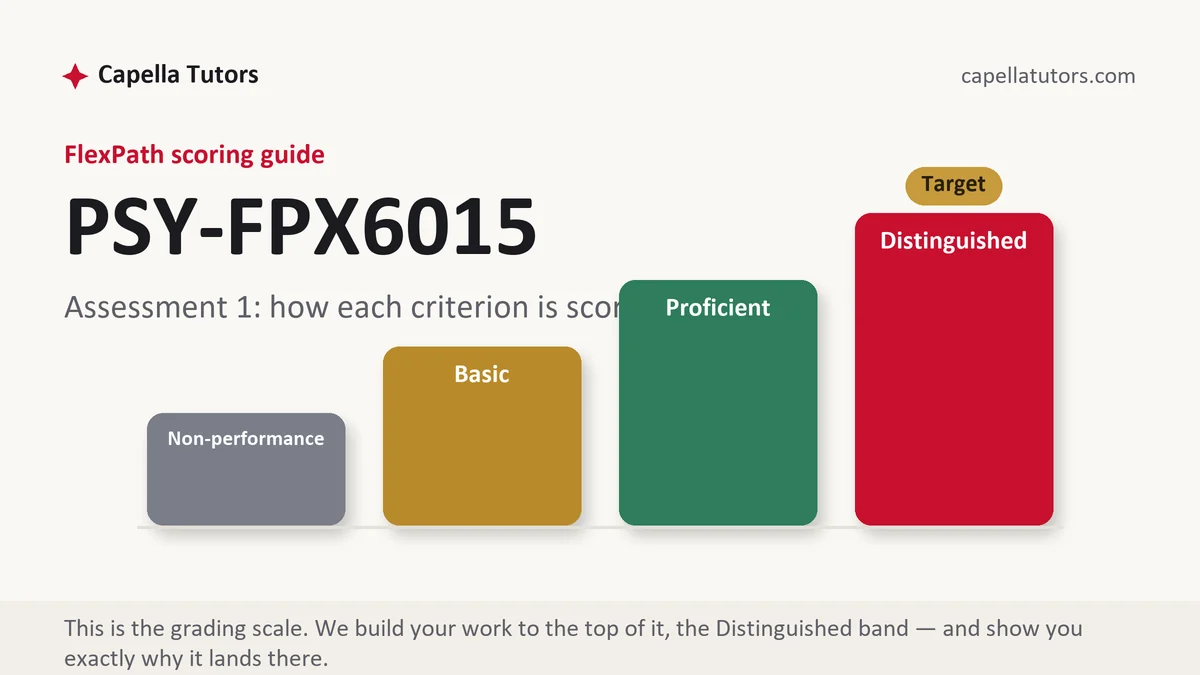
PSY-FPX6015 Assessment 1 grading scale at Capella FlexPath, the criterion levels this assessment is scored on, from Capella Tutors
How Capella FlexPath grades PSY-FPX6015 Assessment 1, visualized by Capella Tutors.

How PSY-FPX6015 Assessment 1 is scored

There are no letter grades in FlexPath. Each criterion on the scoring guide lands on one of four levels, and the level language is the writing brief:

LevelWhat it means on a developmental process traced across periods
DistinguishedThe behaviour is defined so a second observer could agree, the record carries its denominators, the period is connected to the one before and after it with evidence, and the write-up says what one observation cannot support.
ProficientAn accurate account of the process with the observation reported cleanly. Careful, and treating its own limits as a formality.
BasicAn anecdote with theory names attached, and a period described as though it were sealed off from the rest of the life.
Non-performanceA required element is absent, most often the permission and assent procedures or the operational definition itself. A criterion lands here when something required is not present at all.

The lifespan framing is a set of commitments rather than a survey requirement: development runs the whole life, it runs in several dimensions at once, every point carries gain alongside loss, and plasticity is real and bounded. A paper satisfies the framing by tracing one process across a boundary rather than by touring the decades.

The PSY-FPX6015 Assessment 1 method, step by step

  1. Sort the criteria by the kind of claim each wants

    Some ask for a process described, some for evidence appraised, some for an application aimed at a real audience. Label each criterion with its kind before drafting, because those three want different sentence styles and a section written in the wrong one loses credit it had already earned.

  2. Fix the period and the process at the top

    Write the age band and the single process you are following into the first paragraph and keep them there. The fastest way to lose a graduate developmental paper is drift into claims about people in general, and a visible boundary at the top of the document is what stops it.

  3. Define the behaviour before you look at it

    Write the operational definition first: what counts as an instance, what does not, and what the boundary case is. Cooperated is an impression; stayed within arm's reach of the material for the full interval without taking it is a code. If a second observer could not apply your definition, you are collecting opinions rather than observations.

  4. Choose the sampling method and say what it buys

    Time sampling records whether the behaviour occurs in fixed intervals and gives you rates with clean denominators. Event sampling records every occurrence with its context and gives you sequences. Narrative recording gives you richness and no comparability. Name the one you used, and report the intervals or events observed alongside every count.

  5. Connect across the boundary, with the right verbs

    Two sentences satisfy the lifespan commitment: what the antecedent evidence shows about this process entering the period, and what follow-up evidence shows about it leaving. Where that evidence compares age groups measured once, write the older group scored lower rather than the ability declined, because declines is a verb about one person over time.

  6. Write the ethics into the method, then self-score

    Research with a child needs permission from a parent or guardian and the child's own assent, sought in language that child understands and withdrawable without penalty. State the confidentiality limit before anyone begins, since disclosure of harm carries reporting obligations. Remove identifying detail about the setting and family, then mark each criterion and submit early in the week.

A structure that maps to the criteria

Word counts are planning targets our tutors use for a typical opening lifespan deliverable, not Capella rules; expand wherever your scoring guide asks for more.

SectionWhat it must doGuide word target
Process and periodThe one process under study, the age band, and why this period is the right place to watch it.~250 words
Method and definitionsSetting, ages, sampling method, intervals or events, and the operational definition a second observer could apply.~300 words
What was recordedCounts with their denominators, the context of the notable instances, and nothing inferred about motive.~300 words
The process in the literatureWhat research on this period reports, each finding with the design that produced it and the verbs it licenses.~350 words
Before and afterThe antecedent evidence entering the period and the follow-up evidence leaving it, so the period is not sealed.~250 words
Ethics, limits and referencesPermission, assent, confidentiality limit, what one observation cannot support, and current APA both ways.~250 words

Annotated sample excerpt

An original model excerpt from our team, showing the register that scores at the top of the guide. It is study material: learn the moves, then write your own version.

Sample excerpt: method and definitions Original model · Capella Tutors

Observation ran on three consecutive mornings during the 40-minute free-play period in one classroom of 18 children aged 3 years 6 months to 4 years 9 months, with the target child sampled in 15-second intervals across ten minutes each morning, giving 120 intervals in total.1 The behaviour recorded was waiting: an instance began when the child reached for or asked for a material another child was holding, and it counted as regulated waiting only if the child stayed within arm's reach for the full interval without taking the item, a definition a second observer could apply without reading the child's intentions.2 Three mornings with one child describe that child, in that room, during that activity, so results are given as instances per interval observed with the denominator beside them, and the pattern is carried into the next section as a question for the literature rather than as evidence about four-year-olds.3

  • 1Setting, ages, sampling interval and total intervals all arrive before any behaviour, which is what makes the record a protocol rather than an anecdote.
  • 2The definition is written so agreement or disagreement is possible, and it stays out of the child's head. Operational definitions are the line between measuring and impressions.
  • 3Names what three mornings cannot support and reports the denominator with the count. A graduate write-up sizes its own claims before a reader has to.

The full premium sample for your exact assessment, written fresh to your scoring guide and issue, is free to request. Study it, revise it into your own voice, and submit work you understand.

Get the full sample free

The five mistakes that cost Distinguished

  • An anecdote with theory names attached. Two remembered moments and a list of stage labels satisfies no analysis criterion, however familiar the theory is.
  • Definitions written after the observation. A code invented to fit what you already saw cannot be applied by anyone else, which is the whole test of an operational definition.
  • Counts with no denominator. Six instances of waiting means nothing until a reader knows six out of how many intervals, over how long.
  • A sealed period. Treating middle childhood or midlife as self-contained fails the lifespan framing, and the fix is two sentences of antecedent and follow-up evidence.
  • Assent treated as a signature. A child's agreement has to be sought in that child's language, and the confidentiality limit has to be stated before anyone begins.

Pre-submission checklist

  • Every scoring-guide criterion has its own clearly labeled section
  • One process and one age band declared at the top and held throughout
  • The operational definition is written so a second observer could apply it
  • Sampling method named, with intervals or events reported beside every count
  • Antecedent and follow-up evidence present, with verbs matching each design
  • Permission, assent and the confidentiality limit written into the method, current APA both ways

Want this assessment done with backup?

Send the scoring guide, the period the prompt names, and your observation notes if you have them. A team of eight returns a premium original sample built to the top descriptor in 24 to 48 hours, with one pass devoted to checking that no verb in the document claims within-person change from a single occasion, and revisions until each criterion clears.

Keep going

Online now