This manual is for PSY FPX 5201 Assessment 3, start to submission. The closing stage of the integrative project usually asks for the synthesis itself and what follows from it: themes drawn from the literature rather than from your reading order, each theme opening on a claim the grouped studies support, disagreement between studies explained through design and measurement, an application written at the scope a non-licensure master's allows, and a limitations section about this project rather than about the field. Your scoring guide sets the sections, their order and any front matter. Mechanics carry unusual weight because the document is finally long enough for inconsistency to show. Below is the method our tutors use for it, a structure that maps to the criteria, and an annotated sample excerpt. Prefer to hand it off? A premium original sample for this exact assessment comes back in 24 to 48 hours, revised free until it meets the guide. Capella's catalog lists the course as PSY-FPX5201, and some courserooms print PSY5201; both point to this same Assessment 3.
One honesty note before the manual: Capella revises courses and scoring guides over time, so always write to the exact scoring guide attached to your assessment in the courseroom. The course identity above is verified on capella.edu; the method and structure below are our tutors' approach to it, not Capella's official rubric text.
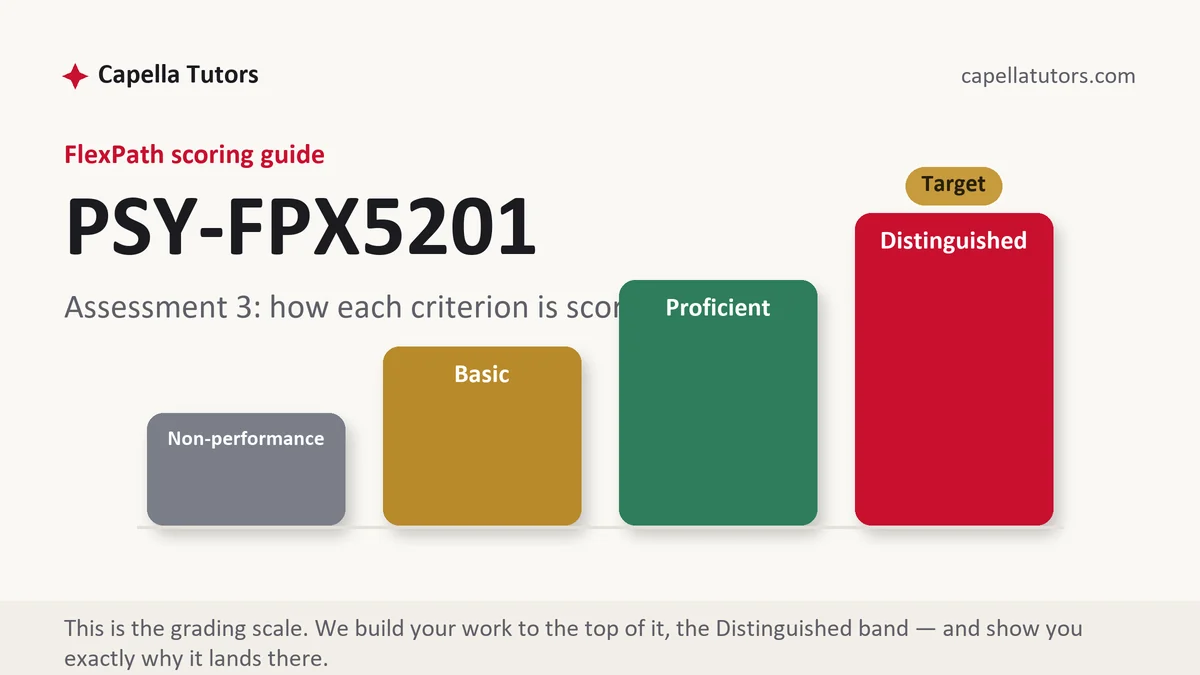
How PSY FPX 5201 Assessment 3 is scored
There are no letter grades in FlexPath. Each criterion on the scoring guide lands on one of four levels, and the level language is the writing brief:
| Level | What it means on a synthesis and application |
|---|---|
| Distinguished | Each theme argues from several studies at once, disagreement is explained by sample, measure or design rather than averaged, the application is sized to the strength of the evidence, and the limitations belong to this project. |
| Proficient | Themes present and supported, application reasonable, limitations acknowledged. Organized, and short of arguing. |
| Basic | One paragraph per study under thematic headings, with the strongest and weakest evidence given the same weight. The classic shortfall at capstone level. |
| Non-performance | A required element is absent, most often the application section or the project limitations. This level records an omission rather than a shortfall. |
The skill this capstone exists to certify is a paragraph that argues from a set of studies rather than a paragraph about one. Everything in the criteria is a way of asking whether you can write it, and the same protocol produces it whichever specialization you came through.
The PSY FPX 5201 Assessment 3 method, step by step
-
Let the literature name your themes
Sort the evidence table until groups appear, then name each group for what it argues rather than for what it covers. Sections named after themes score; sections named after articles do not, and a heading that could be replaced by an author's surname is a filing label rather than a theme. The order of your themes should build toward the answer your question promised.
-
Open each theme on a claim, then recruit the studies
First sentence: what this set of studies supports. Then the studies, grouped by the kind of evidence each supplies rather than listed in date order. Two sources may not sit in adjacent sentences without a stated relationship between them, and any sentence beginning with an author's name and ending with a finding is doing summary rather than synthesis.
-
Explain disagreement structurally
When results conflict, the usual explanations are who was in the sample, which measure stood in for the construct, how long the follow-up ran, whether the design was longitudinal or single-occasion, and whether the analysis was preregistered. Work through those before concluding that the literature is mixed, because mixed is a description and the criterion wants an account.
-
Keep the verbs and the numbers honest
Report effect sizes with their intervals where the studies give them, and size your claim to the interval rather than to the point estimate. Where the designs are observational, the language is associated with rather than improves. A p value tells you how surprising a result would be if nothing were going on; it cannot tell you how large the effect is or how likely your conclusion is to be true.
-
Write the application at the scope your degree allows
This is a non-licensure master's, so the application is program design, training, measurement, consultation or advocacy rather than diagnosis or treatment. Attach each recommendation to the evidence carrying it, and mark the thinner ones as thinner. A ranked set of recommendations reads as judgment; an unranked set reads as enthusiasm.
-
Write limitations about the project, then sweep the mechanics
The databases you did not search, the language limit you applied, the designs you excluded, and the part of your question the evidence turned out not to reach. Then check heading levels stepping down in order, terminology identical in the last section and the first, and every citation matched both ways. Score yourself against every criterion, then submit early rather than late in the week.
A structure that maps to the criteria
Word counts are planning targets our tutors use for a typical closing capstone deliverable, not Capella rules; expand wherever your scoring guide asks for more.
| Section | What it must do | Guide word target |
|---|---|---|
| Question and method recap | The question, the constructs, and a compressed account of how the literature was located, for a reader arriving here first. | ~300 words |
| Theme one | The best-evidenced part of the answer, claim first, studies grouped by evidence type, disagreement explained. | ~500 words |
| Remaining themes | Each subsequent theme in the order that builds the answer, with the weakest evidence marked as weak where it is. | ~500 words each |
| Integration | What the whole body supports, what it does not settle, and where you take a position with a stated reason. | ~350 words |
| Application to practice | Recommendations ranked by evidence strength, scoped to a non-licensure degree, each with an audience. | ~350 words |
| Limitations and references | Limits of this project rather than of the field, current APA both ways, heading levels and terms consistent. | ~300 words |
Annotated sample excerpt
An original model excerpt from our team, showing the register that scores at the top of the guide. It is study material: learn the moves, then write your own version.
Taken together, the eleven studies bearing on early bilingual exposure and inhibitory control support a small association on laboratory conflict tasks and close to none on caregiver-reported everyday measures, and the split follows how the outcome was measured rather than where the sample was recruited.1 Seven of the eleven tested children on a single occasion, so they establish a difference between groups rather than a change within any child, and of the three reporting an effect size with an interval, all three intervals include zero.2 The two studies that matched bilingual and monolingual children on household income and parental education before testing found the smallest differences of the set, which is the pattern to expect when part of a group difference is carried by the circumstances that produce bilingual exposure, and no study here could assign the exposure.3
- 1Leads with what the whole set supports, then names the measurement feature that explains the disagreement. A theme heading earns its place only when a sentence like this can sit under it.
- 2Separates what a single-occasion design licenses from what it does not, and reports precision rather than direction alone. Intervals that include zero are stated, not omitted.
- 3Explains conflict through matching and confounding rather than averaging it away, and closes on the design limit the whole literature shares. That last clause is usually what the top descriptor is buying.
The full premium sample for your exact assessment, written fresh to your scoring guide and issue, is free to request. Study it, revise it into your own voice, and submit work you understand.
The five mistakes that cost Distinguished
- An annotated bibliography under thematic headings. One study per paragraph in reading order fails the synthesis criterion no matter how accurate each summary is.
- Mixed evidence as a conclusion. Saying findings vary and stopping is the sentence the criterion was written to catch, because the account of why is the graded part.
- Equal weight for unequal studies. A preregistered trial and a small single-occasion survey do not carry the same load, and a synthesis that treats them alike has not read either.
- Application beyond the degree. Recommending assessment or treatment decisions from a non-licensure master's misreads the scope the criteria are written for.
- Limitations about the field. Calling for further research says nothing; naming the database you skipped and the design you excluded is a limitation a reader can use.
Pre-submission checklist
- Every scoring-guide criterion has its own clearly labeled section
- Each theme opens on a claim about a set of studies, not on an author's name
- Conflicting results are explained by sample, measure, follow-up length or design
- Effect sizes carry intervals, and verbs match what the designs support
- Recommendations ranked by evidence strength and scoped to a non-licensure degree
- Limitations specific to this project, heading levels and terminology consistent end to end
Want this assessment done with backup?
Send the scoring guide, your evidence table, and whatever draft exists. A team of eight, including a research analyst and two QA reviewers, returns a premium original sample built to the top descriptor in 24 to 48 hours, with separate passes for citation integrity and long-document formatting, revised free until every criterion clears.