This manual is for PSY FPX 5201 Assessment 2, start to submission. The middle stage of the integrative project usually asks you to find the literature and prove you found it: the databases and dates, the concept blocks and how they were combined, the limiters, the written inclusion and exclusion criteria, the number of records surviving each stage, and an evidence table holding one row per study. Your scoring guide decides the form. The search is a graded object here rather than a preliminary to the writing, and the standard it is graded against is whether a second person could repeat it and land in roughly the same place. Below is the method our tutors use for it, a structure that maps to the criteria, and an annotated sample excerpt. Prefer to hand it off? A premium original sample for this exact assessment comes back in 24 to 48 hours, revised free until it meets the guide. Capella's catalog lists the course as PSY-FPX5201, and some courserooms print PSY5201; both point to this same Assessment 2.
One honesty note before the manual: Capella revises courses and scoring guides over time, so always write to the exact scoring guide attached to your assessment in the courseroom. The course identity above is verified on capella.edu; the method and structure below are our tutors' approach to it, not Capella's official rubric text.
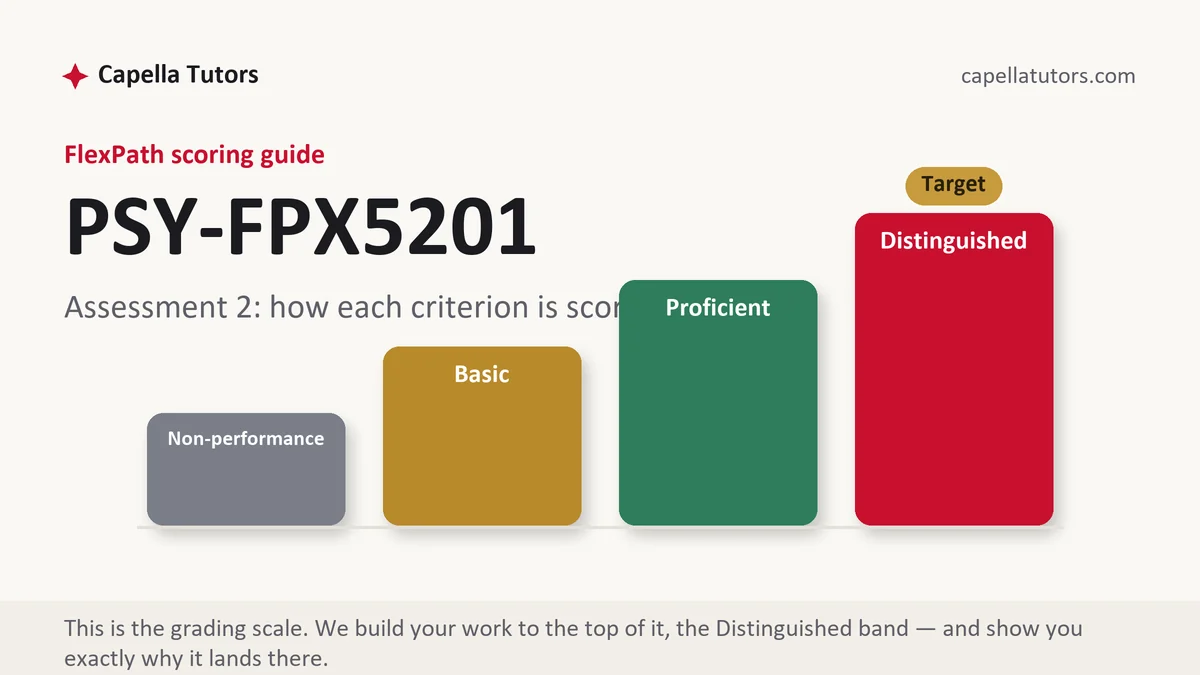
How PSY FPX 5201 Assessment 2 is scored
There are no letter grades in FlexPath. Each criterion on the scoring guide lands on one of four levels, and the level language is the writing brief:
| Level | What it means on a documented search and evidence table |
|---|---|
| Distinguished | The procedure is reproducible to the date, the counts reconcile at every stage, exclusion reasons are reported rather than totalled, and the evidence table records design, sample size and effect size with its interval instead of a sentence of findings. |
| Proficient | Databases, terms and criteria all present, with a complete table. Repeatable in outline, and vague at one or two joints. |
| Basic | A paragraph reporting that peer-reviewed articles were located, and a table summarizing each study in prose. This is the most common landing spot in the method section. |
| Non-performance | A required element is absent, usually the inclusion and exclusion criteria or the stage counts. Nothing written thinly lands here; only something left out does. |
Reproducibility is the entire reason this section exists. A search that ran until enough sources appeared is detectable from the outside, because its dates cluster, its databases are unnamed, and its yield is a round number nobody could arrive at twice.
The PSY FPX 5201 Assessment 2 method, step by step
-
Write the protocol before you search
Decide and record, in advance: the concept blocks taken from your constructs, the synonyms inside each block, the years and languages you will accept, the study designs you will keep, and what disqualifies a record. Written first, this is a protocol. Written afterward from what you happened to find, it is a description, and faculty can tell the difference from the dates alone.
-
Search more than one database, and log as you go
Run the blocks in PsycINFO and in the second database your field actually uses, which for education-facing questions is ERIC and for health-adjacent ones is PubMed. Record the exact strings, the limiters, and the date you ran each search, because a database updates and a count you cannot date cannot be checked. Keep hand-searched references separate from the database yield.
-
Screen in two stages against written criteria
Titles and abstracts first, full texts second, and the criteria stay fixed between them. If you find yourself adjusting a criterion at full text, that is a real event: change it once, say you changed it, and rescreen. Silent criterion drift is the flaw most likely to make your counts stop reconciling.
-
Report why records left, not just how many
Group the full-text exclusions by reason and give the counts: wrong outcome, wrong population, intervention bundled with something else, no usable statistics. Those groups describe what the literature does not contain, which is information your synthesis needs and a total on its own cannot supply.
-
Build the evidence table before any prose
One row per study with columns for authors and year, design, sample size and setting, the measure used, the effect size with its interval where one is reported, and a limitation you noticed yourself. Sort by design rather than by date. A sorted table shows you immediately which of your themes rests on a single cross-sectional study, and paragraphs written from it lead with the claim instead of the citation.
-
Reconcile the arithmetic, then self-score
Records retrieved minus duplicates equals records screened; screened minus excluded equals full texts; full texts minus exclusions equals included. Make those three lines add up before you submit, since a reader who finds one broken subtraction will check everything else. Then mark each criterion yourself and submit early in the week, because faculty have two business days per attempt.
A structure that maps to the criteria
Word counts are planning targets our tutors use for a typical search and selection deliverable, not Capella rules; expand wherever your scoring guide asks for more.
| Section | What it must do | Guide word target |
|---|---|---|
| Question restated | The question and constructs carried forward, with the terms each construct contributed to the search. | ~200 words |
| Search protocol | Databases, concept blocks, synonyms, boolean structure, limiters, and the dates the searches ran. | ~300 words |
| Inclusion and exclusion | The criteria as a list, with the reasoning behind each one and any change you made and disclosed. | ~250 words |
| Yield and screening | Counts at every stage, hand-searched records kept separate, and full-text exclusions grouped by reason. | ~250 words |
| Evidence table | One row per included study: design, sample, measure, effect size with interval, and your own noted limitation. | table plus ~200 words |
| What the search cannot reach | Databases skipped, languages excluded, designs left out, and current APA matched in both directions. | ~200 words |
Annotated sample excerpt
An original model excerpt from our team, showing the register that scores at the top of the guide. It is study material: learn the moves, then write your own version.
PsycINFO and ERIC were searched on 14 June with three concept blocks joined by AND, synonyms inside each block joined by OR, limited to peer-reviewed English-language reports from 2010 onward, returning 287 records, with a further 9 identified from the reference lists of two prior reviews and counted separately.1 After 38 duplicates were removed, 258 titles and abstracts were screened against the written criteria, leaving 44 full texts, of which 22 met every criterion and 6 of those measured achievement with a standardized mathematics assessment rather than with course grades.2 The 22 records excluded at full text left for three recurring reasons: 9 reported no outcome measured in mathematics, 7 delivered the messaging to teachers rather than to students, and 6 bundled it with a tutoring component that cannot be separated from it, which is the reason this literature is easy to overstate.3
- 1Names both databases, the boolean structure, the limiters and the search date, and keeps hand-searched additions out of the database count. Every element a second searcher would need is on the page.
- 2The counts reconcile stage by stage, and the final clause separates studies that measured the outcome directly from those that used a proxy. That distinction will carry the synthesis.
- 3Reports exclusion reasons with counts instead of a bare total, then draws the inference the reasons license. Naming the confounded subset is the move the top descriptor pays for.
The full premium sample for your exact assessment, written fresh to your scoring guide and issue, is free to request. Study it, revise it into your own voice, and submit work you understand.
The five mistakes that cost Distinguished
- A search nobody could repeat. No databases, no strings, no dates and no criteria, and the whole method criterion leaves with them.
- Counts that do not reconcile. If retrieved minus duplicates does not equal screened, a reader stops trusting the table as well as the paragraph.
- Exclusion reasons collapsed into a total. Twenty-two records excluded says nothing; nine excluded for the wrong outcome tells your synthesis what the field has not measured.
- An evidence table made of summaries. One prose paragraph per row is an annotated bibliography in a grid, and it cannot be sorted by design, which is the whole point of building it.
- Effect sizes recorded without intervals. A magnitude with no precision beside it invites the synthesis to treat a noisy estimate and a solid one as equals.
Pre-submission checklist
- Every scoring-guide criterion has its own clearly labeled section
- Databases, exact strings, limiters and search dates are all recorded
- Inclusion and exclusion criteria written as a list, with any mid-search change disclosed
- Stage counts reconcile by subtraction, with hand-searched records kept separate
- Full-text exclusions grouped by reason with counts attached
- Evidence table sorted by design, carrying sample size and effect size with its interval
Want this assessment done with backup?
Send the scoring guide, your question, and the constructs you settled on. A team of eight, including a research analyst and two QA reviewers, returns a premium original sample built to the top descriptor in 24 to 48 hours, with the search documented to its counts and revisions until every criterion clears. One reviewer does nothing but re-add your stage arithmetic.