This manual is for PSY-FPX5201 Assessment 1, start to submission. The opening stage of the integrative project usually asks you to define what you are going to integrate: the problem, why it matters inside your specialization, the question in a form literature could actually answer, and the constructs defined tightly enough that another person would build the same search from them. Your scoring guide decides the sections and the front matter. Nothing later in the capstone can rescue a question that was the wrong size here, which is why this deliverable deserves more time than its length suggests. Below is the method our tutors use for it, a structure that maps to the criteria, and an annotated sample excerpt. Prefer to hand it off? A premium original sample for this exact assessment comes back in 24 to 48 hours, revised free until it meets the guide. Your courseroom may print this as PSY FPX 5201 Assessment 1 or PSY5201 Assessment 1; it is the same deliverable, and PSY-FPX5201 Assessment 1 is what this manual walks through.
One honesty note before the manual: Capella revises courses and scoring guides over time, so always write to the exact scoring guide attached to your assessment in the courseroom. The course identity above is verified on capella.edu; the method and structure below are our tutors' approach to it, not Capella's official rubric text.
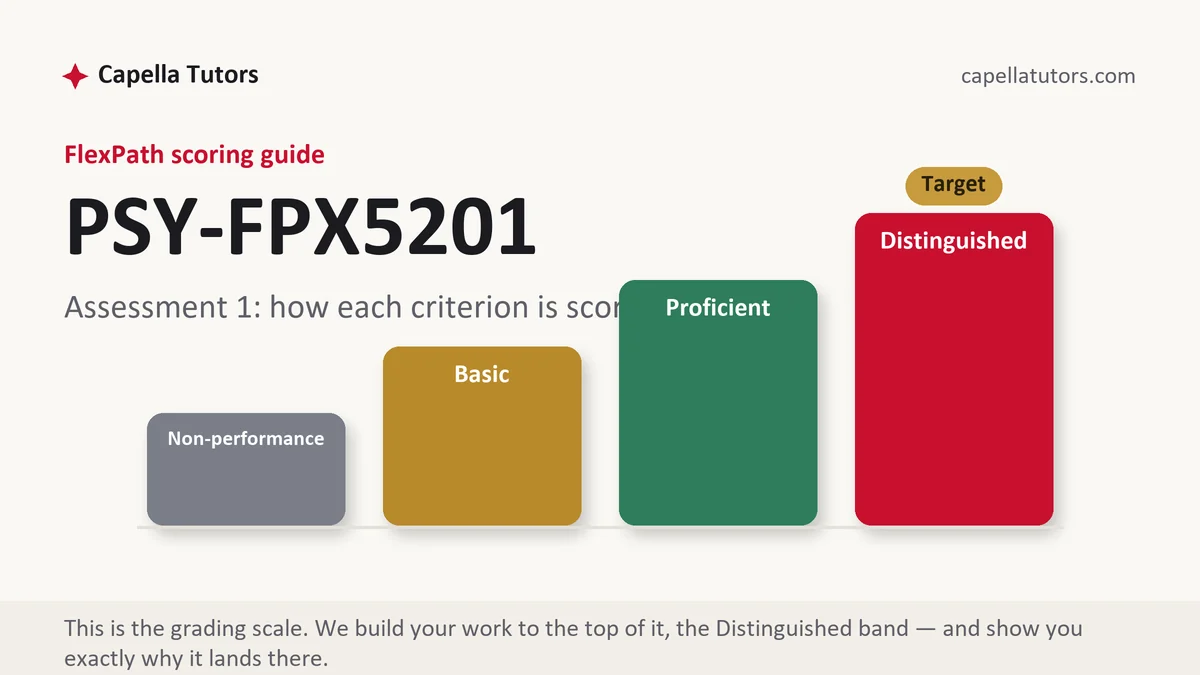
How PSY-FPX5201 Assessment 1 is scored
There are no letter grades in FlexPath. Each criterion on the scoring guide lands on one of four levels, and the level language is the writing brief:
| Level | What it means on a capstone problem statement |
|---|---|
| Distinguished | The problem is argued from evidence, the question carries a population, a construct, an outcome and a boundary, and the constructs are defined by the measures that stand in for them. A reader could build your search from the page. |
| Proficient | A clear problem and a defensible question with constructs defined. Correct, and still a level of precision short of searchable. |
| Basic | A topic announced rather than a question asked, with significance asserted through adjectives instead of evidence. The usual landing place for a first attempt. |
| Non-performance | A required element is absent, most often the operational definitions or the front matter the guide specifies. A criterion falls this far for what is absent rather than for what is underdone. |
The word integrative is the instruction for the whole course, and it starts working here. You are not being graded on discovering something. You are being graded on whether the question you set can be answered by literature that already exists, which is a different skill and a much less forgiving one.
The PSY-FPX5201 Assessment 1 method, step by step
-
Turn the criteria into the outline before you choose a topic
Each criterion becomes a heading with its top-level wording pasted underneath while you draft. Then read the verbs. Synthesize, integrate and evaluate describe work on published literature; collect, administer and recruit describe something else, and if your guide uses the second set, confirm the expectation with your faculty member in writing before you plan anything.
-
Build the question from four parts
A population, one construct, one outcome, and a boundary such as a setting, an age band or a timeframe. Write it as a single interrogative sentence. If the sentence needs an and to hold two outcomes together, you have two projects, and finishing one of them inside a session is the realistic ambition.
-
Test the size of the question by running the search
Before committing, run your terms in PsycINFO and see what comes back. Several thousand hits means the question is still a topic. Fewer than twenty relevant records after screening means you have found a dissertation that needs data you will not collect. Somewhere in between is a capstone, and the test takes an afternoon rather than a quarter.
-
Define constructs by their measures
A construct is only as clear as the instrument standing in for it, so name the instrument in the definition: a standardized parent-report inventory rather than language ability, a curriculum-based test score rather than achievement. Search terms then come out of the measure rather than out of the sentence of your question, which is what makes the search reproducible later.
-
Argue significance instead of asserting it
Replace every claim that the topic is important with a fact and a decision: who is currently choosing something without good evidence, and what changes if the literature answers you. Two prevalence figures with their sources and one description of the decision beat a paragraph of adjectives, and the criteria are written to notice the difference.
-
Set the scope you will not exceed, then self-score
Write down what the project excludes and why, because an unbounded capstone grows until the session ends. Confirm any front matter the guide requires, check current APA in both directions on the sources you already have, then mark each criterion yourself. Evaluation of an attempt can take two business days, so a Monday submission buys a week a Thursday one does not.
A structure that maps to the criteria
Word counts are planning targets our tutors use for a typical opening capstone deliverable, not Capella rules; expand wherever your scoring guide asks for more.
| Section | What it must do | Guide word target |
|---|---|---|
| Front matter | Title page, abstract or overview, and whatever else your guide names, formatted in current APA. | as specified |
| The problem | What is unresolved, for whom, with prevalence or practice evidence carrying the significance rather than adjectives. | ~350 words |
| The question | One interrogative sentence holding population, construct, outcome and boundary, with any sub-questions subordinate to it. | ~150 words |
| Constructs and definitions | Each construct defined operationally through the measures the literature actually uses, with synonyms noted for the search. | ~300 words |
| Scope and preliminary search | What is excluded and why, plus early evidence that a body of literature exists at this size. | ~250 words |
| Relevance and references | What the answer would change in your specialization, at the scope a non-licensure degree allows, plus current APA. | ~250 words |
Annotated sample excerpt
An original model excerpt from our team, showing the register that scores at the top of the guide. It is study material: learn the moves, then write your own version.
Published prevalence estimates for late talking in the second year vary with the cutoff an investigator chooses, and most children identified this way reach typical range without treatment, which is why the decision facing a pediatric practice is not whether late talking matters but whom to refer and when.1 This project asks whether, among children between 18 and 36 months identified as late talkers with no diagnosed hearing loss or global delay, parent-implemented language intervention is associated with larger expressive vocabulary gains than clinician-delivered sessions or monitored waiting.2 Expressive vocabulary is defined as the score on a standardized parent-report vocabulary inventory rather than as caregiver satisfaction or sessions attended, and the search terms in the next section are drawn from that measure rather than from the wording of the question.3
- 1Carries significance with a fact and a pending decision, and admits that the prevalence figure moves with the cutoff. A reader learns who is waiting on the answer in one sentence.
- 2Population, construct, outcome and boundary all present, with the exclusions inside the sentence and the verb held at association because the literature being integrated is mostly not randomized.
- 3Defines the construct by its instrument and says what it excludes, then ties the search to the measure. This is the sentence that makes the method section reproducible later.
The full premium sample for your exact assessment, written fresh to your scoring guide and issue, is free to request. Study it, revise it into your own voice, and submit work you understand.
The five mistakes that cost Distinguished
- A topic wearing a question mark. Anxiety in adolescents is a shelf of literature, not a question, and no amount of later writing will make a synthesis out of it.
- Significance by adjective. Widespread, growing and pressing are claims about a literature the reader cannot check, and each one costs credit that a cited figure would have earned.
- Constructs defined in the abstract. Self-regulation defined without naming a measure produces a search that returns everything and screens nothing.
- Two outcomes in one question. Achievement and motivation are separate literatures, and a capstone that promises both usually delivers half of each.
- A question chosen before any search was run. Learners who lose a capstone session almost always lose it here, by writing first and discovering the literature's shape afterward.
Pre-submission checklist
- Every scoring-guide criterion has its own clearly labeled section
- The question is one sentence holding a population, a construct, an outcome and a boundary
- Each construct is defined through the instrument that measures it, with search synonyms noted
- Significance rests on cited figures and a real decision rather than on adjectives
- A trial search has been run, and its rough yield is reported as evidence of scope
- Front matter formatted as the guide requires, current APA both ways, self-scored before submitting
Want this assessment done with backup?
Send the scoring guide, your specialization, and the question you have in mind. The first thing you get back is an honest read on whether that question is answerable at this size, then a premium original sample built to the top descriptor in 24 to 48 hours, revised until it lands there. Getting the question right here is the cheapest week you will spend on this capstone.