This manual is for PM FPX 4050 Assessment 3, start to submission. This is where most submissions in the course lose a criterion, because a report that lists figures has described a project and a report that says what the figures mean has managed one. The assessment usually asks you to produce a status report for a named audience, tailor the same facts for two more, set an escalation threshold before anybody is upset, and plan the communications that close a project properly. Your scoring guide decides whether that arrives as a sample report, a reporting and escalation section, a closure communication plan, or a briefing to a sponsor. The method below is the one we work to, with a criterion-keyed structure and an annotated sample excerpt. Prefer to hand it off? A premium original sample comes back in 24 to 48 hours with every figure recomputed, revised free until the criteria clear. Capella's catalog lists the course as PM-FPX4050, and some courserooms print PM4050; both point to this same Assessment 3.
One honesty note before the manual: Capella revises courses and scoring guides over time, so always write to the exact scoring guide attached to your assessment in the courseroom. The course identity above is verified on capella.edu; the method and structure below are our tutors' approach to it, not Capella's official rubric text.
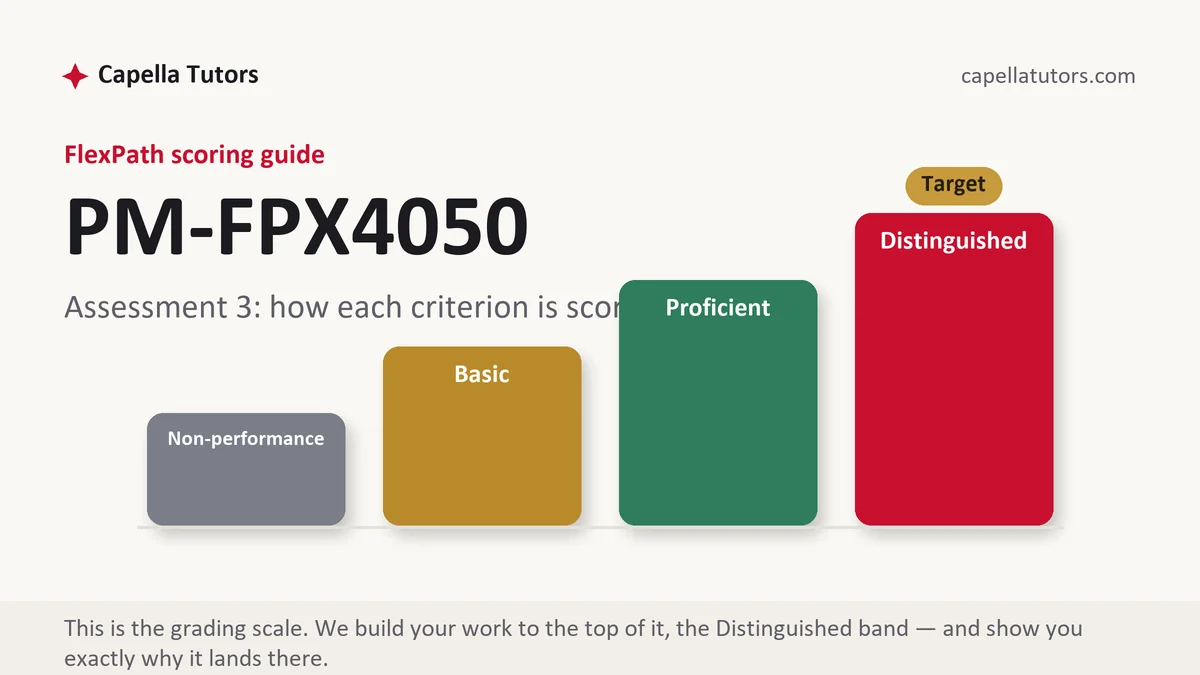
How PM FPX 4050 Assessment 3 is scored
Every criterion is graded on its own, and on a reporting deliverable the four levels separate on one sentence, the one that says what the number means:
| Level | What it means on a reporting and closure deliverable |
|---|---|
| Distinguished | Each figure is translated for the audience reading it, the decision required is named with a date it stops being useful, escalation carries a numeric threshold and an owner, and closure requests acceptance against the original success criteria. |
| Proficient | Accurate reports for the right audiences with correct figures and a clear layout. The reader is told the position and left to decide what follows from it. |
| Basic | A variance table with a paragraph of narrative around it, the same content sent to everybody, and escalation described as happening when appropriate. |
| Non-performance | A required element is absent, usually the escalation threshold or the closure communications, and a project that ends without them leaves acceptance unrequested. |
The test of a status report is whether a sponsor who reads only the first paragraph would still act correctly. Open with the position in a sentence, put the request in the second paragraph, and let the tables sit underneath for the reader who wants them.
The PM FPX 4050 Assessment 3 method, step by step
-
Compute the position before writing a word of it
Take the plan value, the value of the work actually finished and the amount spent, then produce the variances and the two indices. Reporting begins after the arithmetic, since a well-written paragraph resting on a wrong index is worse than a table, and the criteria in this course check both.
-
Translate the same arithmetic three times
The sponsor needs the forecast and the decision. The store managers need the date their store is affected. The install crew needs which two packages are dragging and what changes next week. Same numbers, three registers, and the criterion asking you to tailor communication to an audience is asking for exactly that.
-
Put the request in the report
A report with no question in it has handed the reader homework. Phrase the decision as options with a date by which the answer stops being useful, since a sponsor who has to work out what you want will decide later than you needed them to.
-
Set the escalation threshold in numbers, in advance
A variance beyond a stated percentage, a decision unanswered for a named number of days, or a risk crossing a defined exposure goes to a named person inside a named time. Written before anybody is upset, that rule is governance. Written afterwards it is an argument.
-
Plan closure as communications, not as a thank you
Formal acceptance requested against the success criteria the project started with, the receiving department told in writing what it now owns and who supports it, the supplier notified that the contract is complete, and a lessons record written as instructions somebody could follow. Name who sends each and on what date.
-
Read each report as its audience, then submit
Take the sponsor version and read it as somebody with four minutes, then the store manager version as somebody who only wants a date. Anything that survives in both was probably written for neither. Then self-score against the descriptors and submit with room for a second attempt.
A structure that maps to the criteria
Ranges our tutors use for a reporting deliverable with escalation and closure sections; if the guide asks for a single sample report, the tailoring section absorbs the difference.
| Section | What it must do | Guide |
|---|---|---|
| The report set | Which reports exist, who receives each, and the cadence each one runs on. | ~200 words |
| Position and measures | The figures at the reporting date, the variances, the indices, and the forecast they produce. | ~250 words |
| Tailored versions | The same position written for three audiences, each carrying only what that audience acts on. | ~350 words |
| Decisions requested | The options put to the decision maker and the date each one expires. | ~200 words |
| Escalation | The thresholds as numbers, the named recipient, the time limit, and who monitors the trigger. | ~200 words |
| Closure communications and references | Acceptance request, handover notice, supplier notification, lessons record, current APA both ways. | ~250 words |
Annotated sample excerpt
One position translated twice, from an original model our team wrote, printed as the two paragraphs would actually be sent.
For the operations director: the retrofit carries a budget at completion of 420,000 dollars over 26 weeks; at week 14 the plan called for 210,000 of work finished, the finished work is valued at 189,000, and 220,500 has been spent, which is a cost index of 0.86 and a schedule index of 0.90.1 Every dollar leaving the account is buying 86 cents of installed lane, so the forecast at completion is 490,000 and the decision this month is whether to fund the 70,000 gap or hold the final six stores until the next capital cycle; an answer after the twentieth stops being useful because the installer's crew booking lapses.2 For the store managers, the same position reads differently: your lane cutover moves from the ninth of June to the twenty third, staffing for the changeover week is unchanged, and the two self-service units already installed stay live throughout.3
- 1Three inputs, both indices, one audience. The arithmetic is visible and the paragraph is still short enough to be read in a lift.
- 2The index translated into plain language, the forecast stated, the decision framed as two options, and an expiry date with a reason behind it.
- 3The same facts rewritten for people who act on a date rather than on a forecast. Nothing from the first paragraph is repeated, which is what tailoring actually looks like.
The full premium sample for your exact assessment, written fresh to your scoring guide and issue, is free to request. Study it, revise it into your own voice, and submit work you understand.
The five mistakes that cost Distinguished
- Numbers reported with no interpretation. Figures presented without a line of meaning hand the management thinking to whoever opens the report.
- A report with no request in it. A sponsor who is told the position and asked for nothing will supply nothing, and the decision arrives later than the project needed.
- Escalation with no threshold. Saying issues will be escalated as appropriate leaves the reader unable to tell when, to whom or how fast.
- One version sent to everybody. Detail the executive will not read and summaries the crew cannot act on fail the tailoring criterion in both directions.
- Closure treated as an announcement. Acceptance has to be requested against the original success criteria, and a project that ends without it leaves warranties, ownership and lessons all unresolved.
Pre-submission checklist
- Both indices computed before any narrative is written
- The same position written for three audiences, each carrying only what that audience acts on
- A named decision with options and a date it stops being useful
- Escalation thresholds stated as numbers with a recipient and a time limit
- Closure communications listed with a sender and a date for each
- Every figure traced to its source, each version read as its audience, submitted early in the week
Status report or closure plan due?
Send whatever figures the scenario supplies and the criteria. We compute the position, write it three ways, set the thresholds as numbers and return a premium original sample inside 24 to 48 hours.