This manual is for PM FPX 4050 Assessment 2, start to submission. Analysis is graded on whether the classification produced an action, and the communication plan is graded as an operating document. The assessment usually asks you to position each party by the power they hold and the interest they take, name the gap between how they behave now and how the project needs them to behave, and then build a plan whose every row carries an audience, the information that audience needs, a format, a frequency, a channel and an owner. Your scoring guide decides whether that arrives as an analysis with a grid, a communication management plan, or both inside a briefing. What follows is how our tutors approach it, plus a structure built from the criteria and a marked-up sample. Prefer to hand it off? A premium original sample turns around in 24 to 48 hours, and free revision runs until every criterion is satisfied. Capella's catalog lists the course as PM-FPX4050, and some courserooms print PM4050; both point to this same Assessment 2.
One honesty note before the manual: Capella revises courses and scoring guides over time, so always write to the exact scoring guide attached to your assessment in the courseroom. The course identity above is verified on capella.edu; the method and structure below are our tutors' approach to it, not Capella's official rubric text.
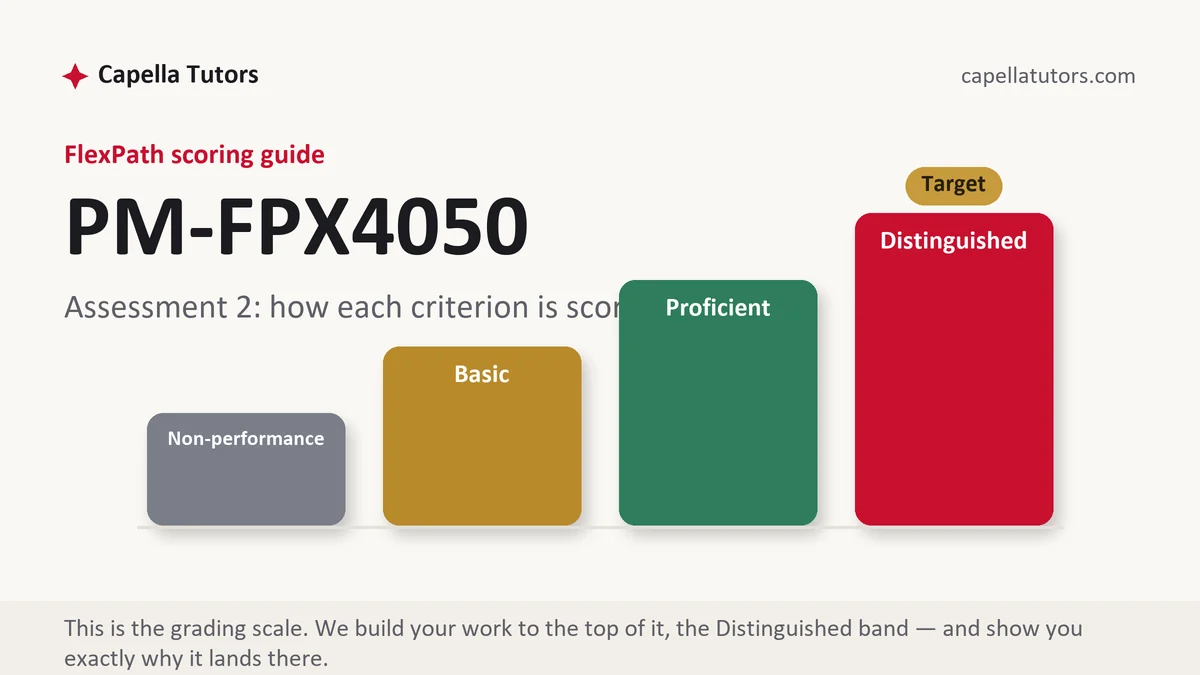
How PM FPX 4050 Assessment 2 is scored
Each criterion sits on one of four levels, and on a planning deliverable the four turn on whether an assistant could run the plan:
| Level | What it means on an engagement and communication plan |
|---|---|
| Distinguished | Every classification produces a named action with a date, the cadence follows from when each audience decides something, and every row carries an owner and a stated method of push, pull or conversation. |
| Proficient | The grid is correct and the plan is complete. Frequencies are set by the calendar, and the treatment for each quadrant is described in general terms. |
| Basic | A grid with names in four boxes and a table of meetings, where the frequency column is filled in and the owner column is not. |
| Non-performance | A required element is absent, most often the owners or the engagement gap, and a plan whose rows belong to nobody cannot be operated at all. |
Volume is part of the design and it grows faster than the team. Eight people carry twenty eight possible pairs of conversations, since the count is the number of people times one fewer over two, and adding a contractor lead and three township representatives takes twelve people to sixty six. That growth is why the plan is a graded artifact rather than a courtesy.
The PM FPX 4050 Assessment 2 method, step by step
-
Position by power and interest, then justify the placement
Power is usually structural, so ask who can stop the work, who can move money and who signs acceptance. Interest follows from what changes for them. Quadrant placement is a judgment rather than a result, so defend each one in a clause and the criterion stops being about the diagram.
-
Turn each position into a treatment
High power with high interest needs a short standing meeting where decisions get made rather than a document. High power with low interest needs a monthly page and an immediate call if a threshold is crossed. Low power with high interest needs proper information, because that is usually where accurate knowledge about the work actually lives.
-
Name the engagement gap and the move that closes it
Write how the party behaves now and how the project needs them to behave, then name the specific move. A township supervisor blocking the trench route usually knows something about the route, so putting two of them on the design group turns resistance into requirements, which is a defensible position rather than a nice sentiment.
-
Build the cadence around decisions, not around days
Ask what decision each audience makes, how often, and how long beforehand they need the information. A sponsor approving spending monthly needs the forecast three working days before the meeting. A daily message to somebody who acts quarterly trains that person to stop reading, which is the failure nobody writes into a plan and everybody experiences.
-
Give every row an owner and a method
A weekly report belonging to nobody is produced twice and then stops. Name the person, and mark whether the item is pushed out, made available to be pulled, or has to happen in a conversation because it needs a response. Those three are different instruments and the criterion usually expects the distinction.
-
Read the plan as though you had to run it, then submit
Hand the table to somebody who was not in the project and see whether they could execute a week of it without asking a question. Every question they ask is a missing column. Then grade yourself against each descriptor and submit while a second attempt still fits the session.
A structure that maps to the criteria
Ranges our tutors use for an analysis with a full communication plan; where the guide asks for one audience only, the tailoring section takes the words the grid would have used.
| Section | What it must do | Guide |
|---|---|---|
| Communication context | The setting the messages travel through: distance, shift patterns, literacy, a regulator in the chain. | ~200 words |
| Classification | Power and interest positions with a defence of each placement, and the treatment each position implies. | ~300 words |
| Engagement gaps | Current behavior against required behavior for each significant party, with the closing move and a date. | ~300 words |
| Communication plan | Audience, information needed, format, frequency, channel, owner, and push, pull or interactive. | ~350 words |
| Volume and load | The channel count as the team grows and what the plan does to keep it manageable. | ~150 words |
| Assumptions and references | Frameworks credited to their authors, uncertain placements flagged, current APA both ways. | as needed |
Annotated sample excerpt
Two plan rows and an engagement gap from an original model our team wrote, printed the way the artifact should read.
Audience: the three township road supervisors. Information needed: the trench route and the week each road closes, not the project's overall progress. Format: a one-page map with dates. Frequency: fortnightly, issued nine working days before any closure. Channel: the existing roads coordination call. Owner: the site lead. Method: interactive, because a closure date needs an answer rather than an acknowledgement.1 Audience: the county broadband board. Information needed: spend against approval and the forecast completion quarter. Format: a half page with the two figures and one decision. Frequency: monthly, three working days before their meeting. Channel: the board pack. Owner: the project manager. Method: push.2 Engagement gap, west township supervisor: currently refusing the Miller Road alignment, needs to be a route reviewer rather than an objector, closed by seating him on the design group from the fourth of March, where his knowledge of the culvert depth arrives as a requirement instead of a complaint.3
- 1Seven fields in one row, including the information the audience needs rather than what the project happens to have. The method is chosen because the item needs an answer.
- 2A second row with a different audience, a different cadence and a different instrument, which is the tailoring the criterion is written to test.
- 3A gap written as current behavior, required behavior, the move, and a date. The reasoning treats the objection as information, which is the defensible reading.
The full premium sample for your exact assessment, written fresh to your scoring guide and issue, is free to request. Study it, revise it into your own voice, and submit work you understand.
The five mistakes that cost Distinguished
- A grid with no consequences. Positioning stakeholders in four boxes earns nothing until each position implies a treatment somebody could carry out.
- Frequencies with no owners. A fortnightly map with no name against it goes out twice and then stops, and this criterion exists to notice.
- One message reused for every audience. Sending the team's detail to the board and the board's summary to the team fails the tailoring criterion twice on one page.
- A cadence set by the calendar. Weekly because weeks exist, rather than because somebody decides something weekly, produces messages nobody reads by the second month.
- Resistance treated as an obstacle. The person refusing the route often knows something about the route, and a plan that never uses that has thrown information away.
Pre-submission checklist
- Every quadrant placement defended in a clause rather than asserted
- A treatment named for each position, specific enough to be carried out
- Current behavior against required behavior for every significant party, with a dated move
- Every plan row carrying audience, information needed, format, frequency, channel and owner
- Push, pull and interactive methods distinguished and chosen for a reason
- The plan tested by a reader who could run a week of it unaided, self-scored, submitted early in the week
Engagement grid or communication plan due?
Send the scenario, the register and the criteria. We defend every placement, turn each into a dated action, and hand back a premium original sample inside 24 to 48 hours with a plan somebody could actually run.