This manual is for PM FPX 4050 Assessment 1, start to submission. Identification is graded on categories rather than on length, and the sponsor, the team and the customer are the easy three. The assessment usually asks you to build a register that finds the parties further out, record what each one controls and wants, and say how each will be contacted, early enough that the plan can still do something about them. Your scoring guide decides whether that arrives as a register, a register with a short analysis, or an identification memo written for a sponsor. Below: how we do it, the structure that results, and a sample excerpt annotated where it matters. Prefer to hand it off? A premium original sample reaches you inside 24 to 48 hours, and revisions cost nothing until the criteria are cleared. Capella's catalog lists the course as PM-FPX4050, and some courserooms print PM4050; both point to this same Assessment 1.
One honesty note before the manual: Capella revises courses and scoring guides over time, so always write to the exact scoring guide attached to your assessment in the courseroom. The course identity above is verified on capella.edu; the method and structure below are our tutors' approach to it, not Capella's official rubric text.
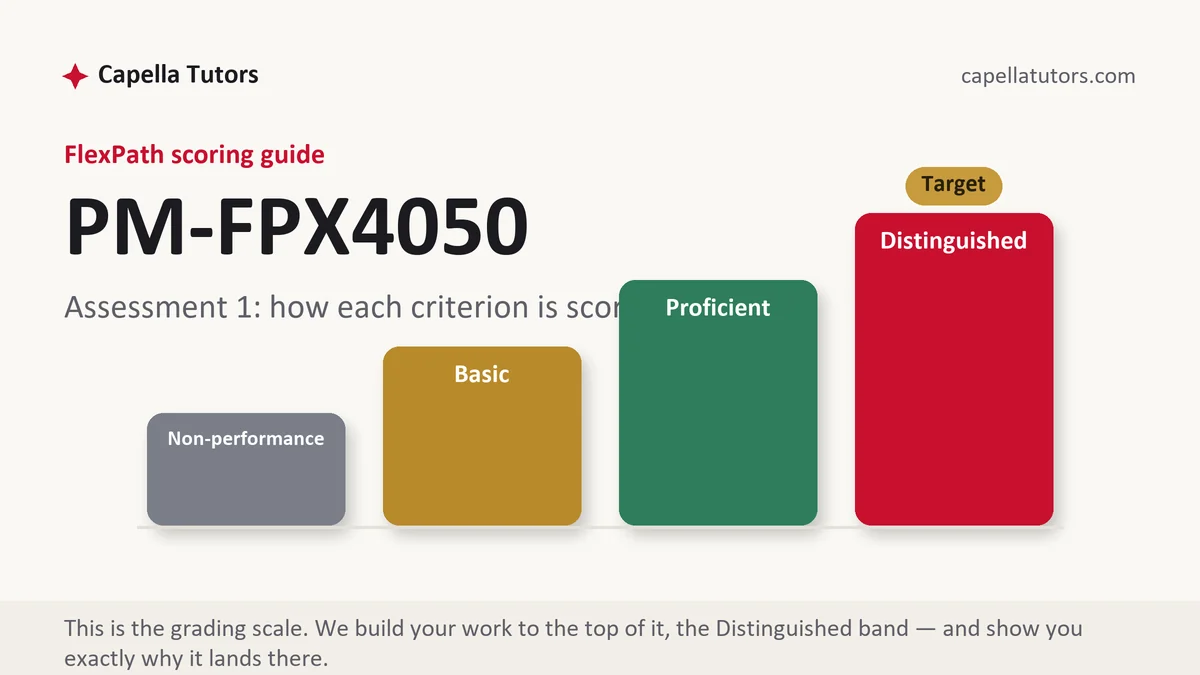
How PM FPX 4050 Assessment 1 is scored
Criteria are graded individually, and on an identification deliverable the four levels turn on who was found:
| Level | What it means on a stakeholder register |
|---|---|
| Distinguished | The non-obvious parties are found, including the ones who lose something if the project succeeds, each entry records what that person controls and wants, and the register says when a position is expected to move. |
| Proficient | A complete and accurate register covering everybody with a formal role. Influence and interest are recorded, and nobody in it was difficult to think of. |
| Basic | A contact list. Names, titles and email addresses with nothing said about what any of them controls or needs from the project. |
| Non-performance | A required field is absent, most often influence or the contact route, and a register with no influence column cannot support the analysis criterion that follows it. |
One category is missing from most registers and it is the expensive one. Somebody usually loses budget, headcount or discretion when a project succeeds, and that person is more consequential than half the people already on your list, so write them down and write down what they lose.
The PM FPX 4050 Assessment 1 method, step by step
-
Work outward from the deliverable, not from the chart
Ask who is different afterwards. A timetable overhaul touches drivers whose shifts move, depot supervisors who build the rotas, the school transport officer whose contract assumes the current stops, and passengers who have no formal standing and considerable voice. The chart shows none of those four.
-
Find the four kinds of party a chart never lists
The functional manager whose staff you are borrowing, the department that has to work differently once you deliver, the reviewer who can stop a release, and the person with no formal role whose opinion everybody checks. Each of them decides something, and criteria in this course reward finding them.
-
Record what each one controls, in specific terms
Not influence high, but can withhold the depot rota, can refuse the stop relocation permit, can approve the fare table. A register saying what somebody controls tells a reader why they matter, and it is the field the later engagement planning is built on.
-
Write what each one wants, from their side of the desk
The information the audience needs rather than the information you have. A driver wants to know whether the shift pattern changes and when they find out; a supervisor wants enough notice to build a rota. Those are different wants and they produce different messages.
-
Note the positions you expect to move
A register drawn once at initiation and never revisited misleads by the third month, and positions move fastest where the project touches money or headcount. Write the trigger: the safety reviewer is peripheral until a stop moves onto a bus lane, at which point they are not.
-
Test the register against the deliverables, then submit
Take each deliverable and ask who has to accept it, who has to change because of it, and who could stop it, then check all three appear in the register. Anything missing is the entry that surprises you in month four. Then self-score and submit with room for a second attempt.
A structure that maps to the criteria
Ranges our tutors use for a register with a short identification analysis; where your guide asks for a full plan, this section shrinks and the planning sections grow.
| Section | What it must do | Guide |
|---|---|---|
| Project and disturbance | What the project delivers and whose work is different once it lands, stated before any names appear. | ~200 words |
| Identification method | How the register was built, which documents and conversations it drew on, and what could still be missing. | ~200 words |
| The register | Every party with role, what they control, what they want, their attitude now, and the contact route. | ~400 words |
| The parties nobody lists | The borrowed-staff manager, the receiving department, the reviewer with a veto, and whoever loses something. | ~250 words |
| Expected movement | Positions you expect to change, the event that would change them, and when you would revisit the register. | ~200 words |
| Assumptions and references | Judgments you are least sure of, frameworks credited to their authors, current APA both ways. | as needed |
Annotated sample excerpt
Three register entries from an original model our team wrote, printed as rows rather than as narrative.
Depot rota supervisor, east garage: controls the shift pattern the new timetable has to fit, wants six weeks of notice before any duty board changes, currently cooperative but sceptical of the running times, contacted by a standing Tuesday call rather than by email.1 School transport officer: controls a contract that names the current stop list, wants confirmation that the two stops serving the academy survive the redesign, currently unaware the project exists, and that last fact is the finding rather than the entry.2 Community rail partnership chair: holds no formal power over this project, is quoted in the local paper whenever the network changes, and is expected to move from peripheral to central the week the consultation drawings are published, which is the point at which a briefing rather than a bulletin is required.3
- 1What the person controls stated as a specific power, then a want expressed in their terms and a contact route chosen to suit them rather than to suit the project.
- 2An entry whose value is the attitude column. Somebody with a contractual interest who has not been told is a problem you have just prevented.
- 3A position with a predicted movement and a named trigger, plus what the treatment becomes afterwards. This is the entry that separates a register from a list.
The full premium sample for your exact assessment, written fresh to your scoring guide and issue, is free to request. Study it, revise it into your own voice, and submit work you understand.
The five mistakes that cost Distinguished
- A register that is a contact list. Names, titles and addresses with no influence, want or attitude recorded have not analyzed anybody.
- Influence recorded as high, medium or low with nothing behind it. A criterion asking what a stakeholder controls wants the specific power, since that is what the engagement plan will act on.
- Only the parties with formal roles. The reviewer with a veto and the department that has to work differently are usually absent from the chart and central to the outcome.
- Nobody who loses anything. A project that disadvantages no one is a project nobody will resist, and the register has almost certainly missed somebody.
- A register with no review point. Positions move when money or headcount is touched, so a snapshot with no revisit date is misleading by the third month.
Pre-submission checklist
- Every deliverable checked for who accepts it, who changes and who could stop it
- What each party controls written as a specific power rather than a rating
- What each party wants written from their side rather than from yours
- The borrowed-staff manager, receiving department, reviewer and loser all present
- Expected movements noted with the event that would trigger them
- The judgment you are least confident about named, self-scored, submitted early in the week
Stakeholder register due and the obvious names run out?
Send the scenario, an organization chart if you have one and the criteria. We find the parties nobody lists, record what each controls, and return a premium original sample inside 24 to 48 hours.