This manual is for PM FPX 4040 Assessment 3, start to submission. This is the deliverable where the writing gets loose and the marks go missing. The assessment usually asks you to say how you would develop a specific team, apply a motivation theory to behavior you can actually point at, set out how you would handle disagreement, and describe a documented route for somebody who is underperforming. Your scoring guide decides whether that arrives as a team management plan, a conflict case analysis, a motivation section inside a resource plan, or a briefing for a functional manager. The method below is how our team works, followed by a criterion-keyed structure and an annotated excerpt. Prefer to hand it off? A premium original sample is back with you in 24 to 48 hours, with unlimited free revision behind it. Capella's catalog lists the course as PM-FPX4040, and some courserooms print PM4040; both point to this same Assessment 3.
One honesty note before the manual: Capella revises courses and scoring guides over time, so always write to the exact scoring guide attached to your assessment in the courseroom. The course identity above is verified on capella.edu; the method and structure below are our tutors' approach to it, not Capella's official rubric text.
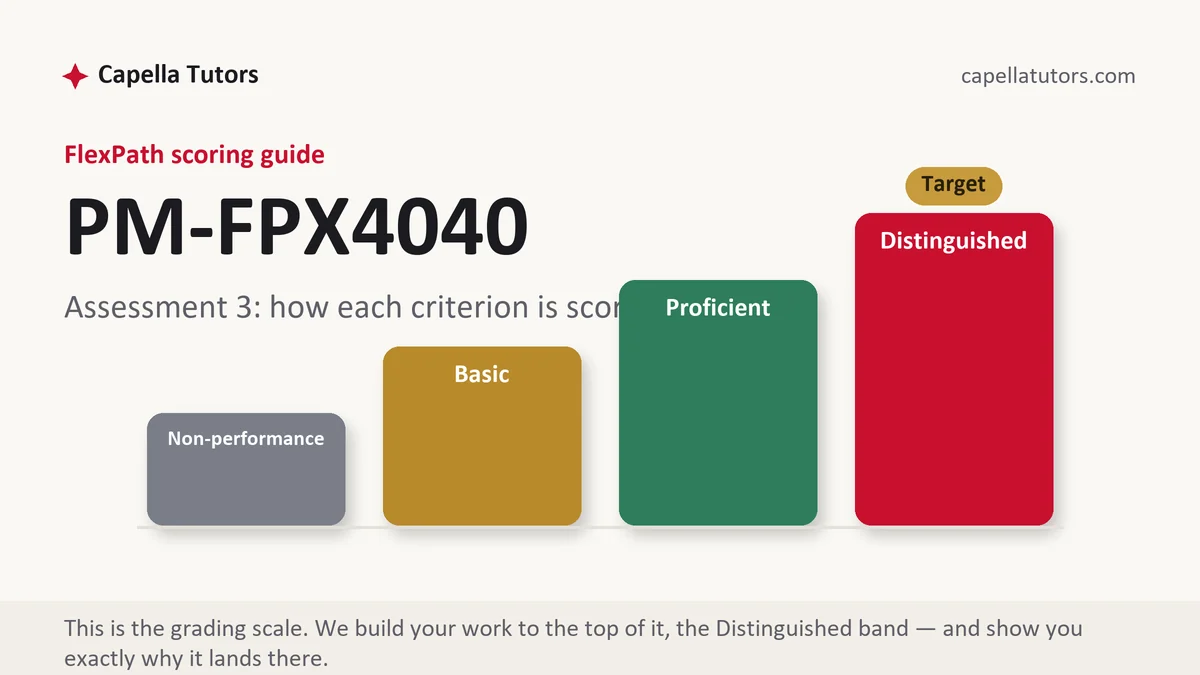
How PM FPX 4040 Assessment 3 is scored
Each criterion is graded against four descriptors on its own, and on a people deliverable the four separate on specificity:
| Level | What it means on a motivation and conflict deliverable |
|---|---|
| Distinguished | A mechanism is traced through this team's actual behavior, the measure that would show it worked is named, task conflict is separated from personal conflict, and the underperformance route is documented with dates rather than intentions. |
| Proficient | The theories are applied correctly and the approaches are sound. The application describes a team in general and nothing states how you would know any of it had worked. |
| Basic | A paragraph summarizing each of several models with a sentence of scenario attached, which is a literature review wearing a plan's headings. |
| Non-performance | A required element is absent, usually the performance route or the escalation path, and a conflict section with no route upward leaves that criterion unanswered. |
Naming a theory is not the same as putting one to work. What earns the top column is a mechanism running through your own scenario: this person is doing careful work nobody sees, so recognition addresses the gap where another bonus does not, and here is what I expect to change and how I would know.
The PM FPX 4040 Assessment 3 method, step by step
-
Describe the team before describing any theory
Write down who is on it, who they report to, what each of them is good at, and what each of them is currently doing that you can observe. Every later section refers back to these facts, and a section with no facts behind it can only be general.
-
Use the stage model as description, not prediction
The recognized stages of team development are a useful way to organize an account and a poor way to forecast a date. Say what you would do in each: structure and clarity early, active mediation once the disagreements start, and stepping back once the team is working without you.
-
Pick one theory that fits and say why it fits
One theory applied carefully beats five summarized. Choose the one that explains the behavior in front of you, name the competing explanation for the same behavior, and say what would tell the two apart. Faculty in this field read that as judgment rather than as hedging.
-
Name the measure that would show it worked
Recognition, autonomy or a redesigned task are interventions, and an intervention with no observable consequence is a hope. Say what you expect to change, in what period, and what you would look at: voluntary contributions to the design review, missed handovers, a survey question, a resignation that does not happen.
-
Separate the disagreement about the work from the one about people
Argument about how the gallery should be laid out is often productive and a plan that suppresses all of it has removed the argument the project needed. Argument about a colleague is not. Give each its own handling, name your default approach, say when you would abandon it, and write the escalation route for two people who do not report to you.
-
Document the performance route, then submit
Underperformance needs a conversation with a date, a written expectation, a review point and a consequence, not a paragraph of concern. Write it as a sequence somebody could follow. Then self-score against the descriptors and submit early enough for a second attempt inside the session.
A structure that maps to the criteria
Ranges our tutors use for a team deliverable carrying motivation and conflict sections; where the guide supplies a conflict case, that analysis takes the words the development section would have had.
| Section | What it must do | Guide |
|---|---|---|
| The team as it is | Who is on it, where they report, what each is good at, and what each is observably doing now. | ~250 words |
| Development approach | The stages used as description, with what you would do differently in each one. | ~250 words |
| Motivation analysis | One theory applied to named behavior, the competing explanation, and the mechanism you would use. | ~300 words |
| Evidence of effect | What you expect to change, over what period, and the observation that would confirm it. | ~200 words |
| Conflict handling | Task conflict against personal conflict, your default approach, and the escalation route. | ~250 words |
| Performance route and references | The documented sequence for underperformance, plus current APA in both directions. | ~200 words |
Annotated sample excerpt
A motivation paragraph from an original model our team wrote, showing the register the top column is describing.
The conservator has stopped volunteering options in the design meetings since the label copy she drafted was rewritten by the marketing lead without a conversation, and she now answers questions rather than raising them.1 That pattern fits the account of autonomy and competence better than it fits a reward explanation, since her pay and her hours are unchanged and what moved was her control over work she is the most qualified person in the room to judge; a bonus would address neither, while restoring her sign-off on conservation wording and asking her to present that section herself addresses both.2 The observation that would confirm it is the number of options she puts into the next three design reviews without being asked, currently zero, and the competing explanation worth ruling out is simple workload, which the loading grid can settle in a morning.3
- 1Behavior described before any theory is named, and described in terms somebody could have witnessed rather than inferred.
- 2The mechanism traced through this person's situation, with the wrong intervention named and dismissed on the evidence rather than ignored.
- 3A measure with a current value and a window, plus the rival explanation and how to test it. Three moves the Basic version of this paragraph never makes.
The full premium sample for your exact assessment, written fresh to your scoring guide and issue, is free to request. Study it, revise it into your own voice, and submit work you understand.
The five mistakes that cost Distinguished
- Theory named but not applied. A paragraph summarizing a model earns nothing without the behavior in your scenario it is supposed to explain.
- Five theories at a paragraph each. A survey of the literature is not an analysis of a team, and the criterion is asking what you would do about these people.
- An intervention with no measure. Recognition proposed with nothing said about what would change afterwards cannot be judged by you or by an evaluator.
- Conflict treated as a personality problem. Argument about the exhibit itself is frequently useful, and a plan that quiets all of it has silenced the debate the work depended on.
- Underperformance answered with concern. The criterion wants a sequence with dates, a written expectation and a review point, which is a process rather than a feeling.
Pre-submission checklist
- The team described in observable facts before any theory appears
- Development stages used as description, with a different action named in each
- One motivation theory applied to specific behavior, with a competing explanation named
- An observable measure with a current value and a period for the change
- Task conflict separated from personal conflict, with an escalation route for peers
- A documented performance route with dates, self-scored against the descriptors, submitted early in the week
Team plan or conflict case due?
Send the criteria, the team and whatever behavior the scenario describes. We trace one mechanism through your people, name the measure that would prove it, and return a premium original sample inside 24 to 48 hours.