This manual is for PM FPX 4040 Assessment 2, start to submission. This deliverable connects people to dates, and it is graded on whether the overload you found was fixed. The assessment usually asks you to total each person's hours period by period, find where somebody is booked past capacity, remove the overload inside available float before asking for anybody new, and set out a matrix showing who performs each deliverable, who answers for it, who is consulted and who is told. Your scoring guide decides whether that arrives as a loading table with commentary, a leveled schedule, a responsibility matrix, or a briefing for a functional manager. What follows is our working method, a structure keyed to your criteria, and a marked-up sample excerpt. Prefer to hand it off? A premium original sample returns in 24 to 48 hours with the loading recomputed independently, revised free until the criteria are met. Capella's catalog lists the course as PM-FPX4040, and some courserooms print PM4040; both point to this same Assessment 2.
One honesty note before the manual: Capella revises courses and scoring guides over time, so always write to the exact scoring guide attached to your assessment in the courseroom. The course identity above is verified on capella.edu; the method and structure below are our tutors' approach to it, not Capella's official rubric text.
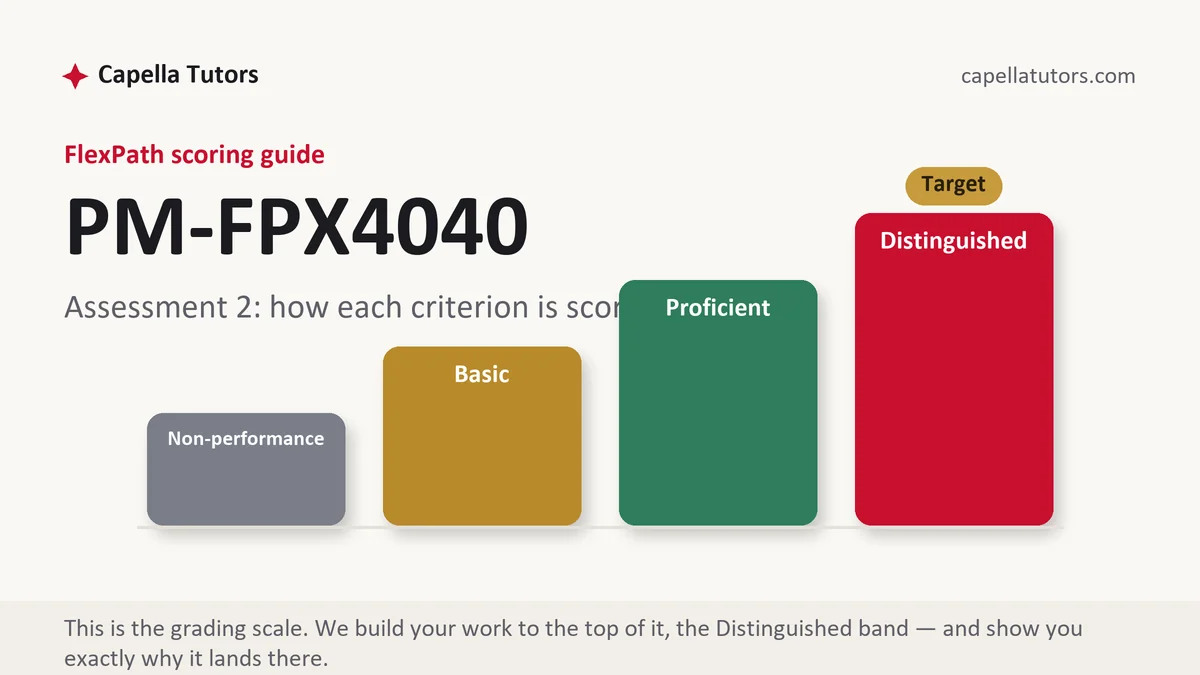
How PM FPX 4040 Assessment 2 is scored
Every criterion carries its own level, and on a loading deliverable the four turn on what happened after the overload was found:
| Level | What it means on a loading and accountability deliverable |
|---|---|
| Distinguished | Hours are totalled per person per period against a stated capacity, the overload is removed inside available float first, the cost is named where float runs out, and every matrix row carries exactly one accountable name. |
| Proficient | The loading is correct and the overloads are identified. An adjustment is proposed in general terms and the schedule is not shown after it. |
| Basic | A staffing list with percentages beside it, no period totals, and a matrix where two or three names share the accountable column on the same row. |
| Non-performance | A required element is absent, usually the period totals or the capacity they are measured against, which leaves the leveling criterion with nothing to grade. |
Leveling inside float is the move that separates the top two columns, because it costs nothing. Check the slack on every overloaded activity before you ask for another person, since moving work that carries slack fixes the week without touching the finish date, and asking for a body fixes it by spending money you did not need to spend.
The PM FPX 4040 Assessment 2 method, step by step
-
State the capacity you are measuring against
Write the productive hours per person per week and where the figure came from, because an overload only exists relative to a stated capacity. A team measured against 40 hours and a team measured against 37 and a half produce different findings from the same schedule, and the criterion wants to know which you used.
-
Total the hours by person and by period
Build the grid: people down the side, weeks across the top, hours in the cells. This is the artifact the criterion is written about, and no amount of narrative substitutes for it, since an overload is a number in a cell rather than an impression about somebody being busy.
-
Find the overload and check the float before reacting
Suppose the imaging analyst appears on three activities in week 12, needing 19, 16 and 13 hours against a capacity of 37 and a half. That is 48 hours, an overload of ten and a half that will be paid for in overtime, in slipped work or in mistakes, and the first question is not who else could help.
-
Level inside the float and show the result
If the 13-hour activity carries four weeks of slack, moving it out three weeks brings week 12 down to 35 hours and lifts week 15 from 21 to 34, both inside capacity, and the finish date does not move at all. Print the grid before and after, because the demonstration is the answer.
-
Price the alternatives where no float exists
When the overload sits on the critical path, name the options and cost them: overtime at a stated premium, a second person with the coordination time that follows, or a date change. An overload with no solution named is a problem you have documented rather than a resource plan.
-
Test the matrix by column as well as by row, then submit
Every row needs exactly one accountable name, since two means nobody and none means the work will not happen. Then read the columns, because a role consulted on everything is a bottleneck you designed and a role with nothing but informed marks probably does not belong on the chart. Self-score, then submit with room for a second attempt.
A structure that maps to the criteria
Ranges our tutors use for a loading deliverable with a matrix behind it; where the guide asks only for the matrix, the accountability discussion grows and the grids shrink.
| Section | What it must do | Guide |
|---|---|---|
| Capacity basis | Productive hours per person per period, where the figure came from, and any part-time assignments. | ~200 words |
| Loading grid | Hours by person and by period, totalled, with each cell traceable to an activity. | ~300 words |
| Overloads identified | Where capacity is exceeded, by how much, and what the consequence would be if nothing changed. | ~200 words |
| Leveling inside float | The activities moved, the slack that permitted it, and the grid after the adjustment. | ~300 words |
| Where float runs out | The costed alternatives, the recommendation, and what it does to the finish date. | ~200 words |
| Responsibility matrix and references | Deliverables against roles with one accountable name per row, columns checked, current APA both ways. | ~250 words |
Annotated sample excerpt
A leveling paragraph from an original model our team wrote, printed the way this section should read: the overload, the slack, the result.
Against a stated capacity of 37 and a half productive hours, the imaging analyst is booked in week 12 for 19 hours on the intake mapping, 16 on the exception rules and 13 on the reporting extract, which totals 48 and leaves her ten and a half hours over.1 The reporting extract carries four weeks of total float, so moving it out three weeks brings week 12 down to 35 hours and lifts week 15 from 21 to 34, both inside capacity, and the go-live date does not move because the slack absorbed the whole adjustment.2 Had the extract sat on the critical path the options would have been overtime at a 1.5 premium for ten and a half hours, a second analyst who costs a week of handover before contributing anything, or a five-day slip, and the recommendation would have named which of the three the sponsor is being asked to buy.3
- 1Capacity stated first, then the three demands, then the arithmetic. The overload is a figure rather than an impression.
- 2Leveling performed inside available float with both weeks shown afterwards, and the finish date explicitly unaffected. This is the paragraph the resource criterion is written for.
- 3The counterfactual priced. Naming what the fix would have cost without float proves the free solution was chosen rather than stumbled upon.
The full premium sample for your exact assessment, written fresh to your scoring guide and issue, is free to request. Study it, revise it into your own voice, and submit work you understand.
The five mistakes that cost Distinguished
- Overloads reported with no adjustment. Showing that somebody is booked past capacity is half the answer, and leveling within float is the other half.
- No stated capacity. An overload only exists against a figure, so a grid with no capacity line has not demonstrated anything.
- A new person requested before the float was checked. Asking for a body to fix a week that slack would have fixed spends money the plan did not need to spend.
- Two accountable names on one row. Shared accountability is the same thing as none, and matrix criteria are usually scored on exactly this.
- Columns never read. A role consulted on every deliverable is a bottleneck you built, and the criterion expects you to have noticed it.
Pre-submission checklist
- Productive capacity per person per period stated with its source
- A loading grid with hours by person and period, every cell traceable to an activity
- Overloads quantified, with the consequence of leaving them named
- Leveling done inside available float, with the grid shown before and after
- Costed alternatives where float runs out, and a recommendation
- One accountable name per matrix row, columns checked for bottlenecks, submitted early in the week
Loading grid or responsibility matrix due?
Send the activities, the availability figures and the criteria. We total the hours by period, level inside the float, price the alternatives where there is none, and hand back a premium original sample inside 24 to 48 hours.