This manual is for PM FPX 4040 Assessment 1, start to submission. People are the resource this course treats as a planning problem, and the first deliverable is arithmetic before it is anything else. The assessment usually asks you to derive the roles the work needs, estimate the effort each activity takes, convert that effort into duration using the fraction of a week each person is actually available, and say where those people come from when you cannot hire anybody. Your scoring guide decides whether that arrives as a resource plan, a set of role analyses, or a request written for a functional manager. Below is the method in six steps, the structure it produces, and an excerpt marked up by our team. Prefer to hand it off? A premium original sample comes back in 24 to 48 hours with the staffing figures recomputed by a second reader, revised free until the criteria clear. Capella's catalog lists the course as PM-FPX4040, and some courserooms print PM4040; both point to this same Assessment 1.
One honesty note before the manual: Capella revises courses and scoring guides over time, so always write to the exact scoring guide attached to your assessment in the courseroom. The course identity above is verified on capella.edu; the method and structure below are our tutors' approach to it, not Capella's official rubric text.
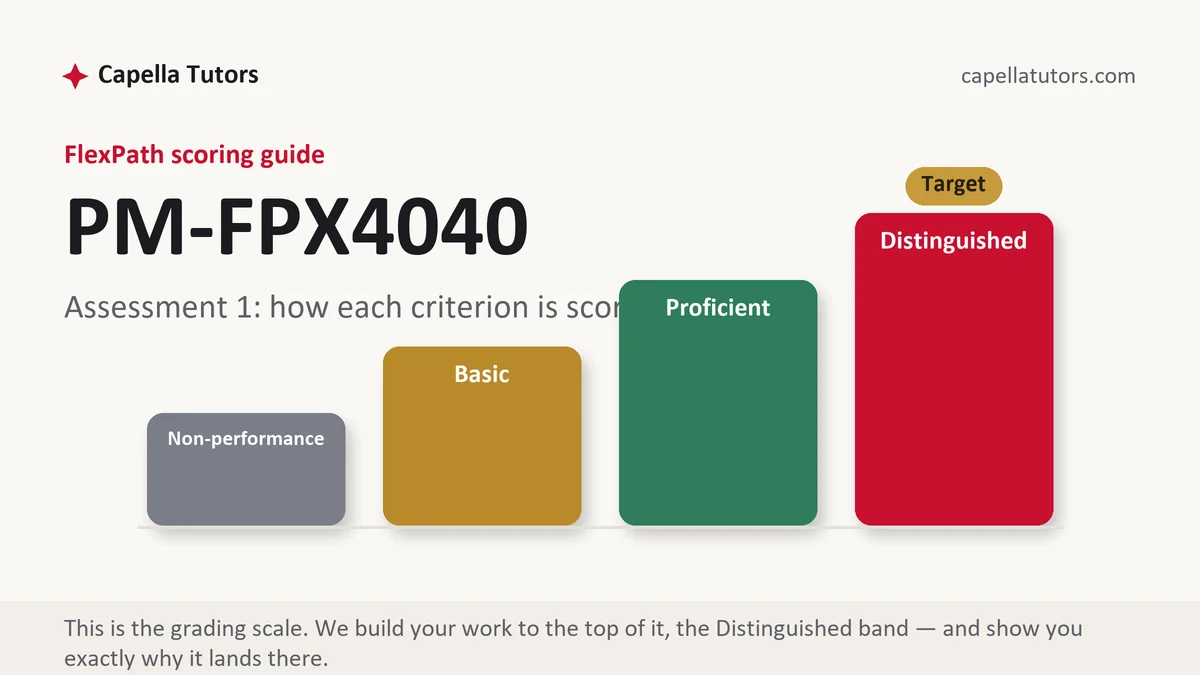
How PM FPX 4040 Assessment 1 is scored
Criteria are scored one at a time, and on a resource deliverable the four levels separate on whether the conversion was done:
| Level | What it means on a roles and availability deliverable |
|---|---|
| Distinguished | Roles are derived from the deliverables, effort and duration are treated as different quantities, durations follow from stated assignment percentages, non-productive time is deducted with a source, and the borrowed specialist is planned for rather than assumed. |
| Proficient | The roles are right and the effort estimates are sound. Availability is mentioned and the durations still read as though everybody worked on this full time. |
| Basic | An organization chart with names against activities and durations copied straight from the effort hours, which under-schedules every shared person in the plan. |
| Non-performance | A required element is absent, usually the assignment percentages or the source of the people, and a plan with no availability figures cannot support the loading criterion later. |
Effort is how many hours the work takes and duration is how long that takes to happen, and a plan confusing the two is wrong on its first page. Where a prompt supplies an assignment percentage it is supplying the conversion factor, and the criteria reward the student who uses it rather than the one who mentions it.
The PM FPX 4040 Assessment 1 method, step by step
-
Derive the roles from the deliverables
Read the breakdown and ask what skills each package needs, then name the role rather than the person. Roles taken from an existing organization chart describe the department you already have, and the criterion is asking what this project requires, which is often something the chart does not contain.
-
Estimate effort in hours, separately from any date
Put an hours figure against each activity and say where it came from, whether that is a rate per unit, a comparable finished job or a declared assumption. Keep dates out of this step entirely, since mixing them is what produces the confusion the next step exists to prevent.
-
Convert effort to duration with the availability figure
An activity needing 132 hours of records-clerk effort, given to somebody released to the project at sixty percent, occupies 24 hours a week and therefore takes about five and a half weeks rather than the three and a third a full-time assumption produces. Do that conversion for every shared resource and the shape of the schedule changes immediately.
-
Deduct the time nobody plans for
Paid leave, training days and the meetings the organization requires take a nominal working year well below its headline hours, so a person released at sixty percent is not delivering twenty four productive hours in every week of the project. State the deduction, name where the figure came from, and carry it through.
-
Plan for the specialist you have borrowed
Most project members in a functional organization report to somebody else, and that manager can reclaim them without asking you. Write the negotiation with the functional manager into the plan as a real activity with a date, and record the availability figure as an assumption with a source, because it is the document that explains the slippage when sixty percent quietly becomes forty.
-
Recheck every conversion, then submit
Take the effort hours and the percentages on their own and redo the arithmetic without looking at your durations. Then confirm that each figure in the prose matches its table, self-score against the descriptors, and submit early enough that a second attempt fits inside the billing session.
A structure that maps to the criteria
Ranges our tutors use for a resource plan built around availability; where your guide asks for a request to a functional manager, the negotiation section grows and the tables stay as they are.
| Section | What it must do | Guide |
|---|---|---|
| Roles and skills required | The roles the deliverables demand, the skills each needs, and where the people are coming from. | ~250 words |
| Effort estimates | Hours per activity with the basis of each figure, kept separate from any calendar assumption. | ~250 words |
| Availability and conversion | Assignment percentages, the deduction for non-productive time, and the durations that result. | ~300 words |
| Acquisition plan | Who is negotiated for, with whom, by when, and what happens if the answer is no. | ~250 words |
| Assumptions register | Every availability figure recorded as an assumption with a source and a review date. | ~200 words |
| Development needs and references | Capability gaps the roles reveal, how they get closed, current APA in both directions. | ~200 words |
Annotated sample excerpt
A conversion paragraph from an original model our team wrote, printed the way a resource section should read.
Indexing the 1998 to 2007 deed volumes is estimated at 132 hours of records-clerk effort, taken from the 4.4 hours per volume the pilot recorded across 15 volumes, and the clerk is released to the project at sixty percent of a 40-hour week.1 Sixty percent is 24 hours, so the activity occupies about five and a half weeks rather than the three and a third that a full-time assumption would have produced, and the schedule uses the longer figure.2 Applying the county's own leave, training and required-meeting allowance of 18 percent brings the realistic figure closer to 20 hours a week and the duration to six and a half, which is recorded as an assumption for review at the end of month one, together with the note that the clerk's line manager may recall her for the annual valuation run in March.3
- 1Effort stated in hours with the rate it came from, and the availability percentage given as a separate fact. Two quantities, kept apart on purpose.
- 2The conversion performed and both answers shown, so the reader can see what a full-time assumption would have cost the schedule.
- 3The non-productive deduction applied with a named source, and the borrowed-resource risk written down as an assumption with a review date.
The full premium sample for your exact assessment, written fresh to your scoring guide and issue, is free to request. Study it, revise it into your own voice, and submit work you understand.
The five mistakes that cost Distinguished
- Durations copied from effort hours. A part-time assignment stretches the calendar, and ignoring it under-schedules every shared person in the plan.
- Availability mentioned but never applied. Naming a percentage in the narrative and leaving the durations full-time answers the criterion in words and fails it in figures.
- Roles lifted from the organization chart. The chart describes the department that exists, and the criterion is asking what the deliverables require.
- A nominal working year taken at face value. Leave, training and mandatory meetings are real hours, and a plan that ignores them is short before the first week.
- A borrowed specialist assumed rather than negotiated. In a functional organization somebody else controls that person's time, so the negotiation is an activity with a date rather than a background condition.
Pre-submission checklist
- Roles derived from the deliverables rather than from an existing chart
- Effort stated in hours with a basis for every figure
- Assignment percentages applied, with the resulting durations shown
- Non-productive time deducted and its source named
- Every availability figure recorded as an assumption with a review date
- All conversions recomputed independently, prose matched to tables, submitted early in the week
Resource plan or staffing analysis due?
Send the activities, whatever availability figures you have and the criteria. We convert effort to duration at your percentages, deduct the time nobody plans for, and return a premium original sample inside 24 to 48 hours.