This manual is for PM FPX 4030 Assessment 2, start to submission. Cost is graded on traceability rather than on precision, which is good news for a student who shows working. The assessment usually asks you to estimate the project by a named method, phase the money across the periods it will be spent in, derive contingency from the risks you actually listed, and keep management reserve separate from the baseline. Your scoring guide decides whether that arrives as an estimate with a spending curve, a budget section inside a plan, or a funding request to a sponsor. What follows is our approach, a criterion-keyed structure, and a sample excerpt with the moves labelled. Prefer to hand it off? A premium original sample returns in 24 to 48 hours with every total added again independently, revised free until the criteria are met. Capella's catalog lists the course as PM-FPX4030, and some courserooms print PM4030; both point to this same Assessment 2.
One honesty note before the manual: Capella revises courses and scoring guides over time, so always write to the exact scoring guide attached to your assessment in the courseroom. The course identity above is verified on capella.edu; the method and structure below are our tutors' approach to it, not Capella's official rubric text.
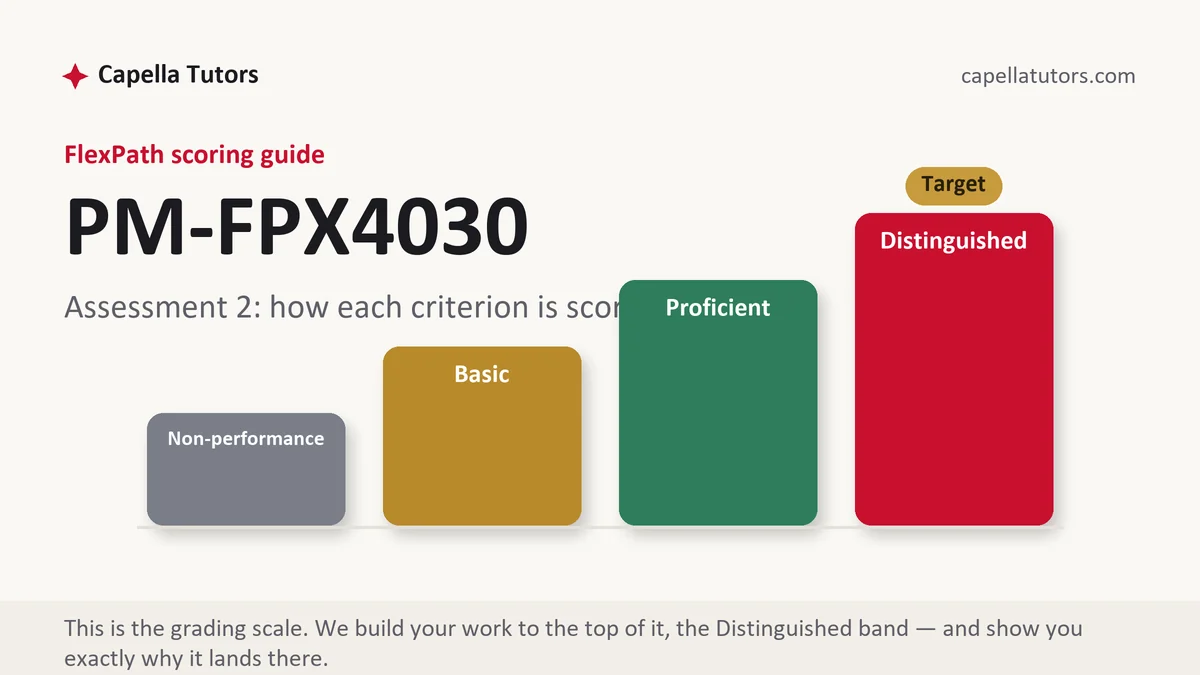
How PM FPX 4030 Assessment 2 is scored
Every criterion is placed on one of four levels, and on a cost deliverable the levels turn on where the numbers came from:
| Level | What it means on a cost estimate and baseline |
|---|---|
| Distinguished | The estimating method is named and justified, every figure traces to a rate, a comparison or a declared assumption, the money is phased across periods, and contingency is derived from the register while reserve sits outside the baseline. |
| Proficient | A complete and correct budget with a stated method. The total is defensible, the spending is not phased, and nothing tells a sponsor whether this month's outflow is a problem. |
| Basic | A single lump sum with a percentage added for contingency, no basis given for either, and reserve used as another word for contingency. |
| Non-performance | A required element is absent, usually the phasing or the reserve treatment, and a budget with no baseline cannot support any later variance report. |
Two pots of money get confused in almost every draft. Contingency answers for the risks you actually listed and lives inside the cost baseline. Management reserve covers what nobody foresaw, sits outside the baseline, and is released by the sponsor rather than spent at your discretion, and criteria in this course usually score that separation on its own.
The PM FPX 4030 Assessment 2 method, step by step
-
Name the method before producing a number
Say whether this is a comparison against a finished project, a rate multiplied by a quantity, or a bottom-up total built from the packages, and say why that method fits what you know. An estimate whose method is unstated cannot be defended when a criterion asks how you arrived at it.
-
Estimate the uncertain activities as a range
Take an optimistic 5 days, a most likely 9 and a pessimistic 25. The weighted three-point estimate is 5 plus 36 plus 25 over 6, which is 11 days, while the plain average of the three is 13, and the difference is worth one sentence about why the weighting exists. The spread matters more, since a 20-day range implies a deviation near 3.3, so 11 days plus or minus 3 tells a sponsor more than a single confident figure.
-
Build the total from the packages upward
Where the breakdown is complete, the bottom-up total is the defensible one, so print the package figures and their subtotals. A reader who can add your packages and reach your total will not question the total, and a reader who cannot will question everything that rests on it.
-
Derive contingency from the register, not from habit
Multiply each identified threat by its probability and add the results. A 40 percent chance of an 18,000 dollar glass reorder is 7,200, a 25 percent chance of a 22,000 dollar specialist sealant removal is 5,500, and a 15 percent chance of a 23,000 dollar switch to mast climbers is 3,450, giving 16,150 dollars of contingency that is arguable and revisable as the risks close.
-
Phase the money across the calendar
A budget with no spending curve cannot tell anybody whether this month is a problem, so distribute the total across the periods the work happens in and show the cumulative line. This is also the artifact every later variance figure is measured against, which is why a criterion about control usually depends on this one.
-
Check the arithmetic with the words switched off, then submit
Read the file once for figures alone, ignoring the prose, and confirm that every subtotal adds and every number in a sentence matches its table. Then self-score against the descriptors and submit early enough that a second attempt still fits inside the billing session.
A structure that maps to the criteria
Ranges our tutors use for an estimate with a phased baseline; if your guide asks for a funding request instead, the justification grows and the tables stay put.
| Section | What it must do | Guide |
|---|---|---|
| Estimating basis | The method chosen, why it fits the information available, and the accuracy range you claim for it. | ~250 words |
| Package estimates | Every package with its figure and the rate, comparison or assumption that produced it. | ~300 words |
| Ranges and uncertainty | The three-point work, the deviation implied by the spread, and which activities carry the widest ranges. | ~250 words |
| Contingency and reserve | Contingency derived from the register inside the baseline, reserve stated separately and outside it. | ~250 words |
| Time-phased baseline | The spend by period and the cumulative curve, plus the total authorization the sponsor is asked for. | ~250 words |
| Control and references | The reporting cadence, the variance threshold that triggers action, current APA both ways. | ~150 words |
Annotated sample excerpt
A baseline paragraph from an original model our team wrote, printed the way a funding section should read.
Bottom-up package estimates total 214,000 dollars, built from a measured rate of 268 dollars per opening across 640 openings plus fixed scaffold and disposal packages, with the rate taken from the contractor's two most recent completed blocks rather than from a catalogue.1 Contingency of 16,150 dollars is carried inside the baseline and derived line by line from the risk register, giving a cost baseline of 230,150; management reserve of 11,500 sits outside the baseline and is released by the property director rather than by the project, so the total authorization requested is 241,650.2 Phased by month the baseline reads 34,000, 61,000, 58,000, 45,000 and 32,150, which puts more than half the outflow in months two and three when four buildings are scaffolded at once, and any month exceeding its figure by more than 8 percent is reported to the director inside five working days.3
- 1A method named, a rate given, and the source of the rate identified. Every figure downstream of this sentence is now traceable.
- 2Contingency and reserve separated with different owners and different sides of the baseline, which is the distinction the criterion scores on its own.
- 3The money phased, the peak explained by the work rather than by the calendar, and a variance threshold attached with a reporting deadline.
The full premium sample for your exact assessment, written fresh to your scoring guide and issue, is free to request. Study it, revise it into your own voice, and submit work you understand.
The five mistakes that cost Distinguished
- An estimating method left unnamed. A total with no method behind it cannot answer the criterion that asks how the figure was produced.
- Contingency set at a round percentage. Ten percent is a habit rather than a derivation, and the register is sitting there waiting to be multiplied out.
- Reserve treated as more contingency. Putting the sponsor's money inside your baseline gives you authority you do not have and corrupts every variance figure.
- A three-point estimate reported as a fact. The weighted figure is the middle of a range, and dropping the spread throws away the part a sponsor can act on.
- A budget with no phasing. One total for the whole project cannot tell anybody whether this month's spending is early, late or wrong.
Pre-submission checklist
- The estimating method named, justified, and matched to what is actually known
- Every package figure traceable to a rate, a comparison or a declared assumption
- Three-point estimates reported with their spread rather than as single numbers
- Contingency derived from the register and held inside the cost baseline
- Management reserve stated separately, outside the baseline, with its release owner named
- The money phased by period with a cumulative line, arithmetic checked alone, submitted early in the week
Cost baseline or funding request due?
Send the packages, the rates and the criteria. We name the method, derive contingency from your register, keep reserve where it belongs and hand back a premium original sample inside 24 to 48 hours with the curve phased.