This manual is for NURS FPX 6620 Assessment 2, start to submission. Hand it off and a premium original sample lands inside 24 to 48 hours, written to your own scoring guide and revised free until it hits the target column. Assessment 2 in this course usually moves from analysis into application: you recommend a coordination model for a specific population and defend the choice for readers who could approve or refuse it. Your scoring guide decides the format, whether that is a report, a proposal, or a briefing document. Below is how our tutors build the recommendation, the section map that satisfies the criteria, and an annotated excerpt from a model version. Capella's catalog lists the course as NURS-FPX6620, and some courserooms print NURS6620; both point to this same Assessment 2.
One honesty note before the manual: Capella revises courses and scoring guides over time, so always write to the exact scoring guide attached to your assessment in the courseroom. The course identity above is verified on capella.edu; the method and structure below are our tutors' approach to it, not Capella's official rubric text.
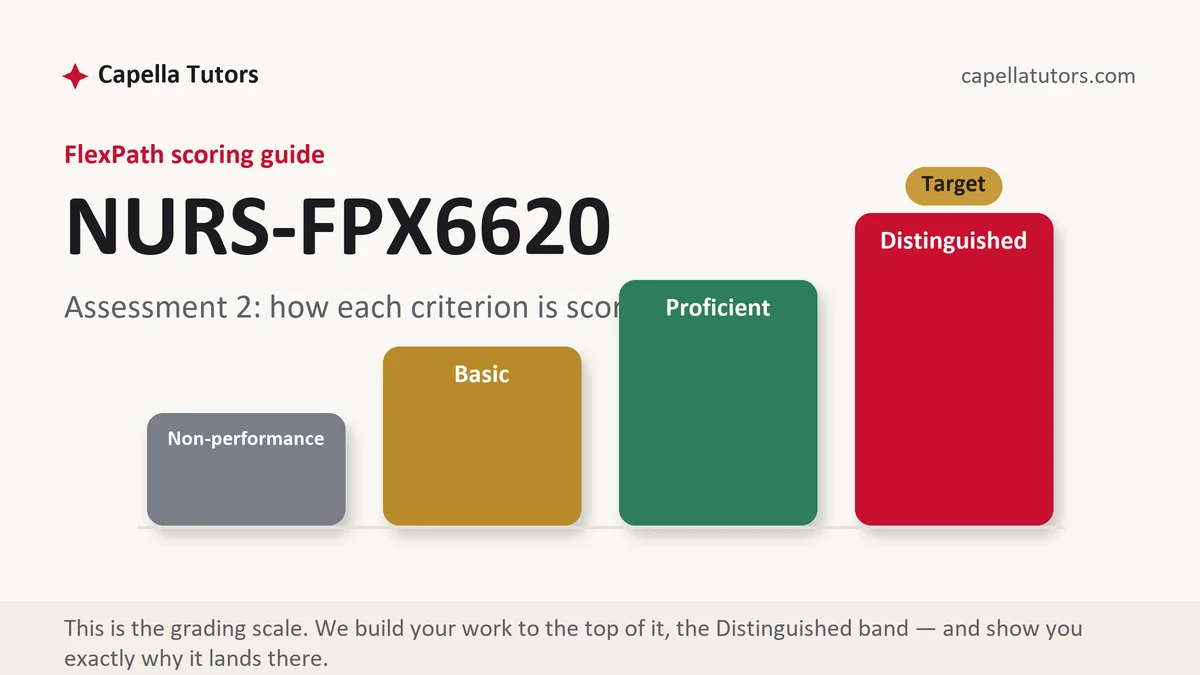
How NURS FPX 6620 Assessment 2 is scored
Nothing in FlexPath is averaged. Each criterion is placed at one of four levels, and on a recommendation the levels read like this:
| Level | What it means on a model recommendation |
|---|---|
| Distinguished | One model is recommended without hedging, the options it beat are named and priced, the evidence behind the choice is graded, and the conditions that would reverse the recommendation are stated. |
| Proficient | A defensible recommendation with support, but the alternatives are summarized rather than genuinely tested, so the decision looks announced rather than earned. |
| Basic | A description of a preferred model with benefits listed and no comparison anywhere in the document. Reads as advocacy, and advocacy sits at Basic. |
| Non-performance | A required element never appears, commonly the alternatives or the measures the recommendation will be judged by. Absence is scored on its own terms. |
A recommendation is graded partly on whether a reader could act on it. Give the model a named owner, a first ninety days, and two measures with a data source, and several criteria improve at once because the document has become usable rather than merely correct.
The NURS FPX 6620 Assessment 2 method, step by step
-
State the decision the document has to produce
Write the decision in one sentence before drafting: which post-acute coordination arrangement the network should adopt, and for which patients. Everything that does not help a reader make that decision is now optional, which is the fastest way to cut a bloated draft down to the criteria.
-
Fix the baseline you intend to be judged against
A recommendation without a baseline cannot be evaluated. For a shared-savings organization reworking its post-acute network, the baseline is concrete: skilled nursing length of stay, discharge-to-institution rate, thirty-day readmission from each facility, and the spread between the best and worst partners. CMS publishes facility-level quality and utilization data, which lets you show variation you did not invent.
-
Build an option set that includes doing nothing
Three or four options, one of which is keeping the current arrangement. A narrowed preferred network with performance criteria, an embedded transition nurse following patients into partner facilities, and a joint accountability agreement with shared data are genuinely different mechanisms. Naming the status quo as an option and pricing it is the move that makes the rest of the document look like a decision.
-
Defend the choice on evidence and arithmetic together
Every claim in the recommendation needs one of two backings, a citation or a calculation. Cite the transitional care and post-acute literature for effect direction, cite federal evaluation material for scale, then do the arithmetic locally: if avoidable days fall by one per admission across a defined volume, what does that yield. Show the arithmetic so a finance reader can check it and label each assumption as an assumption.
-
Write the sequence and the risks in the same section
Turn the recommendation into a sequence with owners and dates, then attach the risk that each step carries: a partner facility declining the data-sharing terms, referral leakage to an excluded facility, a physician group reading network narrowing as a loss of autonomy. A risk paired with a response reads as management, and a risk register with no responses reads as a disclaimer.
-
Read it once as the approving committee, then self-score
Reread the draft as a reader who has to answer for the money: what am I approving, what does it cost, how will we know it worked, what happens if it fails. Then score every criterion yourself and rewrite anything below the top level before you submit.
A structure that maps to the criteria
These proportions are our tutors' planning targets for a master's recommendation document, not Capella requirements; the criteria in your guide decide what gets expanded.
| Section | What it must do | Guide |
|---|---|---|
| Purpose and recommendation | The decision, the recommended model, and the reason in brief, stated on the first page rather than saved for the end. | ~200 words |
| Population and baseline | The patients in scope, their volume, and the current performance figures the recommendation will be measured against. | ~300 words |
| Options considered | Each option with its mechanism, its evidence, its cost, and the reason it was not chosen, including the status quo. | ~400 words |
| Evidence and rationale | The research and federal evaluation material behind the chosen model, graded by design and setting, plus the local arithmetic. | ~350 words |
| Implementation and measurement | Sequence, owners, first-ninety-day milestones, two or three measures with data sources, and the risks with responses. | ~300 words |
| References | APA 7, peer-reviewed sources inside five years, agency reports cited with the issuing body as author. | as needed |
Annotated sample excerpt
An original passage from our team showing the register a recommendation section wants. Use the moves, not the sentences.
The network should narrow to six preferred skilled nursing partners and place a transition nurse inside each one, rather than continuing to discharge across nineteen facilities with no shared accountability.1 Two mechanisms drive that choice: performance variation among current partners is wide enough that facility selection alone moves outcomes, and the transitional care evidence attributes most of the effect to a clinician who follows the patient rather than to the handoff document.2 The recommendation reverses if partner facilities refuse shared data access, since without facility-level results the selection criteria cannot be maintained and the arrangement decays into a preferred list nobody enforces.3
- 1The recommendation is a single unhedged sentence that also names what it replaces. Evaluators reading for a decision find it in the first line instead of hunting for it in a conclusion.
- 2Two mechanisms are given, one local and one from the literature, and the literature claim is attributed to the active component rather than to the model in general. That level of precision is what the evidence criterion is written to reward.
- 3The reversal condition is stated openly. Naming what would defeat your own recommendation is the clearest available signal of analytic maturity, and it usually satisfies the limitations language in the guide as well.
The full premium sample for your exact assessment, written fresh to your scoring guide and issue, is free to request. Study it, revise it into your own voice, and submit work you understand.
The five mistakes that cost Distinguished
- Advocacy dressed as analysis. One model presented with its benefits listed and no option set anywhere in the document.
- No baseline. A recommendation with nothing to compare against later, which leaves the measurement criterion with no numbers to attach to.
- Uncosted enthusiasm. New roles and new technology recommended with no salary, benefit load, license fee, or analyst time named.
- Borrowed effect sizes. A published reduction lifted straight into your setting with no adjustment for volume, population, or staffing.
- Risks without responses. A list of things that could go wrong, none of which the document says what to do about.
Pre-submission checklist
- The recommendation appears in one unhedged sentence on the first page
- Baseline figures cited from a named public source, with estimates labeled as estimates
- At least three options tested, one of them keeping the current arrangement
- Every claim carries either a citation or visible arithmetic
- Two or three measures with numerator, denominator, and a data source you could obtain
- Each named risk paired with a specific response, and the draft self-scored at the top level
Need this recommendation to land?
Send the scoring guide and the network or population you are writing about. We return a premium original sample inside 24 to 48 hours with the option set built out and the arithmetic visible, then revise free until your target column is reached.