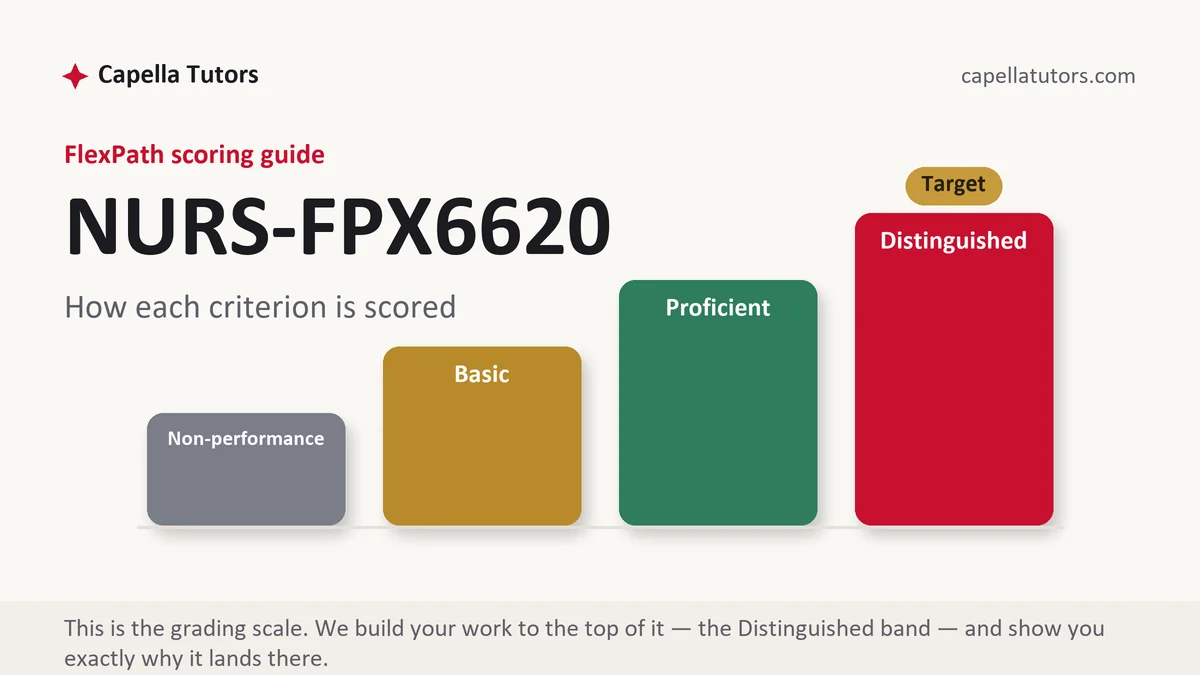
We draft NURS FPX 6620 assessments to a Distinguished target and tutor you through the reasoning, first premium sample free, work back inside 24 to 48 hours. The course is Care Coordination Healthcare Models, worth 2 program points, one of the four courses in the Care Coordination specialization inside Capella's FlexPath MSN, a program that totals 27 program points. Send the scoring guide out of your courseroom and a criterion-by-criterion plan comes back the same day. In Capella's catalog the course code is written NURS-FPX6620.
What NURS FPX 6620 actually grades
The scoring guides in this course treat comparison as a verb. You are asked to put care delivery and coordination models beside each other, accountable care organizations, the patient-centered medical home, nurse-led transitional care, structured disease management, and then decide between them. A model described accurately, its features listed and its origins noted, still lands in Basic when the paper never chooses. The top column belongs to work that commits: this population, these utilization patterns, therefore this model, with the evidence that makes the fit defensible on paper.
Population definition is the second thing evaluators test, and it is where master's work parts company with undergraduate care planning. The unit of analysis is a cohort. Dual-eligible adults with heart failure across a two-county service area. Post-surgical orthopedic patients discharged to skilled nursing. Adults with serious mental illness who keep returning to one emergency department. The criteria want that cohort sized: how many people, what payer mix, what baseline utilization looks like. A model recommendation bolted onto an unsized population reads as a preference, and preferences do not score.
Third, the evidence criterion gets applied per model rather than in bulk. Each option in your comparison carries its own research trail, and the trails are wildly uneven. Some models have a decade of federal evaluation behind them. Others rest on a few single-site pilots and considerable enthusiasm. Naming that asymmetry is the analytic move the guide rewards.
How we help in this course
A 6620 draft off our desk is built as a recommendation memo rather than an essay. The population comes first and comes sized. The candidate models follow, each with the evidence that supports it and the operating conditions it needs to work at all. The recommendation lands in the middle of the document, then the rest of the paper defends it, including a paragraph on what would have to be true for a different model to win instead.
Turnaround holds at 24 to 48 hours per deliverable. Two reviewers read every draft against your own scoring guide before it reaches you, one checking criteria coverage, one checking APA and source quality. Revision passes stay free until the target column is reached, and evaluator comments fold into the next pass at the same speed. Because FlexPath bills flat 12-week sessions and lets you carry two courses at once, the limit on your pace is how fast you can submit on grade.
Matching a model to a population, not to a preference
Most weak papers in this course arrive at their recommendation before the analysis does. The fix is mechanical. Write the population's failure mode down in one sentence, then let that sentence pick the model. If the cohort loses ground in the fortnight after discharge, medication reconciliation missed, follow-up appointment never kept, then a transitional care model has the strongest claim on the work. If the failure is fragmented chronic management with nobody accountable between visits, the medical home is the better answer. If the stated problem is total cost of care across a network of independent practices, you are looking at an accountable care arrangement and its shared-risk mechanics.
Then write the sentence most students skip: what this model will not fix. Transitional care does little for a population whose real problem is no primary care access at all. A medical home cannot absorb a housing crisis. Pair the limit with a named complement, a community health worker program, a behavioral health integration layer, and the analysis reads like it came from someone who has watched a model get implemented.
Where the evidence on each model actually lands
Accountable care organizations have been evaluated at national scale, and the honest summary is that quality measures tend to move before total spending does, with results varying sharply by organization size and starting utilization. CMS publishes its own program results, and citing that material directly is stronger than citing a journal article that summarizes it. The patient-centered medical home has a large literature with a familiar split: access, continuity, and patient experience generally improve, while cost findings stay mixed and depend heavily on how mature the practice transformation is. AHRQ maintains the definitional material and much of the synthesis, which makes it the natural anchor for that section.
Transitional care is where nursing evidence is strongest and most tempting to overstate. Nurse-led transitional care trials report meaningful reductions in early readmission, and pragmatic replications in ordinary systems commonly report smaller effects than the original trials did. The gap between them is not an inconvenience, it is the implementation science point the criteria want you to make: fidelity to the model's active components predicts whether the effect survives. Joint Commission material on handoff communication gives you the standards-side companion to that argument.
The assessments, one by one
Assessment 1
Send us the scoring guide and a premium original sample for this assessment comes back inside 24 to 48 hours, revised free until it meets the guide. Read the full Assessment 1 manual.
Assessment 2
Hand it off and a premium original sample lands inside 24 to 48 hours, written to your own scoring guide and revised free until it hits the target column. Read the full Assessment 2 manual.
Assessment 3
We can build this one with you or for you, first premium sample free and back inside 24 to 48 hours. Read the full Assessment 3 manual.
How to actually write NURS FPX 6620: where to begin
Open the scoring guide before the instructions and build the outline from the criteria, one heading per criterion with its Distinguished language pasted underneath. The assessments in this course usually ask for some combination of a model analysis, a population-matched recommendation, and a piece written for an audience of decision makers rather than classmates, so the outline you build from the guide is the only reliable map.
Choose the population second, and choose one you can defend with public numbers. CMS dashboards, AHRQ statistical briefs, and state health department reports all publish utilization figures at a grain that supports a cohort description. Write the size, the payer mix, and two baseline measures you intend the model to move. Those two measures become the spine of the assessment, since every later model claim can be checked against them.
Only then read about models. Reading first is how students end up writing a fan letter to the medical home. Keep the comparison to three or four candidates and keep them genuinely different from each other, since two variants of one idea leave nothing at stake.
| Section | What goes in it | What Distinguished looks like |
|---|---|---|
| Population and problem | The cohort, its size, its payer mix, and the two or three utilization measures that define the problem. | Numbers with named public sources, and a single sentence stating the failure mode the model must address. |
| Model comparison | Three or four genuinely different delivery or coordination models, each with structure, accountability, and payment described. | Each model judged on evidence strength as well as fit, with the weaker trails identified as weaker. |
| Evidence review | Current peer-reviewed studies plus federal evaluation material for each candidate model. | Findings adjudicated rather than listed, with study design and setting used to decide which result to trust. |
| Recommendation | The chosen model, the reasoning that selected it, and the conditions it needs locally. | A recommendation that names what the model will not fix and pairs it with a complementary intervention. |
| Implications for practice | What adoption means for staffing, referral relationships, data, and the interprofessional team. | Concrete second-order effects traced, including who loses work and who gains it under the new model. |
Developing the synthesis
Synthesis in 6620 means arbitration between models, not a tour of them. The paragraph shape that earns the top column puts two findings in tension inside the same paragraph and then rules. A multi-site evaluation showing modest savings from an accountable care arrangement sits next to a single-system study showing large savings, and you decide which one should guide a decision here, on the grounds of sample, setting, and how closely the study population resembles yours. Naming the tiebreaker out loud is the move. Then state what the evidence cannot settle: most model research cannot isolate which component produced the effect, so say which component your recommendation is betting on and why.
Citations that survive faculty review
The evidence criteria expect current peer-reviewed work, generally inside five years, pulled through the Capella library rather than off the open web. CINAHL is where the nursing model literature lives and PubMed is where the health services evaluations live, and this course needs both. Government material is not a lesser source here, it is often the primary one: CMS program results, AHRQ synthesis and definitional documents, and Joint Commission standards on transitions all get cited as reports in APA 7 form, with the issuing body as author. Attach each source to the criterion it serves, so that the sentence naming your chosen model also names the study that earned it the slot. Citations parked at the end of a paragraph that had already finished arguing are the classic Proficient-not-Distinguished tell.
The mistakes that land Basic instead of Distinguished
- Describing models in sequence without ever comparing them against a common set of criteria.
- A population defined by diagnosis alone, with no size, no payer mix, and no baseline utilization.
- Treating every model's evidence as equally solid when the research bases are obviously unequal.
- A recommendation that arrives only in the conclusion, leaving the paper with nothing to defend.
- No account of what adoption costs in staffing, data infrastructure, or referral relationships.
NURS FPX 6620 questions students actually ask
Which care delivery model should I pick?
The one your population's failure mode selects. If the cohort loses ground in the two weeks after discharge, a transitional care model has the strongest claim. If the problem is fragmented chronic management with no accountable clinician, the medical home fits better. If total cost and shared risk across a network is the stated problem, an accountable care arrangement is the candidate. Pick the model the data points at, then say plainly what the model will not fix.
How much evidence does the comparison need per model?
Enough to show the trails are uneven. Two or three current peer-reviewed sources per model, plus the federal evaluation material where it exists, is a defensible load. What earns the top column is not volume but candor about strength: a model backed by multi-site evaluation and a model backed by two single-site pilots should not be described in the same confident register.
Do I need real data from my own organization?
No. Use publicly reported figures for a population like yours, from CMS or AHRQ datasets, or build a clearly labeled composite cohort with plausible numbers drawn from published rates. State the source of every figure and note where you estimated. Never paste internal reports or identifiable patient data into an assessment.
In NURS FPX 6620 right now?
Send the scoring guide and the population you are working with. Your first premium sample is free and lands inside 24 to 48 hours.