This manual is for NURS FPX 6424 Assessment 4, start to submission. A premium original sample for this deliverable arrives inside 24 to 48 hours and stays in revision until your guide is met. Assessment 4 of NURS FPX 6424 is the synthesis deliverable. Your scoring guide decides the shape, and the assessment usually asks you to turn a one-time analysis into something that keeps working: the measure that gets watched, the owner who watches it, the cadence, the governance that reviews it, and the plan for the day the data changes underneath the report and nobody notices. Capella's catalog lists the course as NURS-FPX6424, and some courserooms print NURS6424; both point to this same Assessment 4.
One honesty note before the manual: Capella revises courses and scoring guides over time, so always write to the exact scoring guide attached to your assessment in the courseroom. The course identity above is verified on capella.edu; the method and structure below are our tutors' approach to it, not Capella's official rubric text.
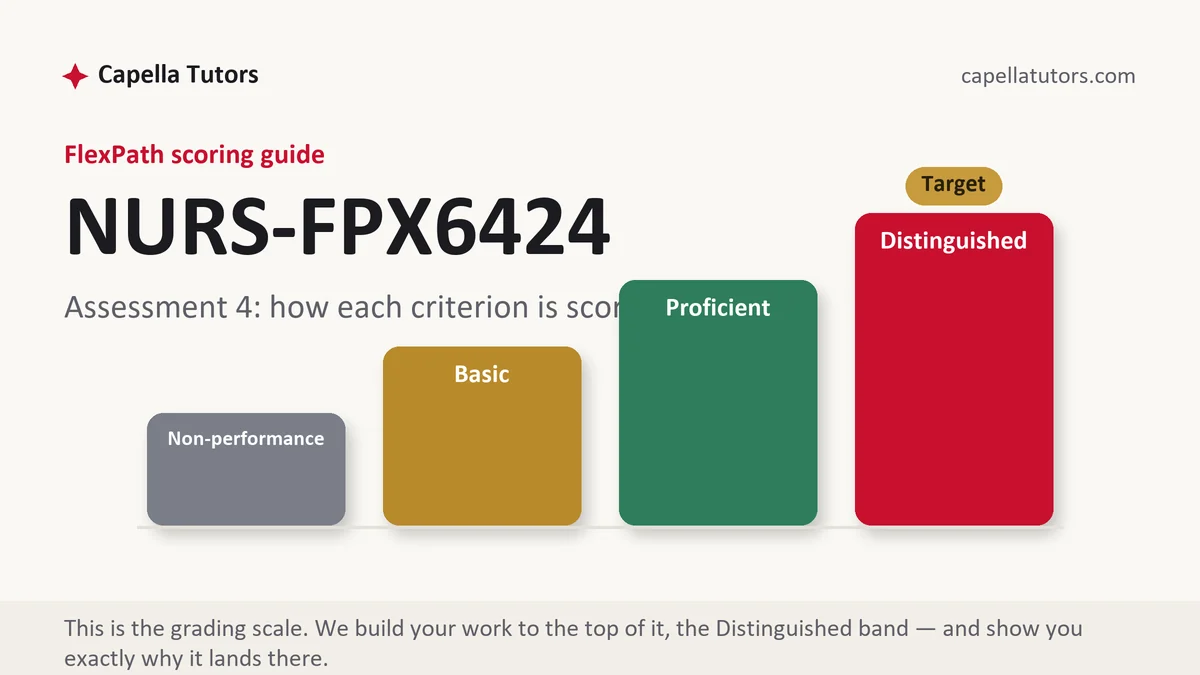
How NURS FPX 6424 Assessment 4 is scored
Four levels per criterion, and on a sustainment plan the levels sort by whether the plan survives the writer leaving:
| Level | What it means on a data program sustainment plan |
|---|---|
| Distinguished | Named owners with named backups, a stated cadence, a definition document under version control, a drift check with a threshold, and an explicit end or handover condition. |
| Proficient | Clear ownership and a reasonable schedule. Complete, and short of the top, because it assumes the data and the definitions stay still. |
| Basic | A plan to continue monitoring, described in general terms, with responsibilities implied. The frequent version, and the criterion caps it. |
| Non-performance | A required element is missing, most often the governance structure or the evaluation of the program itself. |
Analyses do not usually die of disagreement. They die of quiet decay: a field is renamed, an interface changes, a denominator shifts when a service line reorganizes, and the report keeps producing a number that no longer means what its title claims. A sustainment plan is a set of controls against that decay, which is why the criteria keep asking who and how often.
The NURS FPX 6424 Assessment 4 method, step by step
-
Write the measure definition as a governed document
One page per measure: the plain-language question, the numerator with its inclusions and exclusions, the denominator, the window, the source fields, the refresh schedule, the owner, and a version history. Put it under version control and date every change. Definitions that live only in a query are definitions that change without anyone deciding to change them.
-
Name an owner and a backup for every artifact
Each measure, each report, each dashboard, and each map or code list needs a person accountable for it and a second person who can run it. Ownership stated as a department is ownership nobody holds. Add the escalation path: who hears about it when the number looks wrong, and within how long.
-
Build a drift check with a threshold
Decide in advance what would signal that the pipeline broke rather than the world changed: a denominator moving more than a set percentage between periods, a completeness rate falling below a floor, a category appearing that was not in the code list. Attach the threshold, the check frequency, and the response. A monitoring plan with no failure signal is a monitoring plan that reports whatever it receives.
-
Set the governance calendar and the decision rights
Say which committee sees the measure, how often, and what it is empowered to do: adjust the threshold, commission a redesign, retire the measure. Decision rights written down are what keep a standing report from becoming an item nobody can change. This is also where you record who may approve a change to the definition.
-
Keep the equity view in the routine, not the special study
If the measure will drive outreach, staffing, or prioritization, report it stratified by the groups it affects on the same cadence as the overall figure, with denominators, and set a floor below which a subgroup is reported as a count rather than a rate. Equity examined once at launch and never again is the pattern this control exists to prevent.
-
Write the end condition
Say what would justify retiring the measure or handing it to another owner: sustained performance above a threshold, a replacement source, a policy change that makes the question obsolete. Support the governance design with recognized material, including AMIA and HIMSS publications on data governance, ONC resources on healthit.gov, and peer-reviewed informatics literature, cited in current APA.
A structure that maps to the criteria
The proportions below are our tutors' planning targets for a sustainment plan, not Capella requirements; your scoring guide decides the final format.
| Section | What it must do | Guide |
|---|---|---|
| What is being sustained | The finding, the measure it produced, and the decision the measure exists to inform. | ~200 words |
| Measure definitions | Numerator, denominator, window, source fields, refresh schedule, and version history per measure. | ~300 words |
| Ownership and escalation | Owner and backup for every artifact, plus who hears about a suspect number and how quickly. | ~250 words |
| Drift checks and thresholds | The signals that indicate a broken pipeline, their frequency, and the response each one triggers. | ~250 words |
| Governance and decision rights | The reviewing committee, its cadence, and what it may change without further approval. | ~250 words |
| Equity view, end condition, references | Stratified reporting with small-cell handling, the retirement or handover condition, and current APA sources. | ~250 words |
Annotated sample excerpt
An original model excerpt from our team, written the way an operating plan reads. Study the structure, then write your own around your own measure.
Measure: interpreter service requests fulfilled within 30 minutes, as a share of requests placed for patients whose record lists a preferred language other than English, refreshed weekly from the request queue and the encounter table, owned by the language access coordinator with the ambulatory analytics lead as backup.1 The drift check runs on the same schedule and looks at three things: whether the eligible denominator moves more than 15 percent from the trailing eight-week median, whether preferred language is missing on more than 5 percent of encounters, and whether any language appears in the queue that is absent from the current code list, since the audit that started this work found 340 of 6,120 requests routed to a generic other category.2 Any check that trips is reported to the health equity committee within five business days, which may adjust the threshold or commission a redesign but may not change the numerator definition without sign-off from the coordinator and the analytics lead.3
- 1Defines the measure with its numerator, denominator, source, cadence, owner, and backup in one sentence a successor could execute without asking anyone a question.
- 2Sets three concrete drift signals with numeric thresholds and ties one of them to the specific defect the original analysis uncovered. Thresholds decided in advance are what make monitoring a control.
- 3Separates what the committee may change from what requires the owners' sign-off. Written decision rights are what keep a definition from quietly drifting between reviews.
The full premium sample for your exact assessment, written fresh to your scoring guide and issue, is free to request. Study it, revise it into your own voice, and submit work you understand.
The five mistakes that cost Distinguished
- Ownership assigned to a department. Nursing informatics will monitor this names no one, and a control with no person attached is not a control.
- Definitions living in a query. An ungoverned definition changes whenever the query is edited, and the report title keeps promising something the numbers no longer deliver.
- Monitoring with no failure signal. A dashboard that refreshes on schedule and has no threshold reports broken data as confidently as good data.
- Equity as a launch exercise. A subgroup view produced once and never repeated cannot detect the disparity that appears in month seven.
- No end condition. A measure with no retirement or handover criterion becomes a permanent standing item that outlives the decision it was built to inform.
Pre-submission checklist
- Each measure has a one-page governed definition with a version history
- Every artifact has a named owner, a named backup, and an escalation path with a time
- Drift checks specified with numeric thresholds, frequency, and the response each triggers
- Reviewing committee, cadence, and decision rights written down
- Stratified reporting on the same cadence, with a small-cell rule
- A retirement or handover condition stated, sources cited in current APA
Want the sustainment plan written?
Send the scoring guide and the measure or finding you are sustaining. Our writers build the definition pages, the ownership table, and the drift thresholds the criteria are looking for, then two quality reviewers grade the draft before it reaches you. Inside 24 to 48 hours, with free revisions until it meets target.