This manual is for NURS FPX 6224 Assessment 3, start to submission. The third deliverable in NURS FPX 6224 is widely written as a strategic plan for a health technology, and it is the assessment where the course stops being about a tool and becomes about a decision. Your scoring guide decides the format, and the plan usually has to carry a defined problem, an option chosen against weighted requirements with the runner-up refused in writing, the workflow the change rearranges, the governance of the data it produces, the money on both sides with its assumptions declared, and the measures that will show whether any of it worked. Below you get the method, the structure, and an annotated excerpt. Want it built for you? A premium original sample returns in 24 to 48 hours with revisions free until your guide is met. Capella's catalog lists the course as NURS-FPX6224, and some courserooms print NURS6224; both point to this same Assessment 3. In current courserooms this assessment typically appears as "Health Technology Strategic Plan".
One honesty note before the manual: Capella revises courses and scoring guides over time, so always write to the exact scoring guide attached to your assessment in the courseroom. The course identity above is verified on capella.edu; the method and structure below are our tutors' approach to it, not Capella's official rubric text.
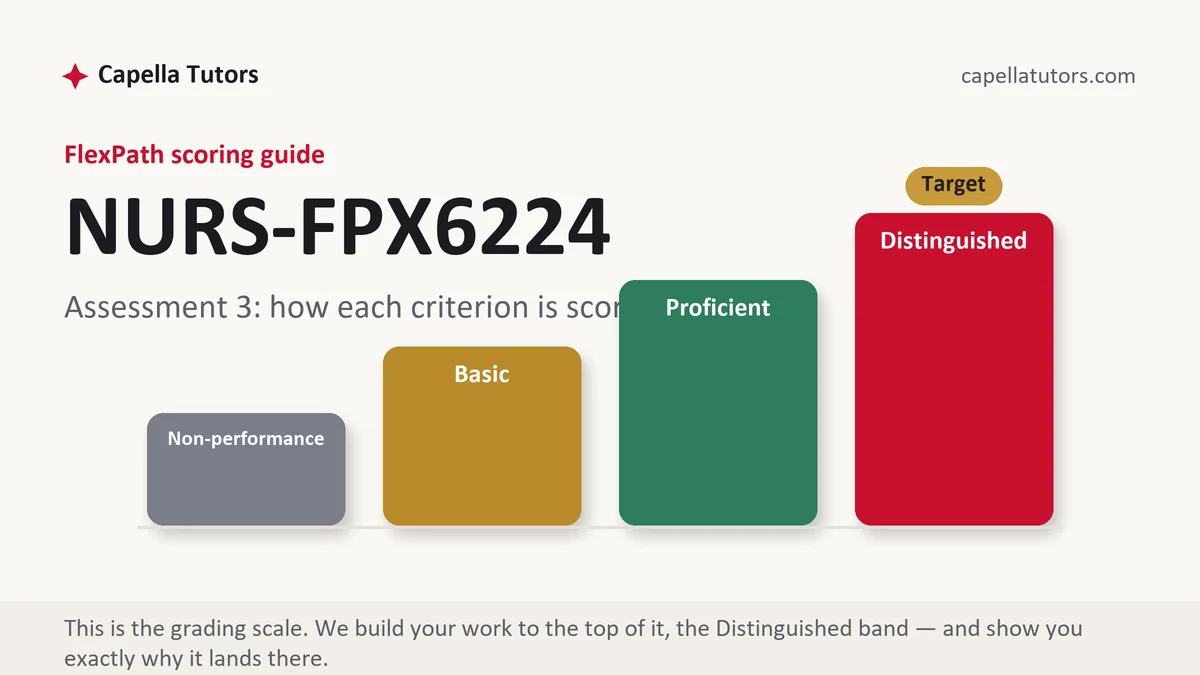
How NURS FPX 6224 Assessment 3 is scored
Each criterion is scored alone against four levels, and on a technology plan the levels separate a decision from a description:
| Level | What it means on a health technology strategic plan |
|---|---|
| Distinguished | An option is chosen against weighted requirements, the rejected candidate is refused for a stated reason, the arithmetic runs in the open with its assumptions declared, governance names stewards and access rules, and the plan states the point at which it would be reversed. |
| Proficient | A complete, coherent plan with figures and a recommendation. What keeps it from the top is that nothing in it would have been decided differently under a worse assumption. |
| Basic | An admiring account of a system. Capabilities described, benefits asserted, no comparison performed, and no number a reader could test. |
| Non-performance | A required component is absent, most often the governance section or the financial analysis, and its criterion goes to the floor regardless of the quality elsewhere. |
A plan is read by people who fund things, so state the assumptions under every projection in the sentence that uses them, and give the reader the working rather than the conclusion. The strongest submissions also do something counterintuitive: they say plainly when the savings case is thin and then argue the plan on the grounds that actually carry it, replacement necessity, a capability the organization cannot otherwise obtain, or an obligation it has to meet. An honest weak case argued well outscores an inflated strong one every time.
The NURS FPX 6224 Assessment 3 method, step by step
-
Restate the problem as the plan's first constraint
One paragraph, with the counts from your needs work and the period they cover, and a sentence naming what the current systems cannot do even when they are used correctly. Everything the plan proposes has to answer that paragraph, and anything that does not answer it is scope you will be asked to defend.
-
Score the candidates against the weighted requirements and refuse one in writing
Two or three realistic candidates, including the option of configuring what you already own, scored on the weighted requirement set. Then write the refusal: which candidate lost, on which requirement, and by how much. A comparison with no rejection is a preference dressed as an evaluation, and the criterion asking you to evaluate options is looking for the rejection.
-
Show the workflow before and after, step by step
Count the steps and name the handoffs in both states, then say what the change taxes. Every system adds work somewhere: a field to complete, a device to carry, a screen to check. Naming the new burden and stating how you will compensate the people carrying it is the section evaluators trust most, because it is the section nobody writes when they are selling.
-
Design the data governance as a section, not a reassurance
Ownership and stewardship by role, access under the minimum necessary standard, audit logging, retention, definitions locked so two reports cannot disagree, and interoperability with what the organization already runs. Where your guide expects regulatory grounding, work from the primary sources on privacy, information management, and interoperability rather than from a review article that summarizes them.
-
Do the arithmetic in the open and declare every input
One-time cost, recurring cost, quantified benefit, and the assumption under each. Discount any benefit built on released minutes and say that you discounted it. Then compute the payback against the asset's useful life, and if the payback exceeds that life, say so and change the argument rather than the numbers.
-
Define adoption, evaluation, and the reversal point
Training hours and who backfills them, super users by unit, a downtime procedure, and then the measures: baseline value, target, source, owner, review date. Add the threshold at which you would stop or roll back. A plan with a reversal point is a plan; a plan without one is a commitment.
A structure that maps to the criteria
Word targets our tutors plan against for a technology plan, not Capella rules; expand any section your guide weights more heavily.
| Section | What it must do | Guide |
|---|---|---|
| Problem and current capability | The counted problem, the period, and what existing systems cannot do when used correctly. | ~230 words |
| Options scored and one refused | Candidates against weighted requirements, the choice, and the rejected option with its reason. | ~300 words |
| Workflow, current and future | Step counts and handoffs in both states, plus the new burden and how it is compensated. | ~280 words |
| Data governance | Stewards by role, minimum necessary access, audit logging, retention, locked definitions, interoperability. | ~280 words |
| Cost, benefit, payback | One-time and recurring costs, quantified benefit with discounts stated, assumptions declared, payback against useful life. | ~300 words |
| Adoption, evaluation, references | Training and backfill, super users, downtime procedure, measures with owners and dates, the reversal threshold, current APA both ways. | ~250 words |
Annotated sample excerpt
An original model excerpt from our team, written where the top of the guide sits. Study how the case is argued when the savings alone will not carry it.
Replacing ninety-six beds with the integrated platform costs seven thousand four hundred dollars a bed above the standard replacement, seven hundred and ten thousand four hundred dollars, plus fifty-eight thousand for the interface build, against a seven year useful life.1 On the benefit side the plan claims only what it can defend: at eighty-eight percent occupancy the units run about sixty-one thousand seven hundred patient shifts a year, four minutes of manual entry saved on each is four thousand one hundred hours, and because released minutes across a shift rarely convert into a position the plan counts half of that time, one hundred and six thousand nine hundred dollars, then adds the eighty-six thousand a year the units currently spend renting specialty surfaces, giving one hundred and ninety-two thousand nine hundred against fifty-one thousand of subscription and informatics support.2 Net recurring benefit is therefore near one hundred and forty-two thousand dollars and payback lands at about five and four tenths years against a seven year life, which is a thin case on savings and the plan says so; the argument it actually rests on is that seventy-one of the ninety-six beds are past service life and will be replaced regardless, which makes the decision a choice between two replacements rather than a choice about whether to spend.3
- 1Capital, interface work, and useful life all appear before any benefit is claimed. Naming the incremental cost rather than the total purchase price is the honest framing, because the beds are being replaced either way.
- 2The discount is applied in the open and explained. Counting half of released time, and saying that is what you did, is the single cheapest way to make a projection credible to a finance reader and to an evaluator.
- 3The writer states that the savings case is weak and then relocates the argument to replacement necessity. Volunteering the weakness is what makes the rest of the document trustworthy, and it is rare enough in submitted work to stand out immediately.
The full premium sample for your exact assessment, written fresh to your scoring guide and issue, is free to request. Study it, revise it into your own voice, and submit work you understand.
The five mistakes that cost Distinguished
- Describing instead of deciding. Pages on what a system does, with no scored comparison and no refused candidate, leave the evaluation criterion empty.
- Total cost presented where incremental cost belongs. If the asset is being replaced anyway, only the premium is the decision. Getting that boundary wrong makes every later figure wrong.
- Undiscounted time savings. Minutes released across a shift are not dollars released from a budget. Discount them and say so.
- Governance written as a privacy promise. Stewards, access rules, retention, and locked definitions are design decisions with owners, not a closing reassurance.
- No reversal threshold. A plan that cannot be stopped has no evaluation criterion to satisfy, because nothing would ever count as failure.
Pre-submission checklist
- The problem restated with counts, a period, and the limits of current capability
- Candidates scored against weighted requirements, with one refused in writing for a stated reason
- Step counts for current and future workflow, plus the new burden and its compensation
- Governance naming stewards, access under minimum necessary, retention, and locked definitions
- Arithmetic shown, time-based benefit discounted openly, payback compared to useful life
- Measures with baselines, owners, and review dates, a reversal threshold, and current APA both ways
Technology plan due in 6224?
Send the prompt, the criteria, the problem, and whatever cost or volume figures you hold. We score the options against weighted requirements, refuse one in writing, show the workflow both ways, design the governance section properly, and run the arithmetic in the open with its assumptions declared. Inside 24 to 48 hours, two independent reads including one on the numbers alone, revisions free until your guide is satisfied.