Hand us a deliverable from this course and you get it back within 24 to 48 hours, drafted against the Distinguished wording in your scoring guide, checked twice before it leaves the studio, and revised at no cost until the score is the one you were promised. The course is NURS FPX 6224, Healthcare Technology and Informatics, worth 2 program points, one of the four courses that make up the Nursing Leadership and Administration specialization, offered in FlexPath within the 27-point MSN. In Capella's catalog the course code is written NURS-FPX6224.
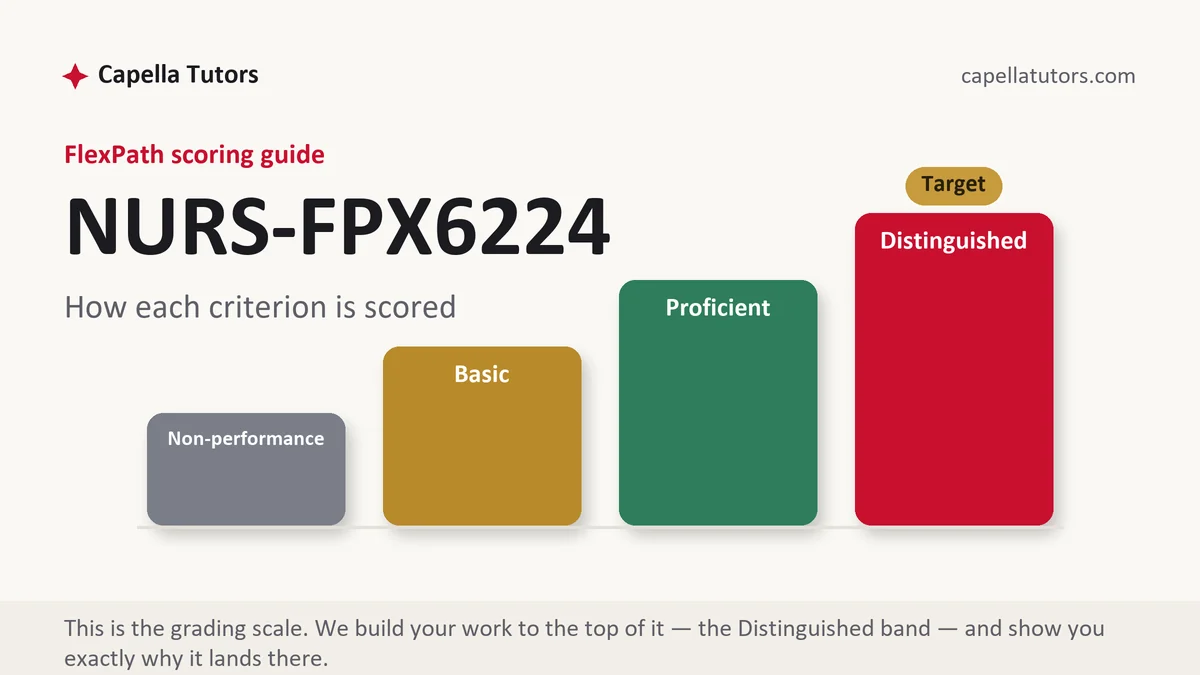
What NURS FPX 6224 actually grades
Nobody is grading your enthusiasm for technology. The criteria are grading a purchasing and adoption decision made by someone who will be held responsible for it. That means the deliverables in this course typically ask you to define a clinical or operational problem, establish what a system would have to do to solve it, appraise the options against those requirements, and then say what the change will cost, what it will return, and who will be worse off on the first Monday after go-live. The most common failure is a paper that describes a technology beautifully and never makes a decision. Decisions are what the top column pays for.
Workflow is the second graded strand and the one nurses are unusually good at. Every system changes who does what, in what order, with how many hands free, and the criteria expect you to show that change rather than assert it. Map the current state and the future state, count the steps, name the handoffs, and be specific about the tax: an extra scan at every administration, an alert that fires often enough that experienced staff learn to dismiss it. Alert fatigue, workarounds, and downtime procedures belong in the analysis because they are where the promised benefit usually leaks away.
Third comes governance of the data itself. A leader who buys a system also buys a data obligation: who owns each element, who may see it, how definitions are kept consistent so two reports do not disagree, where the audit log lives, how long records are retained, and how the system will exchange information with what the organization already runs. Access follows the minimum necessary standard, not convenience, and that has to appear in the plan rather than in a closing paragraph about privacy being taken seriously. Assessments in this course generally reward a candidate who treats data as an asset under management, with named stewards and a review cadence, because that is what distinguishes an informatics leader from an enthusiastic user.
How we help in this course
We draft 6224 work as a decision document. Requirements come first and get weighted, options get scored against them, the workflow comparison is written step by step, the governance section names roles, and the financial case shows its arithmetic instead of gesturing at value. Send us the setting and the problem, a discharge process, a monitoring gap, a documentation burden, whatever your prompt points at, and the draft argues from your organization's constraints rather than from a technology brochure.
Everything runs on the studio's standard terms. One deliverable, 24 to 48 hours, written to the Distinguished target, two independent reads before it reaches your inbox, and free revisions until the criterion you were worried about is the criterion you cleared. Faculty comments return into the same cycle without a fee, which is worth knowing in this course, where evaluators frequently ask for one thing: show me the number behind that claim.
The assessments, one by one
Assessment 1
The opening deliverable in NURS FPX 6224 sets up everything the course grades afterward. Read the full Assessment 1 manual.
Assessment 2
The second deliverable in NURS FPX 6224 is an evaluation of need rather than a purchase. Read the full Assessment 2 manual.
Assessment 3
The third deliverable in NURS FPX 6224 is widely written as a strategic plan for a health technology, and it is the assessment where the course stops being about a tool and becomes about a decision. Read the full Assessment 3 manual.
Assessment 4
The closing deliverable in NURS FPX 6224 usually moves from the decision to the delivery: your scoring guide sets the format, and the assessment typically asks for an implementation plan detailed enough that somebody else could run it. Read the full Assessment 4 manual.
How to actually write NURS FPX 6224: where to begin
Begin by turning the scoring guide into your table of contents. One criterion, one heading, the Distinguished sentence pinned underneath it, and then write only what those headings ask for. In 6224 the criteria usually break into four moves: state the problem and what the current technology does about it, evaluate candidate solutions against defined requirements, analyze the effect on workflow and on the people doing that work, and account for cost, benefit, data governance, and evaluation after go-live.
Choose a problem that a system could plausibly fix and that you can size. Good candidates are unglamorous: nurses charting vital signs twice because the monitors do not interface, a handoff that lives in a paper notebook, telemetry alarms nobody can triage from the desk. Weak candidates are ambitions rather than problems, such as adopting artificial intelligence or going paperless. Write the problem as a sentence with a count in it, how many duplicate entries a shift, how many minutes a handoff takes, how many alarms an hour, because the count becomes the denominator of your entire financial case.
Then do the return-on-investment arithmetic in the open, because this is where 6224 papers separate. Suppose a secure clinical communication and handoff tool costs $86,000 to license and build, plus 1,100 training hours at a loaded $48 an hour, which is $52,800, so $138,800 to reach go-live. Recurring cost is $19,000 a year in subscription and about $24,000 a year for the fifth of an informatics nurse's time it will consume, so call it $43,000 annually. On the benefit side, the unit runs roughly 42 nursing shifts a day, which is 15,330 shifts a year; if each saves 11 minutes of documentation and phone tag, that is 2,810 hours, or about $134,900 of nursing time. Do not claim all of it. Time savings spread across a shift rarely convert into a position, so count half, $67,450, and say in writing that you discounted it. That leaves $24,450 of net annual benefit against soft savings alone, and a payback period north of five years, which is a genuinely weak case. Now add the hard benefit: six avoided communication-related events a year at a defensible internal cost of $7,400 each is $44,400, taking net annual benefit to $68,850 and payback on the $138,800 to just over two years. Show that sequence and the criterion is satisfied: the case rests on avoided harm rather than saved minutes, and any reviewer can test the logic.
| Section | What goes in it | What Distinguished looks like |
|---|---|---|
| Problem and current state | The clinical or operational failure, counted, and what the existing systems do about it today. | A quantified gap tied to a workflow step, with the current technology's limits named. |
| Requirements and options | What a system must do, weighted, and the candidates measured against that list. | A scored comparison with a decision, and the rejected option refused for a stated reason. |
| Workflow impact | Current-state and future-state steps, the handoffs that move, and the new burden created. | Step counts before and after, plus one honest disadvantage the change introduces. |
| Data governance and privacy | Ownership, stewardship, access under minimum necessary, audit logging, retention, interoperability. | Named stewards, a review cadence, and definitions locked so two reports agree. |
| Cost and return | One-time and recurring cost, quantified benefit, the assumptions, and the payback period. | Arithmetic shown, soft savings discounted openly, sources given for every input. |
| Adoption, evaluation, references | Training, super users, downtime plan, the post-go-live measures, current APA both ways. | Metrics with baseline values and review dates, plus a stated point at which you would reverse course. |
Developing the analysis
Health informatics evidence is a field of qualified results, which gives this criterion something to work with. Computerized order entry and clinical decision support reduce certain prescribing errors and also create new failure modes, including alerts overridden so routinely that the safety benefit erodes. Barcode administration systems show error reductions in study conditions and produce documented workarounds in practice when the scanner, the armband, or the network is unreliable. Pick one of these tensions and work it properly: state what the favorable studies measured, state what the unfavorable ones measured, identify the implementation variable that explains the difference, and then require that variable in your own plan. If workaround rate is what separates success from failure, your evaluation section has to measure workaround rate. Repeating a vendor's efficiency claim, or a single study's effect size, is the Basic column in this course. Naming the condition under which the benefit appears, and then building for that condition, is the top one.
Citations that survive faculty review
Keep the two layers separate in your head. Peer-reviewed informatics and nursing research from roughly the last five years, retrieved through the Capella library, CINAHL, and PubMed, supports every claim about error rates, time savings, or adoption behavior. The standards and policy layer supports obligations and definitions: AHRQ health information technology material, Institute for Healthcare Improvement work on reliability, Joint Commission requirements including its guidance on clinical alarm management and information management, CMS program and interoperability rules, and AONL competencies where the deliverable touches the executive role. Vendor white papers are not a third layer. They can describe a product's features, they cannot establish an outcome, and using one as evidence for a benefit claim is the single quickest way to lose the evidence criterion. Write each citation into the sentence it supports so the source is doing argumentative work, then run the two-way match between text and reference list in current APA before you submit.
The mistakes that land Basic instead of Distinguished
- Describing instead of deciding. Three pages on what a system does, with no recommendation and no rejected alternative, leaves the evaluation criterion empty.
- Vendor numbers as evidence. A percentage from a sales sheet has no denominator, no setting, and no method, so it cannot carry a claim.
- No cost of adoption. Licenses are the cheap part; training hours, backfill, interface work, and the productivity dip after go-live are where the money actually goes.
- Privacy as a closing sentence. Governance is a design section with owners and access rules, not a reassurance at the end of the paper.
- Silence about the downside. Every system taxes somebody; naming who, and how you will compensate them, is what the analysis level rewards.
NURS FPX 6224 questions students actually ask
How do I calculate return on investment when the benefit is avoided harm?
You price the event, you estimate how many events the technology prevents, and you show your working. Ask your quality or finance department what the organization uses as an internal cost per medication event, per fall with injury, or per hospital-acquired infection, since most of them hold a figure for exactly this purpose. Then take the reduction rate from published studies rather than from the vendor, apply it to your own baseline count, and state the result as a range with the assumption printed beside it. A criterion is satisfied by a defensible estimate whose logic a reader can audit. It is not satisfied by a vendor percentage repeated without a denominator.
Can I write about a system my organization already implemented?
Yes, and retrospective analysis often scores better than a hypothetical purchase, because you can describe what actually happened to the workflow. Write it as an evaluation: what the selection decision was supposed to buy, what the go-live cost in hours and disruption, which parts of the promised benefit materialized, which did not, and what the organization would do differently. The evidence criterion is easier to satisfy with real adoption data than with projections, and the recommendation section becomes a remediation plan, which is a genuinely executive document.
How technical does the writing need to be?
Precise, not deep. You are expected to use interoperability, interface, discrete field, audit log, and role-based access correctly, and to know that a report is not the same thing as a data feed. You are not expected to write specifications or to explain how a standard is structured. The register that scores well is the one a nurse director uses with an IT project manager: exact about what the system must do and what data it must produce, indifferent to how the vendor makes that happen. When a sentence starts explaining the technology instead of the decision, cut it.
Have a 6224 deliverable open?
Give us the prompt, the criteria, and the problem you want the technology to solve. The first premium sample is free and lands inside two days.