This manual is for MHA FPX 5010 Assessment 3, start to submission. The final deliverable in the sequence is the one that has to commit. The assessment usually asks for a direction the mission can defend and a set of objectives carrying a baseline, a target, a date and an owner, with the capital, workforce and regulatory consequences attached. A document that stops at analysis fails the criterion that matters most here, because a plan is a set of commitments and an analysis is not. Each criterion in your scoring guide is judged once, and the plan has to satisfy all of them. Below is the order our tutors commit things in, the section budget it needs, and an annotated sample excerpt. Rather hand it off? A premium original sample for this exact assessment lands in 24 to 48 hours with objectives already auditable, revised free until the criteria clear. Capella's catalog lists the course as MHA-FPX5010, and some courserooms print MHA5010; both point to this same Assessment 3. In current courserooms this assessment typically appears as "Directional Strategies".
One honesty note before the manual: Capella revises courses and scoring guides over time, so always write to the exact scoring guide attached to your assessment in the courseroom. The course identity above is verified on capella.edu; the method and structure below are our tutors' approach to it, not Capella's official rubric text.
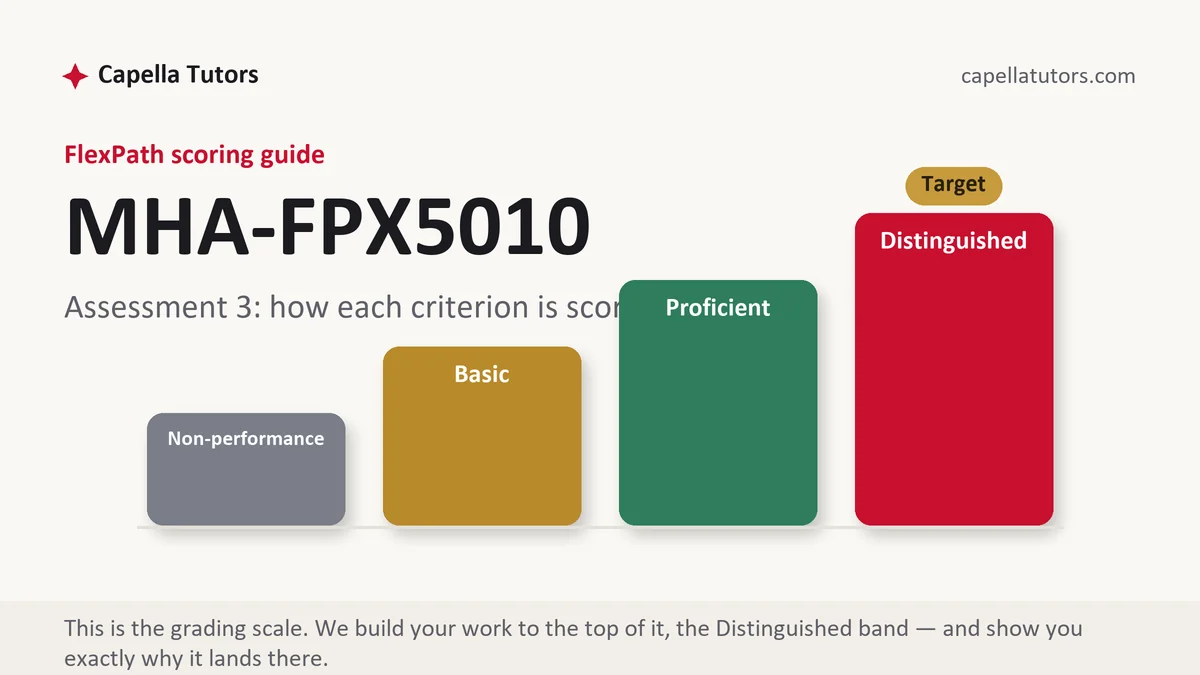
How MHA FPX 5010 Assessment 3 is scored
One judgment per criterion, four possible levels, and the level text describes exactly what the document has to contain:
| Level | What it means on a strategic plan |
|---|---|
| Distinguished | Every objective carries a baseline, a target, a date, an owner and a measurement source, the resources are reconciled to the forecast, and the plan says what it does if the competitor's project opens on schedule. Your criterion names the last step; write it in. |
| Proficient | A defensible direction with objectives that could be tracked. What usually holds it below the top is resourcing: a strategy whose staffing and capital consequences were never worked out. |
| Basic | Direction stated as aspiration. Grow the service line, strengthen community partnerships, become the provider of choice. |
| Non-performance | Objectives, implementation or the link back to the analysis is missing, and the criterion asking for a plan has only an essay to read. |
Fewer objectives score higher. Four with owners beat eleven without, and a plan that names which objective yields when a constrained resource runs short has answered a question most submissions never notice.
The MHA FPX 5010 Assessment 3 method, step by step
-
Choose the direction the analysis actually supports
Go back to the findings you flagged as decisive and pick the direction they point at, even if it is duller than the one you wanted. A strategy contradicted by the writer's own scan is the fastest way to lose the coherence criterion.
-
Test the direction against the mission and the license
Say what the organization's mission commits it to and whether the direction is consistent with it. Then check the regulatory step: some states require a certificate of need for beds, equipment or new services, and naming which state's rules apply is itself a mark of a serious plan.
-
Write four or five objectives, each auditable
Baseline, target, date, owner, measurement source. If a monitoring report could not pass or fail the objective at the end of the period, it is a theme rather than an objective, and themes cannot be reviewed.
-
Reconcile the plan to the forecast
The volume in the objectives, the volume in the forecast and the volume the implementation section resources must all be the same number. This is the most common internal contradiction in planning deliverables and it takes ten minutes to check.
-
Resource it in beds, people and dollars
Capital cost with a source, recruited positions with a time to fill, space with a square footage, and the operating cost of running the thing once it exists. Say who approves each, and say what the plan does if one approval is refused.
-
Write the monitoring section, then self-score
Name the dashboard the organization already produces, the cadence, the escalation threshold and the contingency if the competitor's announced project opens on time. Then read the draft criterion by criterion and rewrite anything short of the top row before you submit.
A structure that maps to the criteria
Section budgets our tutors work to on a typical 5010 plan deliverable. Where your scoring guide differs, follow the guide.
| Section | What it must do | Guide |
|---|---|---|
| Direction and rationale | The chosen strategy and the findings from the analysis that produced it. | ~250 words |
| Mission and regulatory fit | Consistency with the mission, and any state approval the direction would require. | ~200 words |
| Objectives | Four or five, each with baseline, target, date, owner and measurement source. | ~300 words |
| Implementation and resources | Capital, workforce, space and operating cost, reconciled to the forecast volume. | ~350 words |
| Risks and contingency | What stops the plan, and what the plan does when the competitor moves first. | ~200 words |
| Monitoring and references | The existing dashboard, the cadence, the escalation threshold, APA both ways. | ~200 words |
Annotated sample excerpt
One objective from a model plan our team wrote, marked at the three places an objective either earns its criterion or does not.
Objective 2: raise cardiology outpatient volume originating in the northern secondary service area from a baseline of 1,340 visits in the year ending June to 1,880 visits by June 2029, owned by the vice president of ambulatory services and measured monthly on the existing service line volume dashboard by patient origin.1 Delivery is two outreach clinic days a week in the Hallam County medical office building, which is 416 additional session slots a year at 1.3 visits a slot, resourced with 0.4 of a cardiologist, one medical assistant and $71,000 of one time build out.2 If the recruited cardiologist is not in post by January, this objective yields to Objective 1 rather than running at half strength, because a clinic open one day a week trains the referral pattern to go somewhere else.3
- 1Baseline, target, date, owner and the report that measures it, all in the first sentence. An objective a monitoring meeting can pass or fail is the whole requirement.
- 2The target converts into session slots, clinical hours and capital before it is committed to, so the objective and the resource plan describe the same volume.
- 3The yield rule is stated in advance and reasoned. Naming which objective gives way under constraint is the sentence that separates a plan from a wish list.
The full premium sample for your exact assessment, written fresh to your scoring guide and issue, is free to request. Study it, revise it into your own voice, and submit work you understand.
The five mistakes that cost Distinguished
- Objectives without owners. A target nobody is named against becomes everybody's aspiration and nobody's work by the second quarter.
- A plan that contradicts its own forecast. Three different volumes in the objectives, the projection and the staffing model tells an evaluator nobody reconciled the document.
- Unresourced direction. A strategy with no capital, workforce or licensing consequence attached is a preference with a heading on it.
- Regulatory silence. Proposing beds, equipment or a new service without checking whether the state requires an approval invalidates the timeline the rest of the plan rests on.
- Monitoring by invention. Assigning oversight to a dashboard the organization would first have to build guarantees the plan is unmonitored from the start.
Pre-submission checklist
- A direction traceable to the findings the analysis flagged as decisive
- Four or five objectives, each with baseline, target, date, owner and measurement source
- The same volume appearing in the forecast, the objectives and the resource plan
- Capital, positions, space and operating cost priced, with an approver named
- Any state approval requirement identified, with the jurisdiction stated
- A contingency for the competitor's announced project, APA checked both ways
Plan due and the objectives still aspirations?
Send the guide, the scan and the forecast you have. We choose the direction the evidence supports, write objectives a monitoring meeting could pass or fail, reconcile them to the resource plan and add the contingency. Back in 24 to 48 hours, revised free for as long as it takes.