This manual is for MAT FPX 2150 Assessment 1, start to submission. The opening deliverable in this course usually sets a real claim in front of you and asks whether it survives inspection. Almost every claim you will be handed is literally true, which is what makes it worth studying, so calling it misleading earns nothing. What earns the row is naming the choice that produced the impression, showing the arithmetic that exposes it, and writing the honest version. Our tutors' method is set out below, with a structure built from the rows and an annotated excerpt. Prefer to send the item over? A premium original sample built around the item you were assigned returns in 24 to 48 hours, revised free until each row clears. Capella's catalog lists the course as MAT-FPX2150, and some courserooms print MAT2150; both point to this same Assessment 1.
One honesty note before the manual: Capella revises courses and scoring guides over time, so always write to the exact scoring guide attached to your assessment in the courseroom. The course identity above is verified on capella.edu; the method and structure below are our tutors' approach to it, not Capella's official rubric text.
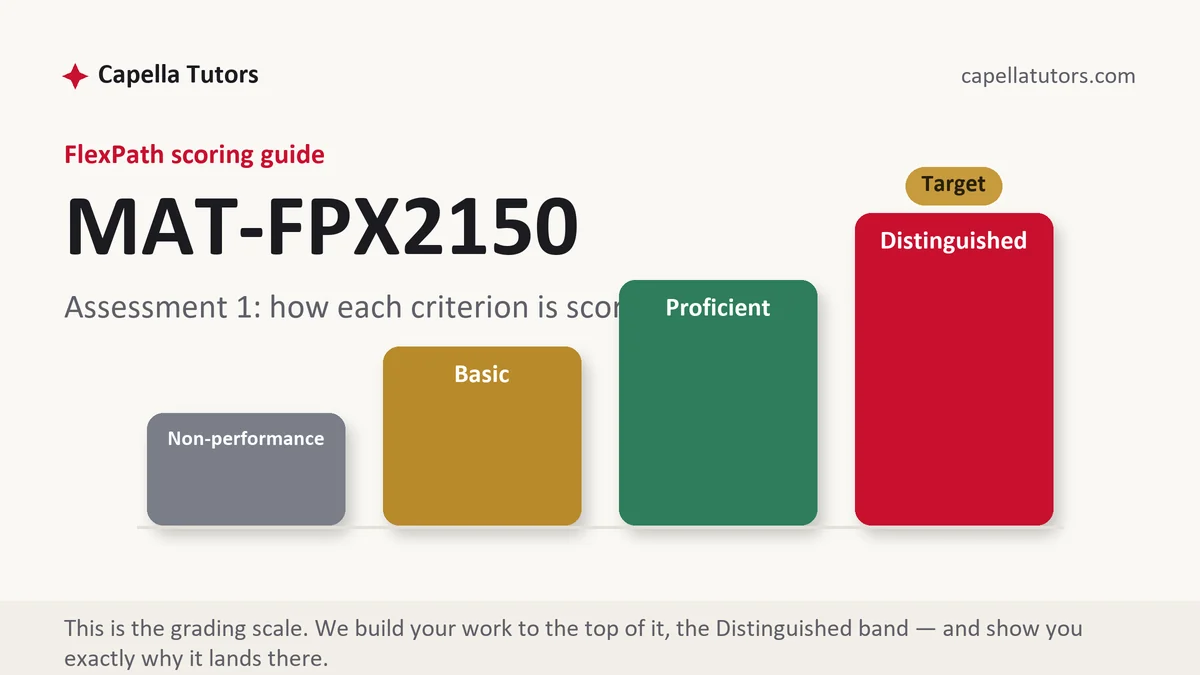
How MAT FPX 2150 Assessment 1 is scored
The guide records a level for each row rather than a mark. Four are available, and the sentence in each describes work you can aim at:
| Level | What it means on a claim analysis deliverable |
|---|---|
| Distinguished | The claim is quoted exactly with its source and date, the figure behind it is traced to an original table, the relative and absolute versions are both computed, the missing quantity is supplied as a number, and the corrected sentence is written for the audience the prompt named. |
| Proficient | The claim is checked accurately and the arithmetic is right. Correct work with the rewrite left generic. |
| Basic | The claim called misleading with an adjective doing the work, or the relative figure repeated with no absolute figure beside it. |
| Non-performance | A required element never appears, most often the rewrite or the source of the underlying number. What empties a row is an element that never appears, not one that is thin. |
Relative and absolute descriptions come from the same two numbers and land on a reader very differently. Halved is accurate and unusable; four fewer failures in every hundred test takers is accurate and decidable. A row about communication is scored on which of those a reader could act on.
The MAT FPX 2150 Assessment 1 method, step by step
-
Read the criteria and write the audience at the top
Prompts here routinely name who the corrected version is for, and the communication row is scored against that person rather than against your instructor. Set the audience down first and let it decide every word choice underneath.
-
Quote the claim rather than paraphrasing it
Copy the sentence exactly, with where it appeared and when, and keep the screenshot. A paraphrase is always easier to knock down than the original, and the row notices which one you argued with.
-
Find the number under the claim
Go to the table or the report the figure came from, not the article repeating it. If forty minutes of searching finds no source, that absence is itself worth writing about and usually makes the better analysis.
-
Compute both versions of the change
Give the relative figure the advertisement used and the absolute figure it left out, in the same paragraph. Add how many people the outcome would take to change once, since that number is what a reader recognizes.
-
Name the choice that created the impression
One specific decision: a base picked because it was unusual, a subgroup reported as though it were everyone, a percentage standing in for a count, or a comparison group withheld. Generic complaint scores nothing.
-
Write the honest sentence, then self-score
One sentence the source can support, pitched at the named audience, using no term they would have to look up. Then mark every row against the guide and submit with two business days in hand.
A structure that maps to the criteria
Read the counts as planning figures our tutors use on claim analysis, not as a standard; your own scoring guide decides the emphasis.
| Section | What it must do | Guide word target |
|---|---|---|
| The claim | The sentence quoted exactly, with where and when it appeared and who published it. | ~140 words |
| The numbers behind it | The figure, its denominator, the period it covers, and the original table it came from. | ~190 words |
| Relative against absolute | Both versions of the change computed, with the arithmetic shown and units carried through. | ~240 words |
| What is missing | The comparison group, the baseline, or the absolute size, supplied as a figure rather than noted as absent. | ~200 words |
| The honest version | The claim rewritten so its source supports it, for the audience the prompt named. | ~180 words |
| Sources | The item examined cited as itself, the data table cited in current APA with its retrieval date. | as needed |
Annotated sample excerpt
A model analysis from our writers, written at the register the highest level names. Study it, then write the same moves in your words.
The banner reads that subscribers are half as likely to fail the certification on their first attempt, sourced to the company's own survey of 1,400 subscribers and dated to a March release.1 The two figures behind it are a 4 percent first-attempt failure rate among subscribers against 8 percent among non-subscribers, so the halving is accurate, while the absolute change is 4 fewer failures in every hundred test takers and about 25 people would have to subscribe for one additional first-attempt pass.2 The choice that created the impression is the reporting of the relative figure alone, and the honest sentence is that among 1,400 subscribers who answered the survey, 4 percent failed on the first attempt against 8 percent of non-subscribers, a gap that could also reflect the extra studying anyone who buys an app is already doing.3
- 1The claim is quoted rather than summarized, and its publisher and date arrive with it. Arguing with a paraphrase is a row lost before the arithmetic starts.
- 2Both descriptions of the same change are computed side by side, and the number of people needed for one different outcome is added because that figure is what a reader can picture.
- 3The specific choice is named, then the rewrite stays inside what the survey supports and admits the self-selection. Nothing in it is hostile and every part of it is scoreable.
The full premium sample for your exact assessment, written fresh to your scoring guide and issue, is free to request. Study it, revise it into your own voice, and submit work you understand.
The five mistakes that cost Distinguished
- A proportional change reported with no absolute size next to it. Halved and four fewer in a hundred describe one event to two different readers, and only one of them can be acted on.
- The claim paraphrased before it is examined. A reworded version is easier to attack and is not the sentence the assessment handed you.
- The article cited instead of the table. Coverage of a figure is not the figure, and the row asks where the number was published.
- Misleading used as the finding. An adjective cannot be scored; the specific choice, the arithmetic, and the missing quantity can.
- A rewrite aimed at nobody. The audience named in the prompt is the audience the communication row is graded against.
Pre-submission checklist
- Each row of the guide given its own section, with the audience at the top
- The audience named at the top and held to throughout
- The claim quoted exactly, with publisher, date, and where it appeared
- The underlying figure traced to an original table and cited with its retrieval date
- Relative and absolute versions both computed, with the arithmetic shown
- One honest sentence written for the named audience, every row self-scored
A published claim to take apart?
Send the criteria together with the advertisement, report, or bill you were assigned. A team of eight, including a research analyst and two QA reviewers, returns a premium original sample in 24 to 48 hours with the source found, the arithmetic shown, and the honest sentence written for your named audience, revised free until the rows clear.