This manual is for MAT FPX 2001 Assessment 2, start to submission. Design a Focused Survey Template asks you to refine the initial design into a focused survey: final questions with clear wording and appropriate answer formats, the type of variable each question produces, such as categorical or quantitative, and how you will analyze the responses, using the template in the courseroom. The grade turns on the link between question and analysis. A question whose answer format matches the statistic you plan to use scores above a well-worded question with no analysis plan. Below is the method our tutors use, a structure that maps to the criteria, and an annotated sample excerpt. Prefer to hand it off? A premium original sample for this exact assessment comes back in 24 to 48 hours, revised free until it meets the guide. Capella's catalog lists the course as MAT-FPX2001, and some courserooms print MAT2001; both point to this same Assessment 2. In current courserooms this assessment typically appears as "Design a Focused Survey Template".
One honesty note before the manual: Capella revises courses and scoring guides over time, so always write to the exact scoring guide attached to your assessment in the courseroom. The course identity above is verified on capella.edu; the method and structure below are our tutors' approach to it, not Capella's official rubric text.
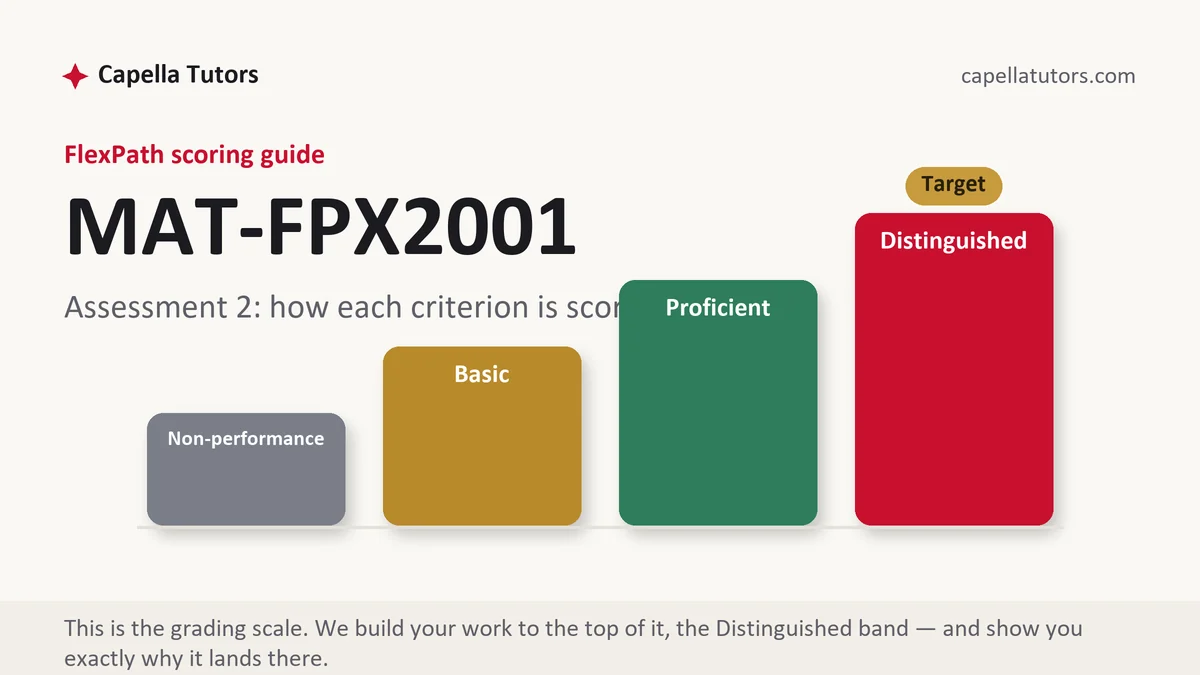
How MAT FPX 2001 Assessment 2 is scored
FlexPath does not use letter grades. Each criterion in the scoring guide lands on one of four levels, and the level descriptions are the real writing brief:
| Level | What it means on the focused survey design |
|---|---|
| Distinguished | Questions are focused, neutral and clearly worded, answer formats fit each question, variable types are identified correctly, and the analysis plan matches each variable. |
| Proficient | The survey is well designed, but some variable types or analysis plans are unclear. |
| Basic | Questions are broad or leading and the analysis plan is missing in places. |
| Non-performance | A template section is missing. |
Build directly on the topic and population from Assessment 1.
The MAT FPX 2001 Assessment 2 method, step by step
-
Narrow the questions
Keep only questions that answer your research question.
-
Choose answer formats
Yes or no, multiple choice, Likert scales or numbers.
-
Identify variable types
Categorical, ordinal or quantitative for each question.
-
Plan the analysis
Percentages for categorical data, means and standard deviations for quantitative data.
-
Check wording
Remove leading or double-barreled questions.
-
Pilot if possible
Ask a few people to test the survey for clarity.
A structure that maps to the criteria
Complete the template in your courseroom; these are the fields evaluators check.
| Section | What it must do | Guide |
|---|---|---|
| Study purpose and population | Carried from Assessment 1. | template field |
| Focused questions | Final wording and answer formats. | template field |
| Variable types | For each question. | template field |
| Analysis plan | Statistic for each variable. | template field |
Annotated sample excerpt
An original model excerpt from our team, written to show the register that reaches the top of the guide. Learn the moves, then write your own version.
Question 4: "On average, how many days per week do you work from home?" with answers 0 to 5.1 This produces a quantitative, discrete variable, so the analysis will report the mean and standard deviation and a histogram of the distribution.2 An earlier draft asked, "Do you enjoy working from home and find it productive?", which combined two questions and could not be analyzed cleanly, so it was split into two separate items.3
- 1Writes a clear question with defined answers.
- 2Identifies the variable type and matching analysis.
- 3Shows how a flawed question was fixed.
The full premium sample for your exact assessment, written fresh to your scoring guide and topic, is free to request. Study it, revise it into your own voice, and submit work you understand.
The five mistakes that cost Distinguished
- Questions off topic. Keep only what answers your research question.
- Mismatched formats. Choose formats that fit the analysis.
- Wrong variable types. Check categorical versus quantitative.
- Double-barreled questions. Ask one thing at a time.
- No analysis plan. Name the statistic for each question.
Pre-submission checklist
- Focused questions
- Appropriate answer formats
- Variable types identified
- Analysis plan for each
- Neutral wording
- Template completed
Want the focused survey template written?
Send the scoring guide and any materials from your courseroom. Our team returns a premium original focused survey template in 24 to 48 hours, revised free until it meets the guide.