This manual is for IT FPX 4993 Assessment 2, start to submission. The middle deliverable in IT FPX 4993, Cybersecurity Capstone, is the one the course exists for: choose the controls, then defend each choice against the option you rejected, with the arithmetic on the page and the condition that would reverse the decision stated plainly. Each criterion is decided alone against the guide your own courseroom issued. The order our tutors work in is set out below, beside an outline mapped to the criteria and a marked passage. Rather delegate it? A premium original sample for this exact assessment lands in 24 to 48 hours with every selection argued rather than announced, revised free until the guide is satisfied. Capella's catalog lists the course as IT-FPX4993, and some courserooms print IT4993; both point to this same Assessment 2.
One honesty note before the manual: Capella revises courses and scoring guides over time, so always write to the exact scoring guide attached to your assessment in the courseroom. The course identity above is verified on capella.edu; the method and structure below are our tutors' approach to it, not Capella's official rubric text.
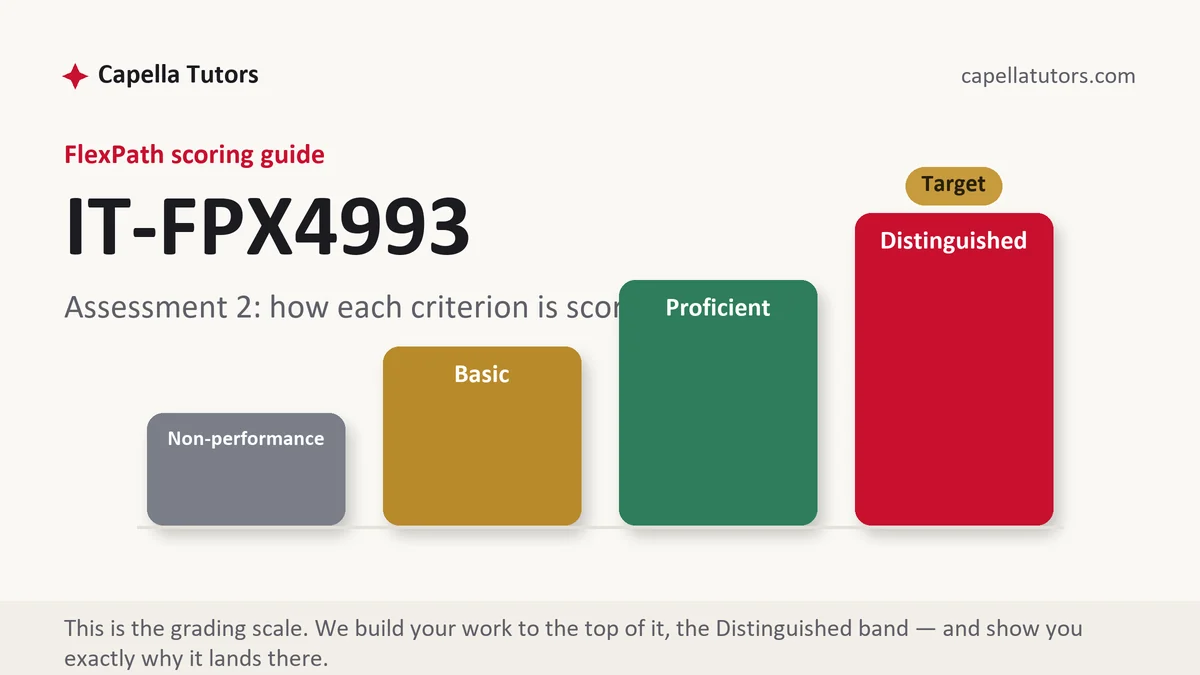
How IT FPX 4993 Assessment 2 is scored
Four levels per criterion, each decided on its own, and no total underneath. In this deliverable the gap between the middle two levels is almost always one absent clause:
| Level | What it means on a control selection and defense deliverable |
|---|---|
| Distinguished | Every selection names the option it beat, the constraint that decided it, the cost accepted and the circumstance that would flip the answer, with the framework reference the control satisfies cited by revision. The extra move is the reversal condition, and it is the cheapest column in the course to earn. |
| Proficient | The controls are appropriate and mapped to a framework. Complete and professional, one column short because nothing on the page says what was rejected. |
| Basic | A list of sensible controls nobody would argue against. Correct selections with no visible reasoning land here almost every time. |
| Non-performance | A required element is absent, most often the framework mapping or any consideration of alternatives. What is missing costs the criterion outright. |
Notice what the pattern is doing. Choice, alternative, deciding constraint, cost accepted, reversal condition, repeated for every decision in the portfolio, is what turns a set of recommendations into a defense, and it is the same five moves whether the subject is logging, backups or endpoint control.
The IT FPX 4993 Assessment 2 method, step by step
-
Select against the register rather than against a catalog
Each control you propose should point at a numbered risk from your own assessment. A control chosen because it is good practice has no argument attached, while a control chosen because it addresses the third row of your register inherits all the evidence you already gathered.
-
Map each selection to a framework reference by revision
Name the control catalog item or the framework function the selection satisfies, with its revision, so a reader can see the recommendation is not improvised. Then say where your selection goes beyond the reference and where it deliberately falls short.
-
Put the money on the page
A three-year total is more honest than a purchase price, and a per-unit cost multiplied out is more honest than a bundle. Show the arithmetic in the sentence rather than in an appendix nobody opens, because an argument a manager can check is the one that gets approved.
-
Let a constraint decide it, not a preference
Cost, staffing, an existing contract, a compliance obligation or the way the workforce actually operates. Name the single deciding factor in one sentence, because a decision attributed to several factors at once reads as a decision nobody made.
-
State the cost you accept and the condition that reverses it
Every choice gives something up. Write what you gave up, then write the change in circumstances under which you would choose the other way, which proves the comparison was real rather than decorative.
-
Keep the rejected options cited
A defense is stronger when the alternative was researched than when it was dismissed, so the vendor documentation and the published evidence behind the option you did not take belong in the reference list too, with dates on anything priced.
A structure that maps to the criteria
Internal targets for the defense stage of a capstone rather than published requirements; the criterion carrying most weight in your guide is the one to lengthen.
| Section | What it must do | Guide |
|---|---|---|
| Selection basis | How controls were chosen, which register rows drive which selections, and the framework references in play with revisions. | ~200 words |
| Identity and access decisions | What was selected, what was rejected, the deciding constraint, the cost accepted and the reversal condition. | ~300 words |
| Logging and detection decisions | Destination, retention, what is collected and what is deliberately not, argued the same five ways. | ~300 words |
| Recovery and resilience decisions | Backup approach, restore testing, retention and immutability, with the arithmetic behind the choice on the page. | ~300 words |
| Framework mapping table | Each control against the reference it satisfies, the register row it answers, and any gap left open deliberately. | ~150 words |
| Unresolved questions and sources | What you could not test, the pilot that would settle it, and vendor and standards documentation cited with dates in current APA. | ~200 words |
Annotated sample excerpt
An excerpt our team wrote at the level a guide's highest column describes. Study the five moves in order, then run them on your own decisions.
Logs from the water utility's business network go to a hosted collection service rather than to a server in the basement, and the deciding constraint is staffing rather than cost, because the utility employs one and a half people in technology and neither of them can patch and tune a search cluster on top of the existing workload.1 The arithmetic does not favor the decision and is reported anyway: the hosted service is quoted at 1,150 dollars a month for the ingest volume the environment produces, which is 41,400 over three years, while a self-hosted collector is roughly 9,000 in hardware plus 2,400 a year in licensing, about 16,200 across the same period, so the choice costs 25,200 dollars for an operational capability nobody on staff currently has.2 The reversal condition is a headcount change: a second full-time administrator makes the self-hosted option the correct answer and the saving real, and the cost accepted meanwhile is that log data lives with a third party, which is why the retention setting and the exit clause are named in the contract section rather than left to the vendor.3
- 1Names the choice and the single deciding constraint in one sentence, and it is not the obvious one. A decision driven by staffing rather than price reads as somebody who knows the organization.
- 2Reports arithmetic that argues against the decision. Volunteering the inconvenient total is the strongest credibility move available in a capstone defense.
- 3Supplies the reversal condition and the cost accepted, then points at where the accepted cost is managed. Three obligations discharged in one sentence.
The full premium sample for your exact assessment, written fresh to your scoring guide and issue, is free to request. Study it, revise it into your own voice, and submit work you understand.
The five mistakes that cost Distinguished
- A control stated with no alternative. Naming a measure nobody would argue against leaves the analysis criteria with nothing to grade.
- Costs quoted as a purchase price. A license figure with no term, no unit count and no three-year total cannot be compared with anything.
- Several factors credited with one decision. A choice attributed to cost, security and usability at once reads as a decision that was never actually made.
- Framework references with no revision. Control identifiers and wording move between revisions, so an unversioned mapping cannot be checked against the catalog.
- No reversal condition anywhere in the document. A comparison with no circumstance that would change the answer was a formality rather than an analysis.
Pre-submission checklist
- Every criterion in the guide has a section with a matching name
- Each control pointing at a numbered row in your own risk register
- Framework references cited with revisions, gaps left open deliberately named
- Arithmetic shown in the sentence, with a multi-year total
- One deciding constraint per decision, stated in a single sentence
- Cost accepted and reversal condition written for each choice, current APA both ways
Defense sections due and the arithmetic missing?
Send your register, the controls you are considering and the criteria for this stage. Each selection comes back with the option it beat, the deciding constraint, the multi-year arithmetic and the condition that would reverse it, mapped to a framework reference by revision. The first premium sample is free.