Bring us the organization, the scoring guide, and whatever scope you have sketched, and a premium original sample comes back inside 24 to 48 hours with an artifact set that agrees with itself and a written defense for every technical choice in it, read twice before it reaches you. This course appears on your plan as IT FPX 4993, Cybersecurity Capstone, worth 3 program points, the capstone of the Information Assurance and Cybersecurity FlexPath specialization inside a BS in Information Technology that requires at least 90 program points with a minimum of 27 at the 3000 level or above. Take the sequencing and any prerequisite gate from your own program evaluation, because a capstone is the one course where a registration surprise costs a whole billing session. In Capella's catalog the course code is written IT-FPX4993.
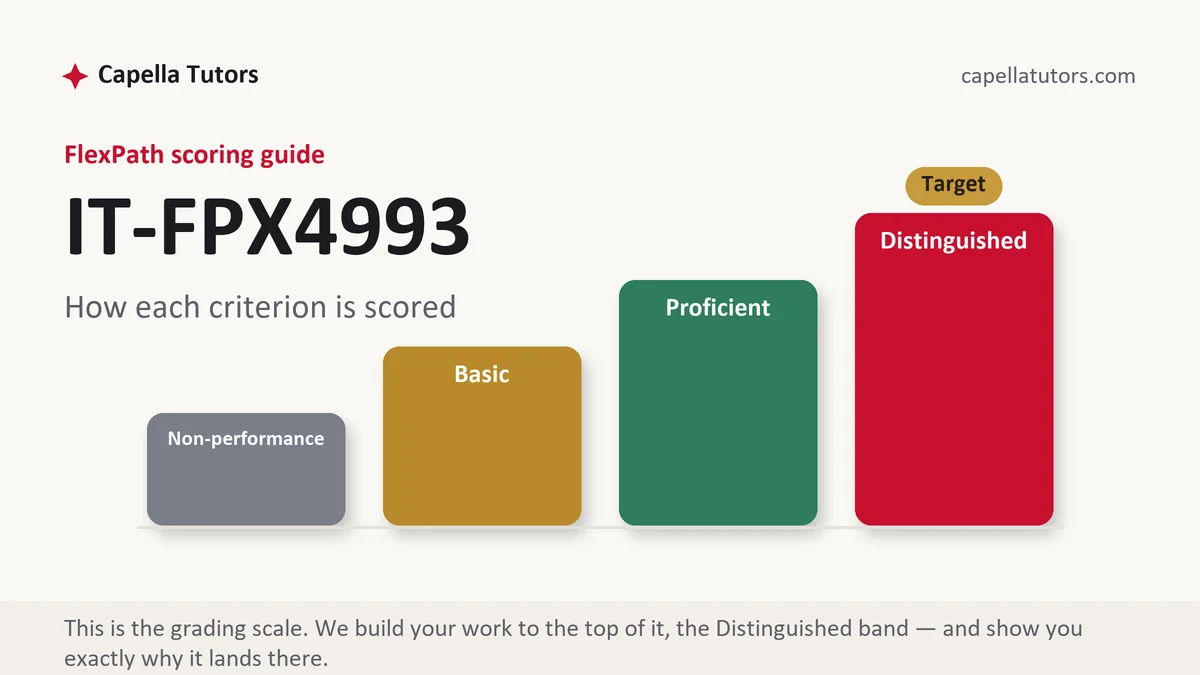
What IT FPX 4993 actually grades
A capstone is graded on whether the degree adds up, which is a different question from whether you learned anything new. Little of the technical content here will be unfamiliar, and the criteria are not looking for novelty. They are looking for integration: an organization defined tightly enough to analyze, a security problem inside it stated in one sentence, and a body of work that somebody could read without you standing next to it explaining what you meant. That body of work usually arrives as a set rather than as an essay, and coherence across the set is the single largest source of lost marks. The network diagram, the asset inventory, the risk register, the control mapping, the policy language, the incident response procedure, and the implementation roadmap all have to describe the same system using the same names and the same numbers. A server called the application host in the diagram and the production server in the risk register is not a naming problem, it is a signal to the reader that the documents were written separately and never reconciled.
The second thing being graded, and the one this course exists for, is the defense. Every technical choice you make has an alternative you did not take, and the top of the scoring guide belongs to students who name it out loud. A sentence saying that multifactor authentication was selected earns nothing, because nobody was going to argue against it. A paragraph saying that hardware-backed authenticators were chosen over push-notification approval, because approval fatigue is what defeated the second factor in the incident that started this project, at a cost per user and a replacement process for lost tokens, and that the decision would reverse if the workforce turned over fast enough to make token logistics dominate, is a defense. Do that for the segmentation approach, the logging destination, the backup schedule, the authentication provider, and the awareness program, and the analysis criteria answer themselves. The move is always the same: the choice, the rejected option, the deciding constraint, the cost accepted, and the condition that would flip it.
The third thing is discipline, and capstones fail on it more often than they fail on skill. Scope is the first exposure, since a project that grows a section every week arrives shallow everywhere and finished nowhere. Evidence is the second, because a capstone claim is only worth what supports it, and a roadmap with no cost and no owner is a wish list with headings. Presentation is the third, and it matters more here than in any earlier course, since this is the artifact you will hand to an interviewer. That means a document a stranger can navigate, figures that carry captions and dates, an executive summary written for somebody who will read one page, and no real employer data left in it. If your case organization is genuine, anonymize it, say that you have done so, and keep live configuration, addresses, and credentials out of a file you intend to circulate.
How we help in this course
Capstone support from us starts with scope rather than with prose, because that is where the grade is decided. We read the guide, help you narrow the problem to something a billing session can actually contain, then build the traceability spine so every artifact answers a risk and every risk points to an artifact. Drafts come back with the defense written into them: each significant decision carries the alternative, the constraint, the cost, and the reversal condition, and the numbers in the roadmap reconcile with the numbers in the assessment. Tell us the organization, its size, the data it holds, and what your faculty member has already approved, and the whole set will describe one system rather than five.
Terms hold at capstone scale. Each piece lands inside 24 to 48 hours, written to the Distinguished descriptors, after eight people have worked it: research pulls your guide and the current standards, a subject writer builds the analysis and the artifact set, a scoring-guide reviewer grades the draft criterion by criterion, an APA and originality pass reconciles the sources, and an editor takes the final read. Revisions stay free until the guide is satisfied and faculty comments come back into the queue at no charge. Since an attempt can take two business days to be evaluated and a capstone usually carries more than one, the pacing that works is to get the earliest deliverable in well ahead of the date you have circled.
The assessments, one by one
Assessment 1
The opening deliverable in IT FPX 4993, Cybersecurity Capstone, generally asks you to fix the project in place: an organization defined tightly enough to analyze, a security problem stated in one sentence with four boundaries in it, an asset inventory and architecture view, the controls that already. Read the full Assessment 1 manual.
Assessment 2
The middle deliverable in IT FPX 4993, Cybersecurity Capstone, is the one the course exists for: choose the controls, then defend each choice against the option you rejected, with the arithmetic on the page and the condition that would reverse the decision stated plainly. Read the full Assessment 2 manual.
Assessment 3
The closing deliverable in IT FPX 4993, Cybersecurity Capstone, usually pulls the portfolio together and points it forward: a post-incident review with a timeline, a root cause separated from its symptoms, the control gaps the event exposed, a phased roadmap with owners and costs, a residual risk. Read the full Assessment 3 manual.
How to actually write IT FPX 4993: where to begin
Narrow before you write anything else. Draft the problem statement as one sentence with four boundaries in it: this organization, this system or population, this category of data, and this timeframe. Then test it by asking what evidence would show the problem is solved, and if you cannot answer, the statement is still too large. Once it holds, build the traceability spine as a single table with a row per risk or requirement and columns for the artifact that addresses it, the evidence that it was addressed, and the criterion in the guide it serves. Empty cells are your work plan for the rest of the session, and they also tell you which claims have to be softened into recommendations.
Then practice the defense on a decision with money attached, because that is where a written argument is easiest to grade and hardest to fake. Say the case organization runs a clinic network of 400 endpoints and the assessment recommends internal segmentation. Two routes are available. A pair of segmentation appliances costs 18,000 dollars up front with 4,200 a year in support, which is 30,600 over three years. Host-based microsegmentation licensed at 4 dollars per endpoint per month across 400 endpoints is 19,200 a year, or 57,600 over the same three years. On cost alone the appliances win by 27,000 dollars and a weak paper stops there. The defense keeps going: the appliance pair enforces policy only where traffic crosses it, so a laptop that leaves the building is unprotected until it returns, while the host agents travel with the device and hold policy on untrusted networks, which is the deciding factor for a clinic whose staff work from three sites and their homes. Then name the reversal: if the workforce were static and the endpoints were desktops that never moved, the appliances would be the correct answer and the saving would be real. Choice, alternative, arithmetic, deciding constraint, reversal condition. That is the paragraph the guide is asking for, repeated across every decision you make.
Close by being explicit about the limits of what you did. Name the tests you could not run, the systems you were not allowed near, the assumptions the whole analysis rests on, and the pilot that would settle the biggest open question. Then write the executive summary last, once the numbers have stopped moving, and keep it to one page that states the problem, the three findings that matter, the recommended program, its cost, and the decision you want made. A reader who stops after that page should still be able to repeat your argument accurately, and if they cannot, the summary is doing the wrong job.
| Section | What goes in it | What Distinguished looks like |
|---|---|---|
| Problem statement and scope | The organization, the system in scope, the data involved, the timeframe, and what is excluded. | A boundary tight enough to finish, with exclusions justified rather than quietly dropped. |
| Current-state assessment | Asset inventory, architecture view, existing controls, findings, and a risk register with ratings. | Findings sourced to observation or stated assumption, with ratings a reader could reproduce. |
| Design and control selection | Recommended controls, the framework references they satisfy, and the alternatives considered. | Every selection defended against the option rejected, with the deciding constraint named. |
| Implementation plan | Phases, dependencies, owners, costs, timeline, and the measures that will show it worked. | Costs carried through consistently, with sequencing that respects real dependencies. |
| Defence and residual risk | The written argument for each decision, what it costs, and what remains unaddressed. | Reversal conditions stated, and residual risk owned by a named role rather than left blank. |
| Portfolio and sources | Executive summary, figure captions, redaction statement, appendices, and current APA references. | A document a stranger can navigate, with every artifact naming the same system the same way. |
Developing the analysis
The argument most worth settling in a security capstone is how a limited budget splits between stopping incidents and surviving them, because every recommendation you make sits somewhere on that line. The prevention case is intuitive: patching, segmentation, authentication, and configuration hardening remove whole classes of event, and money spent there pays every day whether or not anything happens. The detection and response case is the one that experience teaches: prevention is never complete, an intrusion that goes unnoticed for weeks costs far more than one caught the same afternoon, and logging, alerting, tested backups, and a rehearsed response procedure are the only controls that change the outcome once the first control has already failed. The mistake in student papers is refusing to choose. Take a stated figure, say a security budget of 60,000 dollars for the year in your case organization, split it explicitly, and defend the split against the risk register you built rather than against a general principle. If your top three risks are credential theft, ransomware, and a lost laptop, then authentication and endpoint encryption are prevention money and tested offline backups plus a response plan are the survival money, and the ratio follows from those three rows. State what the split leaves undefended, and say which single additional purchase you would make first if another 10,000 dollars appeared.
Citations that survive faculty review
At capstone level a reference list is judged on whether these are the sources a practitioner would defend a real decision with. Primary standards carry the control language, meaning the national standards institute publications on risk management, controls, and incident handling, and the cybersecurity framework whose functions organize a program, each cited with its revision. Regulation carries obligation, so cite the rule text or the regulator's own published guidance rather than a summary written by somebody selling a product. Sector incident reporting carries scale, and the annual breach investigation and breach cost studies are usable if the publishing year appears in your sentence and you treat the figures as population averages rather than as your client's forecast. Vendor documentation is the correct source for what a product does and for what it costs, cited as vendor documentation with a date, and it is never evidence that the product is the right choice. Peer-reviewed work retrieved through the Capella library supports anything about human behavior, including why awareness training changes click rates by less than the vendor slide claims. Two capstone-specific habits matter. Label the artifacts you produced yourself as your own work rather than leaving a reader guessing whether a diagram came from a source, and keep your rejected options cited too, since a defense is stronger when the alternative was researched rather than dismissed. Reconcile everything in current APA in both directions.
The mistakes that land Basic instead of Distinguished
- A scope that grows every week. Adding a section each time something interesting appears produces a project that is broad, thin, and unfinished.
- A choice stated with no alternative. Naming a control without the option it beat leaves the analysis criteria with nothing to grade.
- Artifacts that contradict each other. When the diagram, the register, and the roadmap use different names and different totals, the reader stops trusting all three.
- A roadmap with no cost and no owner. Phases and dates without money and a named role are a schedule nobody can approve.
- Real employer data left in the file. Live addresses, configuration, and identifiable staff turn a portfolio piece into a document you cannot show anyone.
IT FPX 4993 questions students actually ask
Can I use my employer as the case organization?
Often yes, and only with permission and redaction. Ask your manager before you start rather than after the draft exists, because the conversation is easy in advance and awkward once a document is written. Then strip anything that identifies the organization or its people: replace the name, generalize the location, change host names and addresses, remove screenshots that carry a logo or a real account, and never include configuration files, key material, or anything resembling a credential. State in the front matter that details have been altered and that no confidential material appears, which protects you and tells the grader why the specifics look generic. If permission is not forthcoming, build a composite from public sector reporting and typical sizing, say plainly that the organization is constructed, and keep the numbers internally consistent, because an openly modeled case beats a real one you were not allowed to describe.
How big should the project actually be?
Small enough to finish with evidence, which is almost always smaller than the version in your head. The reliable test is the artifact list: write down every document you intend to produce, estimate the hours each needs honestly, and compare the total against the hours you can actually spend inside a twelve-week billing session while also writing the assessments themselves. One system assessed to real depth, with findings you can support and a plan somebody could execute, scores better in every criterion than an enterprise program sketched at the level of a slide deck. If the guide asks for breadth, get it by covering a full lifecycle on a narrow target rather than a shallow pass over a wide one, and say in the scope section what you deliberately left out and why.
How do I defend a choice when I could not test the alternative?
Say so in the sentence and then argue from what you do have, which is published evidence and your stated constraints. An untested comparison is normal in professional work, and the failure is not the absence of a bench test but the pretence that one happened. Write what you would have measured, what the published sources say about the difference, and what your organization's constraint does to that comparison, then propose the pilot that would settle it, including its length, its sample, and the measure that would decide the outcome. A reviewer reads that as somebody who knows the boundary of their own evidence. A reviewer reads an unqualified performance claim with no source as somebody who guessed, and it costs more than the honest version ever would.
Capstone scope still moving?
Give us the scoring guide and the case organization behind it. We narrow the problem, build the traceability spine, and write the defense into every decision. Your opening premium sample is free of charge.