This manual is for IT FPX 4780 Assessment 2, start to submission. The middle deliverable in IT FPX 4780, Mobile Application Design and Development, usually moves under the interface: separate logic from screens, decide what survives a rotation and what survives the operating system reclaiming your process, specify local storage, and define what happens when the device and the server disagree. Verdicts are issued criterion by criterion against the guide your courseroom supplied, one at a time. What our tutors do with it is set out below, beside an outline built criterion by criterion and a marked-up passage. Rather delegate it? A premium original sample for this exact assessment comes back inside 24 to 48 hours with the sync rules written out, and revisions cost nothing until the guide is satisfied. Capella's catalog lists the course as IT-FPX4780, and some courserooms print IT4780; both point to this same Assessment 2.
One honesty note before the manual: Capella revises courses and scoring guides over time, so always write to the exact scoring guide attached to your assessment in the courseroom. The course identity above is verified on capella.edu; the method and structure below are our tutors' approach to it, not Capella's official rubric text.
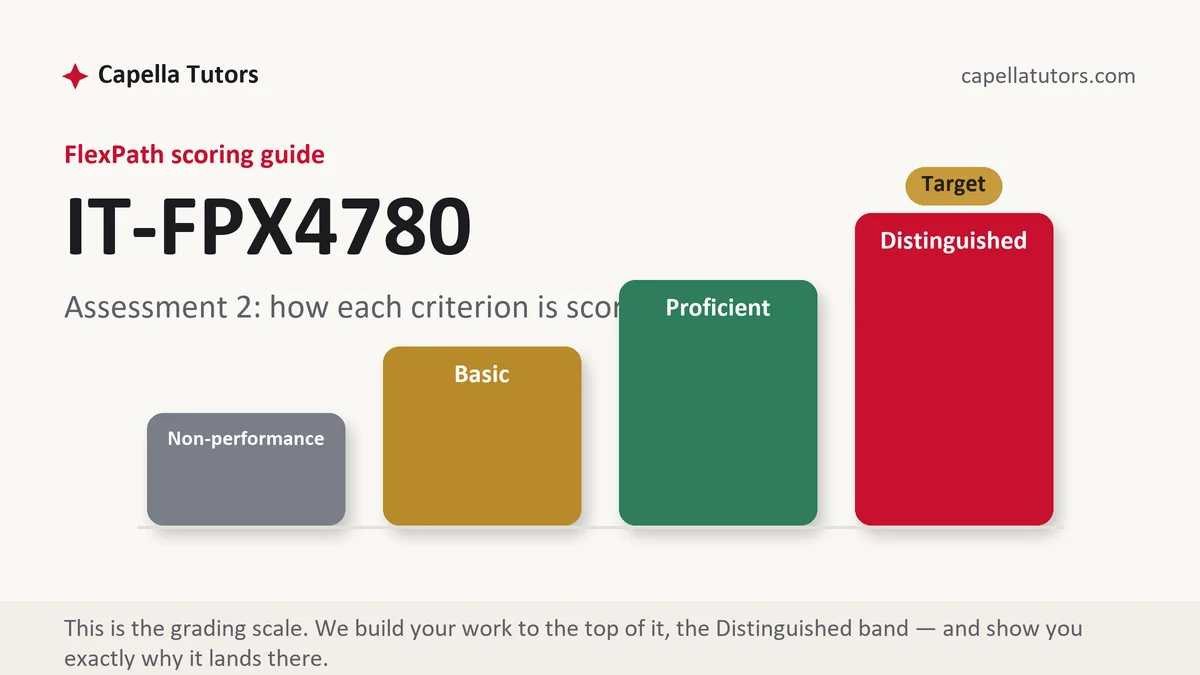
How IT FPX 4780 Assessment 2 is scored
FlexPath produces a set of separate verdicts rather than a score. Each criterion arrives at one of four levels, and those four descriptions are as near to a specification as the courseroom offers:
| Level | What it means on an architecture and offline data deliverable |
|---|---|
| Distinguished | State handling is specified for a configuration change and for process death separately, local storage is chosen per kind of data, and the conflict rule is named rather than implied. The criterion contains one move past correct, and it is written there in plain words. |
| Proficient | The architecture is sound and the offline story exists. Solid work that leaves a reader to infer the rule the criterion asked you to state. |
| Basic | An architecture diagram with layer names and no decisions in it. Structure that would function, described in a way that shows no choice was made. |
| Non-performance | Something the guide requires is absent, most often the conflict resolution rule or the process-death case. Missing beats weak as a way to lose a criterion. |
This deliverable is where a course project either becomes a real application or stays a demonstration. Nothing you claim about accessibility or performance afterwards survives if the app forgets what the user typed the moment the phone rotates.
The IT FPX 4780 Assessment 2 method, step by step
-
List, per screen, what must survive what
Three questions per screen: what has to be redrawn after a rotation, what has to survive the system reclaiming a backgrounded process, and what the user would be angry to lose entirely. Those three answers map onto saved instance state, a holder that outlives a configuration change, and a real local database, and the mapping is the section the criterion is marking.
-
Separate the screens from the logic and say where the boundary is
Name the layers, then name what is not allowed to cross each boundary. A screen that queries the database directly is a design decision as much as an accident, and stating the rule you followed is what turns a diagram into an architecture.
-
Write the app offline first, then add the network
Read from local storage, write locally first, queue the outbound change, and reconcile later. An app built on the assumption that the network answers is the most common defect at this level, and the correction is cheap to describe and expensive to retrofit.
-
Name the conflict rule and the case it gets wrong
Last write wins, a merge at field level, or a prompt to the user are all defensible, and none of them is correct in general. Pick one, say what it costs, and give the concrete example where your rule produces the wrong answer, because that admission is reliably worth a column.
-
Handle background work and the drawing thread explicitly
Scheduled work runs when the platform decides rather than when you asked, so say what your app does when a sync is deferred for six hours. Then confirm that nothing long-running touches the thread that draws the interface, since a frozen screen is graded as a defect and not as slowness.
-
Keep secrets out of the package
A token belongs in the platform's own protected key storage and never in the general preference store, transport is encrypted by default, and nothing sensitive is baked into a package a stranger can unzip. One paragraph naming where each secret lives closes a criterion most submissions leave open.
A structure that maps to the criteria
Internal planning targets for a second technical document rather than published rules; expand whichever criterion your own guide leans on.
| Section | What it must do | Guide |
|---|---|---|
| Architecture overview | The layers, what each owns, what is forbidden to cross each boundary, and the rule you applied when it was tempting to cheat. | ~250 words |
| State and lifecycle | Per screen, what survives a configuration change, what survives process death, and which storage tier carries each item. | ~300 words |
| Local persistence and schema | What is stored on the device, in what shape, with what keys, and how much space it is expected to occupy after a year. | ~250 words |
| Network and sync | The offline-first read and write path, the outbound queue, retry behavior, and the named conflict resolution rule with its failure case. | ~300 words |
| Background work and threading | Scheduled tasks, what happens when the platform defers them, and how long operations stay off the drawing thread. | ~200 words |
| Secrets, limitations and sources | Where each credential lives, what you could not build, and platform documentation cited by section and date in current APA. | ~200 words |
Annotated sample excerpt
An excerpt our team wrote at the register a guide's highest level describes. Take the shape of the reasoning, then write it for your own project.
Inspectors working the county's well and septic permits spend most of a day beyond any usable signal, so every form writes to the device database first and enters an outbound queue that drains when connectivity returns, which makes the local copy the working truth for up to nine hours at a stretch.1 Conflicts are resolved per field rather than per record, because two people editing the same permit almost always touch different fields, and a whole-record last-write-wins rule would silently discard an office clerk's corrected parcel number in favor of an inspector's untouched copy.2 The case this rule still gets wrong is a genuine disagreement about one field, where a field-level merge picks the later timestamp and loses the earlier judgment, so any field flagged as an inspection result is exempted from the merge and raised to the supervisor as a queued review item instead.3
- 1Grounds the architecture in the physical situation of the user, with a duration attached. Nine hours offline is a requirement; poor connectivity is an adjective.
- 2States the rule and the specific wrong outcome the alternative rule would have produced. A named loss is what makes the choice look decided rather than defaulted.
- 3Admits the residual failure and handles it. Naming the case your own rule cannot settle, then routing it to a person, is the move that separates the top two columns.
The full premium sample for your exact assessment, written fresh to your scoring guide and issue, is free to request. Study it, revise it into your own voice, and submit work you understand.
The five mistakes that cost Distinguished
- Rotation treated as the whole state problem. A screen rebuilt after a configuration change is one case, and the system reclaiming a backgrounded process is a harsher one that ordinary in-memory holders do not survive.
- Offline described as handled. Handled is not a rule, and the criterion wants the read path, the write path, the queue and the reconciliation named separately.
- A conflict rule with no failure case. Every resolution strategy loses something, and the submission that says what it loses reads as engineering rather than as marketing.
- Background sync assumed to run on time. The platform meters scheduled work, so a design with no answer for a six-hour deferral has an untested assumption at its core.
- Tokens in ordinary preference storage. Anything readable from an unpacked package or a backup is not stored securely, and this is a scored control rather than a nicety.
Pre-submission checklist
- Every criterion in the guide has a matching labeled section
- Per screen, the configuration-change case and the process-death case answered separately
- Storage tier chosen per kind of data, with the reason stated
- Offline read path, write path, queue and retry behavior all specified
- Conflict rule named, with the case it gets wrong and what you do about it
- Secrets located, platform documentation cited by section and date, current APA both ways
State handling and sync rules due?
Send the brief, whatever you have already built, and the criteria for this stage. The architecture comes back with boundaries and forbidden crossings named, state comes back answered for rotation and for process death separately, and the conflict rule comes back with its failure case written. First premium sample free.