This manual is for IT FPX 4575 Assessment 2, start to submission. The middle deliverable in this course usually asks you to manage services and packages properly and then use the journal and the audit subsystem to answer a question about what happened on a system, with each record tied to the question it was configured to answer. Scoring is done criterion by criterion against the guide that came with your own assessment. Below is how our tutors run it, a structure drawn from the criteria, and an excerpt with its moves labelled. Prefer we run it for you? A premium original sample for this exact assessment comes back within 24 to 48 hours, and revisions run free until it satisfies the guide. Capella's catalog lists the course as IT-FPX4575, and some courserooms print IT4575; both point to this same Assessment 2.
One honesty note before the manual: Capella revises courses and scoring guides over time, so always write to the exact scoring guide attached to your assessment in the courseroom. The course identity above is verified on capella.edu; the method and structure below are our tutors' approach to it, not Capella's official rubric text.
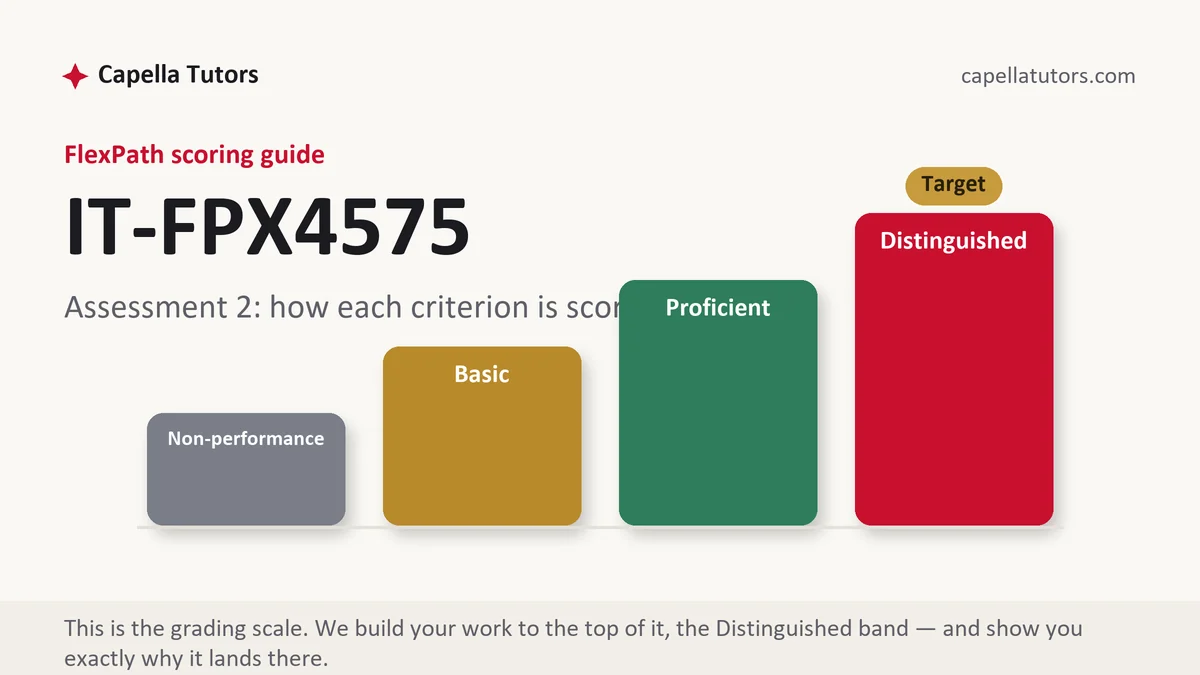
How IT FPX 4575 Assessment 2 is scored
Each criterion is marked at one of four levels and nothing is combined into a total. The top descriptor is the specification for the write-up:
| Level | What it means on a services and audit deliverable |
|---|---|
| Distinguished | Boot persistence is demonstrated rather than assumed, package origin and version are recorded, every audit rule is written for a question stated in advance, and log retention and integrity are addressed before the records are needed. |
| Proficient | Services are managed correctly and the logs are read accurately. The commands are right and no rule or query is tied to a question it was meant to answer. |
| Basic | Units started, logs displayed, and everything captured. Nothing distinguishes running now from enabled at boot, and the audit section repeats a configuration example from a guide. |
| Non-performance | A required element is absent, most often the audit configuration or any evidence the service survives a restart. |
Two distinctions carry this deliverable. Starting a unit now is not the same as enabling it at boot, and confusing them produces a service that works until the machine reboots, which is exactly the criterion being tested. Logging and auditing are also different subjects: logs say what happened, and the audit record says who touched what.
The IT FPX 4575 Assessment 2 method, step by step
-
Rebuild the criteria as headings, then write the question
Give each criterion a heading, then state in one sentence what the logs and audit records are supposed to answer. Rules written without a question produce volume, and volume is what makes a record unusable at the moment somebody actually needs it.
-
Manage the unit properly and prove persistence
Start the service, enable it for boot, then reboot and show its state afterward. The write-up needs both commands and the post-restart output, because the persistence criterion is not satisfied by an assertion that enabling was done and it is trivially satisfied by evidence.
-
Record package origin and version
Say which repository a package came from, which version installed, and how updates reach the system. An evaluator reproducing your work on the same release needs that; without it the procedure cannot be repeated and any behavior you describe cannot be confirmed.
-
Query the journal with a bounded window
Filter by unit and by time rather than paging through everything, and paste the output as text rather than describing it. A bounded query is also the honest way to present evidence, since a reader can see exactly which interval you looked at and therefore what you might have missed.
-
Write audit rules for the stated question
Watch the specific files and the specific system calls the question requires, place the rules where the configuration expects them, and say for each one which question it answers. Then address retention and integrity, because a record that rotates away or can be edited by the account under investigation answers nothing.
-
Interpret every capture, then self-score
Follow each command and its output with a sentence saying what it proves and, where relevant, what it rules out. Then work the guide yourself, marking each criterion, and rewrite anything below the top level. Submit early, since faculty may take two business days to return an evaluation.
A structure that maps to the criteria
The lengths below are the planning figures our tutors use on a services and logging deliverable, not Capella rules, so weight them toward whichever criterion your guide treats as heaviest.
| Section | What it must do | Guide |
|---|---|---|
| Environment and question | Distribution, release, and the single question the logging and audit configuration exists to answer. | ~150 words |
| Service management | Units started, units enabled, the post-restart state, and dependency or ordering notes. | ~300 words |
| Packages and updates | Repository, package version, how updates are applied, and what is deliberately held back. | ~200 words |
| Journal queries | The bounded queries run, their output as text, and what each interval establishes or excludes. | ~300 words |
| Audit configuration | Rules placed and the question each answers, plus retention, rotation, and record integrity. | ~350 words |
| Sources and format | Documentation for the release with retrieval dates, control references by version, current APA. | as needed |
Annotated sample excerpt
An original excerpt from our team, showing journal and audit evidence answering one question inside a scoped window. Read what makes each sentence admissible, then apply it to your own capture.
Written authorisation from the security lead covers one workstation, asset tag WS-0416, and the two hours either side of 09:12, when the user reported opening an attachment from an unexpected sender.1 A journal query bounded to that window shows the mail client spawning an archive utility and then a shell, and an audit rule already watching process execution recorded the full command line the shell ran, which is the detail a service log on its own would never have carried.2 The finding that decides the response is persistence, because a user-level unit was written and enabled, so it survives a restart, and the difference between started and enabled is exactly why this workstation cannot be cleared by rebooting it.3
- 1Establishes the authorisation and the scope in the first sentence, so the examination is bounded by something a reader can check rather than by convenience.
- 2Shows the journal and the audit record answering different halves of the question, which is the distinction between logging and auditing the criterion tests.
- 3Ends on the started against enabled distinction and turns it into a response decision, so the course concept is doing work rather than being defined.
The full premium sample for your exact assessment, written fresh to your scoring guide and issue, is free to request. Study it, revise it into your own voice, and submit work you understand.
The five mistakes that cost Distinguished
- A unit started but never enabled. It runs until the next reboot, and boot persistence is precisely what the criterion tests.
- Audit rules copied from a guide. A rule with no stated question produces volume, and volume is what makes the record useless when it is needed.
- Logs read without a bounded window. An unbounded search cannot tell a reader which interval was examined or what fell outside it.
- Retention and integrity ignored. A record that rotates away, or that the account under examination can edit, answers nothing at all.
- Output pasted with no interpretation. The criterion asks what the evidence establishes, so a sentence per capture is worth more than another screenshot.
Pre-submission checklist
- The question the logging and audit configuration answers is stated first
- Both start and enable are shown, with state confirmed after a restart
- Repository, package version, and update mechanism all recorded
- Journal queries bounded by unit and time, with output pasted as text
- Each audit rule paired with the question it answers, plus retention and integrity
- Every capture followed by one interpreting sentence, then self-scored
Service and audit write-up due?
Send the prompt, the criteria, and the release you are working on. Units come back with persistence demonstrated, journal queries come back bounded and interpreted, every audit rule comes back paired with its question, and one pass exists only to run the syntax on a clean installation. It is with you inside 24 to 48 hours.