This manual is for IT FPX 4575 Assessment 1, start to submission. The opening deliverable in a Linux course usually asks you to build a system, design the accounts and groups a described organization needs, and set filesystem permissions you can explain digit by digit, with every claim carried by a command and its output. It is graded the FlexPath way, one criterion at a time, against the guide in your courseroom. The tutor method is set out below, along with a section plan the criteria can mark and an annotated excerpt. Rather have it written for you? A premium original sample written for this exact assessment returns in 24 to 48 hours, and we revise it free until the guide is satisfied. Capella's catalog lists the course as IT-FPX4575, and some courserooms print IT4575; both point to this same Assessment 1.
One honesty note before the manual: Capella revises courses and scoring guides over time, so always write to the exact scoring guide attached to your assessment in the courseroom. The course identity above is verified on capella.edu; the method and structure below are our tutors' approach to it, not Capella's official rubric text.
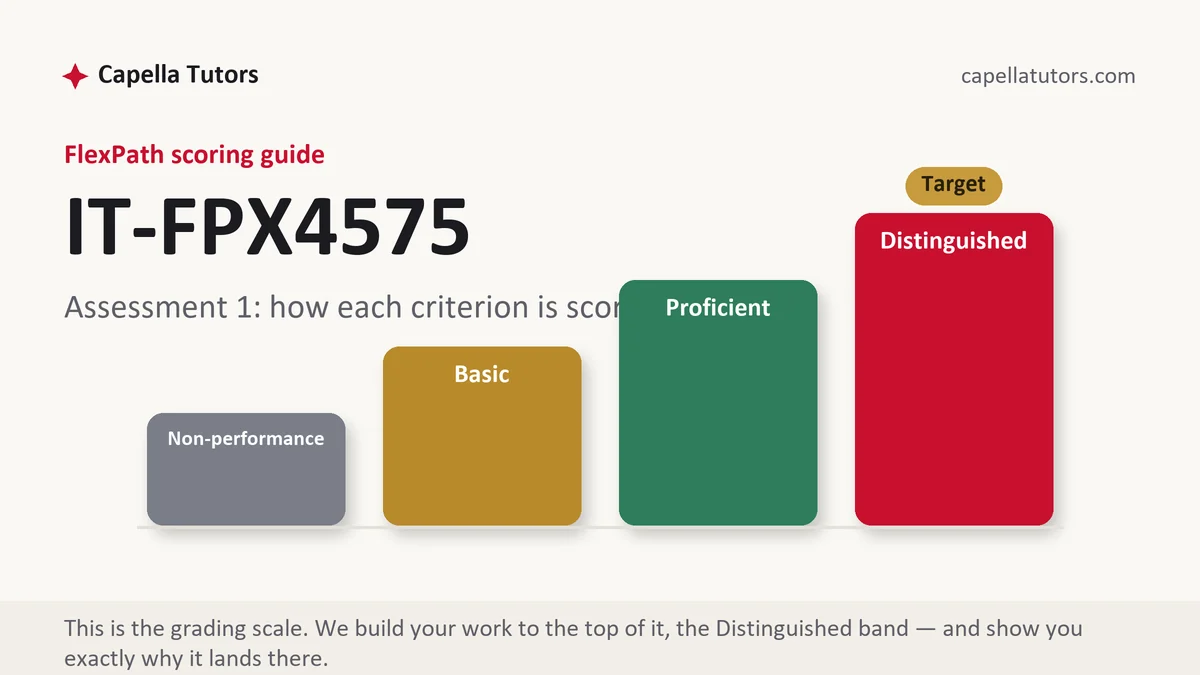
How IT FPX 4575 Assessment 1 is scored
FlexPath records a level for each criterion and never a score. The four descriptors are worth reading as build instructions before you touch a terminal:
| Level | What it means on a permissions lab write-up |
|---|---|
| Distinguished | Every mode is explained digit by digit including the special bits, the group design is argued from who needs access to what, inheritance is proved by an actual test rather than described, and each step appears as the command, its output, and one sentence saying what the output demonstrates. |
| Proficient | The system is configured correctly and documented clearly. The commands worked, the modes are right, and none of the numbers has been explained. |
| Basic | A sequence of screen captures with headings. Something was configured, the reasoning is absent, and at least one permission was opened wider than the task needed. |
| Non-performance | A required element is absent, most often the distribution and release, or any verification that the configuration behaves as claimed. |
Set the evidence habit before you touch the system, because it decides half the grade in a practical course. A capture with no command visible proves nothing, and a command with no output proves you typed it rather than that it worked. Build the document as you go, keeping a plain text file beside the terminal so commands are pasted rather than retyped with a fresh error in them.
The IT FPX 4575 Assessment 1 method, step by step
-
Turn the criteria into headings, then name the distribution and release
Half the commands in this subject are only correct relative to that answer, since Debian and Red Hat families differ on package tooling, repository configuration, and default service names. State the family and the release in the first paragraph and stay inside it for the whole document.
-
Design the groups from who needs access to what
List the roles in the scenario, then the resources, then draw the group for each intersection that actually exists. A group per team is a habit; a group per access requirement is a design, and the criterion asks you to argue the second rather than assert the first.
-
Scope elevation instead of sharing a password
Rights belong to a configured policy, granted per command where possible, rather than to a root password everybody knows. Edit the elevation rules through the tool that validates them before saving, because a syntax error written directly into that file can lock every administrator out of the machine at once.
-
Read every mode out loud, digit by digit
640 means the owner reads and writes, the group reads, and nobody else has anything. Special bits are where the design lives: the set-group-identity bit on a directory makes new files inherit its group, and the sticky bit stops one member deleting another's file in a shared space.
-
Account for the creation mask
A new file does not arrive with the permissions you assumed, because the shell applies a mask at creation. If a shared directory is meant to be group writable, the mask has to permit group write or the inheritance you configured will produce read-only files and the design will not do what the paper promised.
-
Verify by behavior, then self-score
Prove inheritance by creating a file as one member and editing it as another, and show the long listing of the directory itself rather than of its contents. Then mark yourself D, P, B, or N on each criterion and rewrite anything under the top. Submit early, because an evaluation can absorb two business days.
A structure that maps to the criteria
These lengths are planning targets our tutors use for a first systems deliverable rather than Capella requirements, so expand whichever section your own guide weights most heavily.
| Section | What it must do | Guide |
|---|---|---|
| Environment | Distribution, release, virtualization platform, and how the system was installed and snapshotted. | ~150 words |
| Scenario and access analysis | The roles in the organization, the resources, and which role legitimately needs which access. | ~250 words |
| Users and groups | Accounts created, group design argued from the analysis, and the elevation policy with its scope. | ~300 words |
| Directories and modes | Layout, ownership, every mode in octal explained digit by digit, and the special bits used. | ~350 words |
| Verification | Command, output, and interpretation for each check, including the behavioral test of inheritance. | ~300 words |
| Sources and format | Documentation for the release with retrieval dates, structural standards, current APA both ways. | as needed |
Annotated sample excerpt
An original excerpt from our writers, showing a four-digit mode taken apart in front of the reader. Study what each sentence accounts for, then do the same for the modes your own scenario needs.
The drop directory the drafters share, /srv/cad/incoming, is owned by root and the drafters group with mode 3770, and every digit in that number is a decision rather than a default.1 The leading 3 combines the set-group-identity bit, so a file created inside inherits the drafters group instead of the creator's private group, with the sticky bit, so one drafter cannot delete another's drawing even though the directory is group writable.2 The 7 and 7 give the owner and the group read, write, and traverse, the trailing 0 leaves everyone else with nothing, and the creation mask still has to permit group write or the inheritance just configured will hand back read-only files.3
- 1Names the path, the ownership, and the mode in one sentence, so the reader knows exactly what is being explained before the explanation starts.
- 2Splits the leading digit into its two bits and gives each a purpose in the scenario, which is where the design criterion actually lives.
- 3Accounts for the remaining digits and then raises the mask, closing the gap that otherwise makes a correct mode produce the wrong behavior.
The full premium sample for your exact assessment, written fresh to your scoring guide and issue, is free to request. Study it, revise it into your own voice, and submit work you understand.
The five mistakes that cost Distinguished
- Permissions widened to everyone as the fix. Global read and write clears the symptom and creates the first item an auditor will write up.
- Two distribution families mixed inside one procedure. Two package managers inside a single document show the steps were never executed as printed.
- Screen captures that never show the command. Output on its own proves neither what produced it nor which system produced it.
- A mode stated but not explained. The criterion wants the digits accounted for, and 2770 with no reading attached is a number rather than a design.
- The creation mask ignored. Inheritance configured on the directory still yields read-only files if the mask strips group write, and the paper will have promised behavior the system does not have.
Pre-submission checklist
- Distribution and release named in the first paragraph and used throughout
- Group design argued from a role and resource analysis, not from team names
- Elevation scoped through a validated policy rather than a shared password
- Every mode explained digit by digit, special bits included
- The creation mask addressed wherever inheritance is relied on
- Inheritance proved by a behavioral test, then self-scored before submission
Permissions lab due?
Send the prompt, the criteria, and your distribution and release. Each step comes back as the command, the output, and the sentence saying what it proves, every mode comes back explained digit by digit, and one pass exists only to run the commands on a clean installation of the release you named. Turnaround is 24 to 48 hours.