This manual is for IT FPX 4345 Assessment 1, start to submission. The opening deliverable in a data modeling and statistics course usually asks you to describe a dataset honestly and turn the situation behind it into a conceptual and logical model, with entities named, keys chosen on purpose, and every relationship carrying a cardinality a reader can check. It is graded the FlexPath way, criterion by criterion. The method our tutors use for it is set out below, with a structure keyed to the criteria and one annotated excerpt. Would you rather we wrote it? A premium original sample for this exact assessment is back with you in 24 to 48 hours, with free revision until it meets the guide. Capella's catalog lists the course as IT-FPX4345, and some courserooms print IT4345; both point to this same Assessment 1.
One honesty note before the manual: Capella revises courses and scoring guides over time, so always write to the exact scoring guide attached to your assessment in the courseroom. The course identity above is verified on capella.edu; the method and structure below are our tutors' approach to it, not Capella's official rubric text.
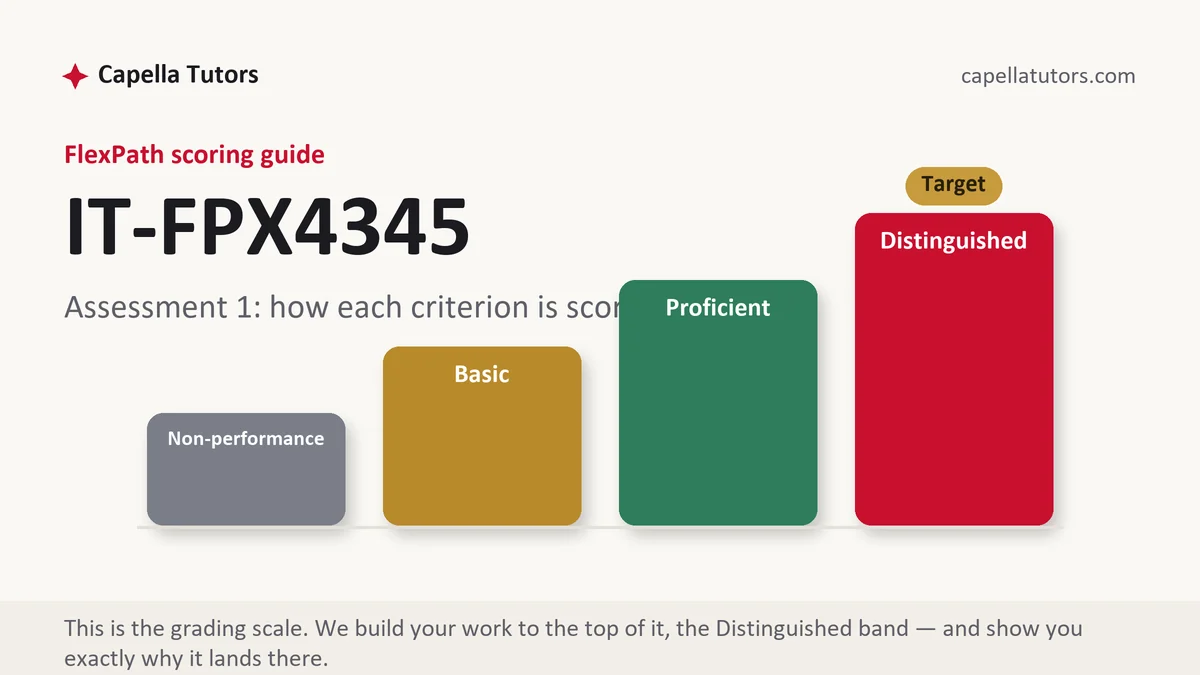
How IT FPX 4345 Assessment 1 is scored
FlexPath issues no letter grades. Each criterion on your scoring guide is placed at one of four levels, and the wording of those levels is the writing brief:
| Level | What it means on a data description and model |
|---|---|
| Distinguished | The design is defended rather than displayed. Every key is chosen for a stated reason, every relationship reads as a sentence somebody could contradict, and the attributes you chose not to store are named. There is always an extra move written into the criterion; find it and make it. |
| Proficient | Complete and technically correct. Entities, attributes, keys, and cardinality are all present, and none of them have been argued for. |
| Basic | A diagram with a caption underneath. The structure exists, the reasoning does not, and this is where a first modeling submission usually lands. |
| Non-performance | A required element is absent outright, most often the data description or a primary key. Missing, rather than weak, is what floors a criterion. |
Undergraduate work here is graded on whether the design can be interrogated, not on whether the drawing is tidy. Apply one test before submitting: point at any column and say aloud which key determines it. If that sentence comes out cleanly every time, the design criteria are already near the top of the guide.
The IT FPX 4345 Assessment 1 method, step by step
-
Convert the criteria into headings before you open the data
The prompt says what to produce; the criteria decide what it is worth. Build the outline from the guide and park each top-level descriptor under its own heading. Anything that will not file under one of those headings is decoration, and any criterion left without a heading is one you are about to miss.
-
Write the unit of analysis in one sentence
Say what one row stands for before you name a single entity, because a table that mixes two units produces totals nobody can interpret. A row meaning one delivery attempt and a row meaning one parcel answer different questions, and choosing between them is a modeling decision. Put that sentence where a reader trips over it.
-
Inventory the columns before you invent the entities
List every field with its type, its meaning in the business, its range, and the number of rows where it is empty. That inventory tells you which attributes travel together and therefore which entities exist. Entities invented from intuition and then filled with leftover columns is the fastest route to a design you cannot defend.
-
Choose each primary key deliberately and say why
A key must be unique, never absent, and stable across the life of the row, so test every candidate against those three properties in writing. Where a natural candidate fails one, name the property that failed and introduce a surrogate as a stated decision. A sequence number added by habit says nothing about what makes a row distinct.
-
Write every relationship as a falsifiable sentence
Cardinality drawn as crow's feet leaves the criterion unanswered, so convert each line into business language a domain reader could dispute: one van carries many attempts, one attempt belongs to exactly one van, and an attempt with no van recorded is possible because 318 rows arrived that way. Mark optional participation explicitly.
-
Self-score against the guide, then attack your own model
Mark every criterion D, P, B, or N yourself and rewrite anything below the top. Then put three awkward questions to the design: what happens when a driver changes name, what happens when one parcel is attempted twice, and which column is missing for a question the scenario clearly implies. Send it in early in the week, because an evaluation can take two business days to come back.
A structure that maps to the criteria
Word counts here are planning targets our tutors use for a first modeling deliverable rather than Capella requirements, so expand any section your own guide weights more heavily.
| Section | What it must do | Guide |
|---|---|---|
| Scenario and purpose | The organization, the decision the data supports, and the question the model has to make answerable. | ~150 words |
| Data description | Row count, collection window, each column with its type and meaning, missing values counted, unit of analysis stated. | ~300 words |
| Conceptual model | The entities, what each represents in the business, and the relationships between them in plain language. | ~300 words |
| Logical model and keys | Attributes assigned to one entity each, primary keys justified, foreign keys, cardinality with optionality. | ~350 words |
| Constraints and governance | Data types, required fields, referential rules, which columns identify a person, and retention. | ~200 words |
| References | Method and standards sources in current APA, matched both ways, each with the edition or version used. | as needed |
Annotated sample excerpt
An original model excerpt from our team, showing the register that scores at the top of a modeling criterion. Take the moves, then build the model your own scenario needs.
The dispatch export from Harbourline Courier arrives as one row per delivery attempt, 41,206 rows covering the twelve weeks from 6 January to 29 March, with 318 rows carrying no van identifier and 1,142 carrying no recipient postcode.1 A row is therefore an attempt rather than a parcel, which matters immediately, because 3,904 parcels were attempted more than once and any total built by counting rows would report them twice.2 Four entities follow from that reading. Parcel, Driver, and Van each own the attributes depending only on themselves, while Attempt owns the timestamp, the outcome code, and the originating depot, and carries the foreign keys to the other three.3
- 1Opens with counts, the collection window, and the empty cells rather than a definition of a database. The evaluator gets something checkable in the first clause.
- 2States the unit of analysis and then shows the cost of getting it wrong using a number from the data itself.
- 3Assigns every attribute to exactly one entity and names which entity carries the keys, so the logical model arrives already justified.
The full premium sample for your exact assessment, written fresh to your scoring guide and issue, is free to request. Study it, revise it into your own voice, and submit work you understand.
The five mistakes that cost Distinguished
- Entities invented before the columns were read. A design built from intuition and filled with leftover fields cannot survive one question about which key determines what.
- A surrogate key introduced by reflex. Adding a sequence number without testing the natural candidates hides the fact that uniqueness was never worked out.
- Cardinality left as notation. Symbols on a diagram satisfy nobody; the criterion wants the relationship as a sentence a domain reader could contradict.
- Empty cells passed over in silence. Missing values are a finding, so count them, say whether they cluster in one group, and record what you did.
- Personal identifiers modelled without comment. A design holding names, addresses, or account numbers that never mentions classification or retention leaves a criterion untouched.
Pre-submission checklist
- Every scoring-guide criterion has its own labelled section in the document
- The unit of analysis is stated in one sentence and used consistently after it
- Row count, collection window, and a per-column missing-value count all appear
- Each primary key is tested against uniqueness, presence, and stability in writing
- Every relationship appears as a sentence with its cardinality and its optionality
- Self-scored at the top level on every criterion, submitted early in the week
Want the model built with the reasoning attached?
Send the column list or the export itself, the scenario, and the scoring guide. A team of eight, including a research analyst and two QA reviewers, returns a premium original sample with every key defended and every relationship written as a checkable sentence, inside 24 to 48 hours, revised until the guide is satisfied.