This manual is for IT FPX 4071 Assessment 3, start to submission. The later work in this course usually asks for the report, which is the only part of an authorized test a client keeps. It carries two audiences at once: an executive who needs the risk, the cost, and the first action, and an administrator who needs the reproduction steps and the evidence. Severity has to come from a method rather than from an adjective, because high and serious are feelings. Below: the method, a structure that answers the criteria in order, and one annotated model excerpt. Short on days? Send the brief and a premium original sample returns in 24 to 48 hours, revised free until the guide is satisfied. Capella's catalog lists the course as IT-FPX4071, and some courserooms print IT4071; both point to this same Assessment 3.
One honesty note before the manual: Capella revises courses and scoring guides over time, so always write to the exact scoring guide attached to your assessment in the courseroom. The course identity above is verified on capella.edu; the method and structure below are our tutors' approach to it, not Capella's official rubric text.
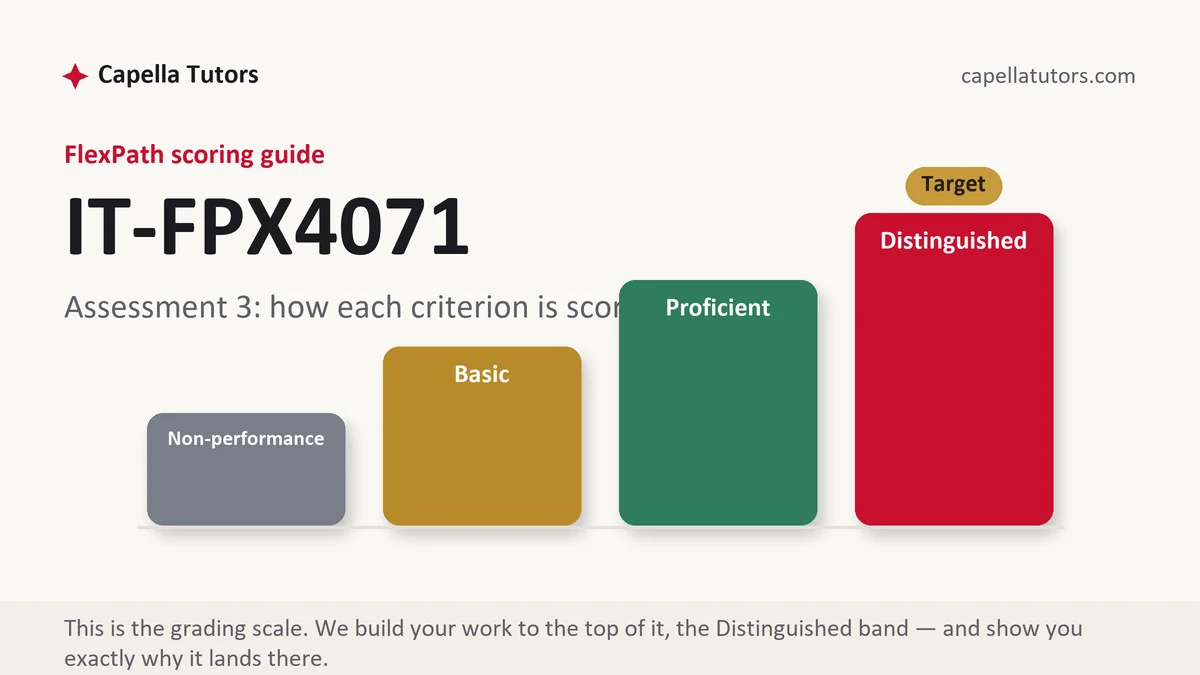
How IT FPX 4071 Assessment 3 is scored
Every criterion is marked at one of four levels. Write to the wording of the level you are aiming at:
| Level | What it means on a findings and reporting submission |
|---|---|
| Distinguished | Findings are reproducible by another tester, severity carries the vector selected and an environmental adjustment with its reason, and the summary names what the test did not cover. A retest sentence closes the report. |
| Proficient | Findings, evidence, severity, and remediation are all present and correctly formatted. Complete, with the context behind each rating unstated. |
| Basic | Findings written as assertions with severity chosen by adjective. Where the report lands when the ratings came from instinct. |
| Non-performance | A required element is absent, most often the reproduction steps or the remediation owner, so the finding cannot be verified or fixed. |
One finding to one weakness is the rule that saves this deliverable. Bundling six issues into a single entry hides the ones that matter, makes remediation impossible to track, and costs you the criterion for clarity as well as the one for analysis.
The IT FPX 4071 Assessment 3 method, step by step
-
Build the report skeleton from the criteria, then fill named holes
Write the section headings from your scoring guide before assembling any evidence, then collect only what fills a gap. Working the other way round produces a folder of screen captures and a panic on the last evening.
-
Write each finding in reproduce-then-conclude order
Give the finding an identifier, the affected asset by name or count, a description of the weakness, the steps another tester would follow, the evidence, then the severity and the fix. Evidence before conclusion is what lets an administrator at a credit union confirm the problem without calling you, and confirmability is what the criterion rewards.
-
Score severity by properties, then adjust for the environment
Rate the finding on how it is reached, what conditions it needs, whether an account or a user action is required, and what it exposes, and quote the components you selected so a reader can check your arithmetic. Then adjust: a weakness on a host reachable only through a private network that twelve administrators can use is less exposed than the base score suggests, and a weakness already listed in a public catalog of exploited flaws is more urgent than the score implies.
-
Make evidence prove something rather than decorate
A useful capture shows the request that produced it, the response, and enough context to identify the target, with anything sensitive masked in a way you describe. Place it after the reproduction steps, number the caption, refer to that number in the prose, and transcribe any text your argument depends on. Never edit an image to strengthen a finding.
-
Write remediation as an instruction with an owner
Say what to change, who owns the change, and roughly how much effort it takes. A fix with no owner is a fix nobody makes. Where the real remedy is architectural and slow, give the interim measure as well and label it as interim rather than letting it read as the answer.
-
Rewrite the summary for a reader who stops there, then self-score
Give the count of findings by severity, the single worst outcome achieved and how, the two fixes that remove the most risk for the least money, and a plain statement of what the test did not cover. Add one sentence on retest, because a finding closes when it is verified fixed rather than when it is reported fixed. Then mark yourself row by row and upload with time to spare inside the two business day window.
A structure that maps to the criteria
Word targets our tutors plan against for a test report at this level, not Capella rules; let your own scoring guide decide the weighting.
| Section | What it must do | Guide |
|---|---|---|
| Executive summary | Risk in business terms, the worst outcome achieved, the priority fixes, what was not covered, and retest. | ~300 words |
| Scope recap | The authorization, the window, and the systems tested, restated briefly for a reader starting here. | ~150 words |
| Findings | One entry per weakness with identifier, asset, description, steps, evidence, severity, and fix. | ~400 words |
| Severity method | The scoring system used, the components selected, and the environmental adjustment with its reason. | ~250 words |
| Remediation plan | Fixes ordered by risk removed against effort, each with an owner and an interim measure where needed. | ~200 words |
| Sources | Scoring specification and vulnerability catalog entries cited by identifier, current APA both ways. | as needed |
Annotated sample excerpt
One finding from a model report our team produced, written in the order that lets an administrator verify it before an argument is made.
The member portal's password reset flow returns a different response time and message for a registered address than for an unregistered one, which allows an unauthenticated visitor to confirm whether any given email belongs to a member.1 Steps to reproduce, evidence, and the affected endpoint appear below; the behavior was observed on all three tested addresses and on the authorized test account.2 Base severity is medium on the vector recorded in the appendix, and the environmental adjustment raises practical urgency because the client is a community institution whose membership is geographically concentrated, so confirming membership is a meaningful step toward a targeted approach to a named person.3 Remediation: return one identical response and timing for every address, owned by the portal vendor, estimated at under a day.
- 1Leads with what an attacker obtains rather than with the mechanism, which is the sentence a decision-maker needs before any detail arrives.
- 2Points at the reproduction steps and the sample size before drawing a conclusion, so the finding can be confirmed rather than believed.
- 3Adjusts the base rating using a fact about this client and says why. Environmental reasoning is the judgment the top column is written around.
The full premium sample for your exact assessment, written fresh to your scoring guide and issue, is free to request. Study it, revise it into your own voice, and submit work you understand.
The five mistakes that cost Distinguished
- Severity chosen by adjective. High, serious, and dangerous are feelings, and the criterion is asking for a method and a vector.
- Findings nobody could reproduce. Without steps and evidence a finding is an assertion, and the client cannot verify the fix.
- Six issues bundled into one entry. The important weakness gets buried and remediation tracking becomes impossible.
- An executive summary full of tool names. That section exists for a reader who will never open a terminal, and jargon wastes the page.
- No statement of what was not tested. A scoped engagement is not a clean bill of health, and saying so protects the client and you.
Pre-submission checklist
- One finding per weakness, each with its own identifier
- Reproduction steps and evidence placed before the conclusion
- Severity scored by method, with the selected components recorded
- An environmental adjustment stated with the reason behind it
- Every remediation written as an instruction with an owner and an effort estimate
- Summary free of tool names, coverage limits stated, retest mentioned, then self-scored per row
Report due and the findings are a pile of captures?
Send the scenario, the criteria, and whatever notes or output you hold. Findings come back reproducible, severity comes back scored and adjusted with reasons, remediation comes back owned, and the summary comes back readable by a board, inside 24 to 48 hours. Revision is free until the guide is met and the first premium sample is free.