Send the case, the criteria, and whatever tool output or lab notes you have, and a premium original sample comes back inside 24 to 48 hours with an authorization and scope statement at the front, findings written so another tester could reproduce them, and severity ratings you can defend when challenged. The catalog lists this one as IT FPX 4071, Cyber Attacks and Ethical Hacking, three program points in the Information Assurance and Cybersecurity specialization, delivered in FlexPath inside a BS in Information Technology whose completion requires at least 90 program points, no fewer than 27 of them at the 3000 level or above. In Capella's catalog the course code is written IT-FPX4071.
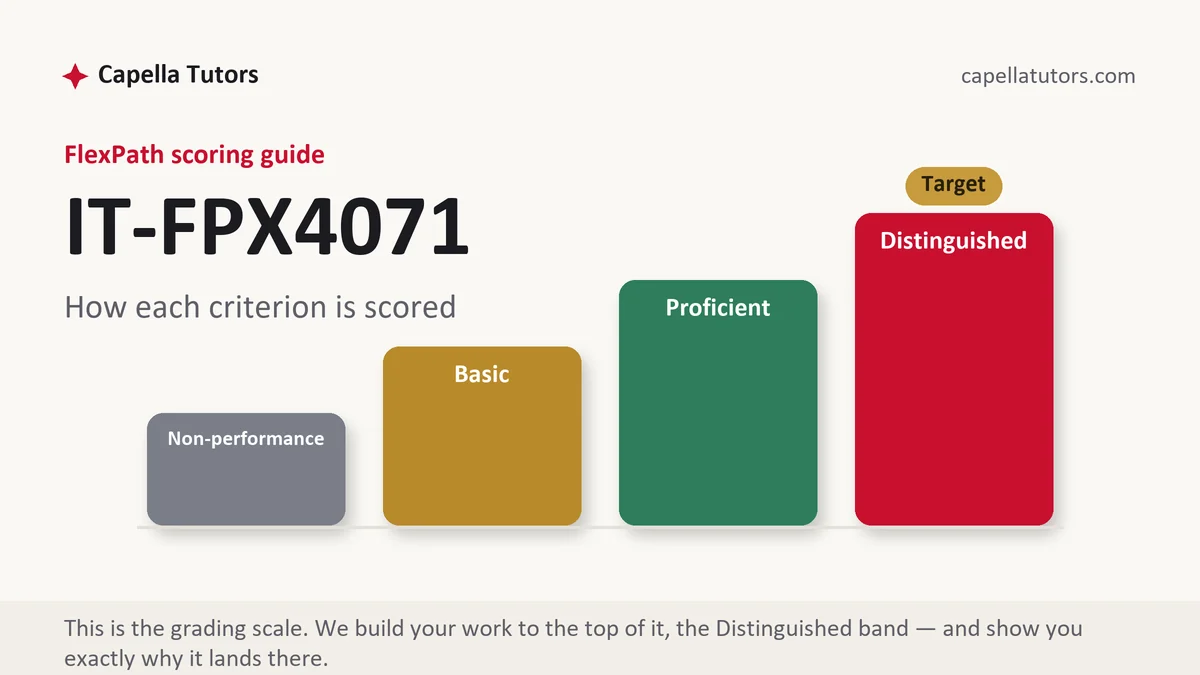
What IT FPX 4071 actually grades
Everything in this course rests on a permission slip, and the criteria are built to find out whether you know that. A submission that demonstrates technique without establishing authority has failed the professional standard the course exists to teach, no matter how good the technical work is. So the opening section names the client, names the systems in scope, names what is explicitly excluded, states the testing window, gives an emergency contact, and records who signed. Rules of engagement follow: whether social engineering is permitted, whether denial of service testing is allowed, whether production systems may be touched during business hours, and what the tester does the moment evidence of a prior real intrusion appears. Students find this section boring and evaluators do not, because it is the part that separates a security professional from someone with a scanner.
The technical spine is the attack lifecycle, and the grading follows its stages. Reconnaissance gathers what is publicly available, from registration records and certificate transparency logs to job advertisements that reveal which systems a company runs. Scanning and enumeration turn that into a list of live hosts, open ports, service versions, and accounts. Exploitation converts a weakness into access, privilege escalation converts a foothold into control, persistence keeps the access across a reboot, and lateral movement turns one host into a network. Keep the vocabulary precise, because the fastest way to lose the analysis criterion is to use the wrong word. A vulnerability is the flaw in the system, an exploit is the working technique that abuses the flaw, a payload is what runs afterward, and a compromise is the outcome. Describing a scan result as a compromise overstates your evidence, and an evaluator who has run tests will notice immediately.
The third graded strand is the report, which is the only deliverable a client actually keeps. It carries two audiences in one document. An executive summary tells a manager what the risk is, what it would cost, and what to do first, written in language with no tool names in it. The technical section gives each finding an identifier, an affected asset, a description of the weakness, the steps to reproduce it, the evidence, a severity with the reasoning behind it, and a remediation with an owner. Severity has to come from a method rather than from an adjective, so use a scoring system, show the vector you selected, and then adjust for the environment in front of you. A weakness on an internet-facing server with no authentication in front of it outranks a nominally worse flaw that requires an attacker to already hold domain credentials, and saying so in writing is exactly the judgment the top column is asking for.
How we help in this course
Work we produce for 4071 is built to survive being challenged. The scope and authorization section is drafted first, findings are written in the reproduce-then-conclude order so the evidence precedes the claim, every severity carries the vector string and a sentence explaining the environmental adjustment, and remediation lines are specific enough that an administrator could act on them without calling you. Where the assessment supplies tool output, we interpret it rather than paste it, and where it supplies a fictional client we hold the recommendations to that client's apparent size and budget. Tell us the scenario, the systems named in it, and which stages of testing your criteria actually require.
Studio terms apply without change. Delivery inside 24 to 48 hours, aimed at the Distinguished descriptor, and eight people handle the file in sequence, with a research analyst pulling your guide and the current scoring specification, a subject writer building the findings and the narrative, a scoring-guide reviewer grading the draft criterion by criterion before you ever see it, an APA and originality reviewer reconciling the sources, and an editor closing it out. Unlimited revision at no charge until the guide is satisfied, faculty feedback handled free in the same queue, and because a submitted attempt can take two business days to come back, we plan your dates so a resubmission still lands inside the 12-week billing session.
The assessments, one by one
Assessment 1
The opening deliverable in Cyber Attacks and Ethical Hacking usually asks for the paperwork that makes the rest of the work legitimate: the client, the systems in scope, what is excluded, the testing window, the contacts, the signature, and the methodology you will follow. Read the full Assessment 1 manual.
Assessment 2
The middle deliverable in this course usually covers the gathering stages of an authorized test: what is publicly discoverable about the client, what is live once you are permitted to look, and what each result actually implies. Read the full Assessment 2 manual.
Assessment 3
The later work in this course usually asks for the report, which is the only part of an authorized test a client keeps. Read the full Assessment 3 manual.
How to actually write IT FPX 4071: where to begin
Read the criteria, then decide which stages of the lifecycle your deliverable actually covers, because attempting all of them badly is worse than covering two properly. Most prompts at this level want reconnaissance and enumeration described in depth, one exploitation path explained end to end, and a report that turns the result into business language. Build the document skeleton from the scoring guide rows before you gather a single piece of evidence, then collect evidence to fill named holes. Working the other way round produces a pile of screenshots and a panic on the last day.
Then make severity something you can defend under questioning. Score a finding by its properties rather than by how alarming it feels. A weakness reachable across the network, requiring no special conditions, needing no account, needing no user to click anything, confined to the affected component, and exposing sensitive data completely, produces a high base rating in any standard scheme, and quoting the components you selected lets a reader check your work. Then adjust for the environment. If the affected host sits behind a virtual private network that only twelve administrators can reach, the real exposure is lower than the base score, and you say so with the reason attached. If a public catalog of vulnerabilities already known to be exploited lists the flaw, the practical urgency is higher than the score suggests, and you say that too. Two sentences of environmental reasoning per finding will do more for your analysis criterion than a longer tool transcript.
Finish by rewriting the summary for a reader who will never open the technical section. Give the number of findings by severity, the single worst outcome the tester achieved and how, the two remediations that would remove the most risk for the least money, and a plain statement of what the test did not cover so nobody mistakes a scoped exercise for a clean bill of health. Add a retest sentence, because a finding is not closed when it is fixed, it is closed when it is verified fixed. That last line is the professional habit the course is trying to install, and it costs you eleven words.
| Section | What goes in it | What Distinguished looks like |
|---|---|---|
| Authorization and scope | Client, systems in scope, exclusions, window, contacts, and the signature that permits the work. | Exclusions justified and the stop condition for discovering a real intrusion written out. |
| Methodology | The published methodology followed, the stages performed, and the tools with their versions. | A named framework followed visibly, with deviations explained rather than left silent. |
| Reconnaissance and enumeration | Public information gathered, hosts and services identified, and what each finding implied. | Interpretation attached to every result, and passive work separated from active work. |
| Findings | One entry per weakness with asset, description, reproduction steps, evidence, severity, and fix. | Findings another tester could reproduce, with severity scored by method and adjusted for context. |
| Executive summary | Risk in business terms, the worst achieved outcome, the priority fixes, and what was not tested. | No tool names, no jargon, and a first action a manager could approve on Monday. |
| Sources and format | Testing standards, scoring specifications, vulnerability catalog entries, current APA. | Primary specifications cited directly with identifiers a reader can look up. |
Developing the analysis
The argument worth having in this course is whether offensive testing is a good use of a security budget, and a graded paper takes a position instead of assuming one. The case for it is that a real attempt finds the chain nobody modeled, since individually minor issues combine into a path that no scanner reports and no checklist anticipates. The case against is timing and coverage. A test is a photograph of one week, the estate changes the following Tuesday, the scope excluded whatever was inconvenient, and organizations frequently pay for the exercise and then leave the findings open. Continuous scanning covers more ground more often and understands far less about what it sees. A bug bounty buys breadth from strangers and hands you triage work and disclosure risk. The mature answer sequences them by maturity: an organization that has never patched consistently gets nothing from a red team exercise it cannot act on, while an organization with a working vulnerability program learns something real from an adversary simulation. Say which stage your scenario is at, recommend accordingly, and note the objection you are overruling.
Citations that survive faculty review
Methodology documents come first in an offensive security paper, and citing them is what separates a structured test from an improvisation. The technical guide to information security testing and assessment published by the National Institute of Standards and Technology gives you a defensible sequence, the Penetration Testing Execution Standard and the Open Source Security Testing Methodology Manual give you alternatives worth naming, and the Open Worldwide Application Security Project testing guide governs anything web-facing. Adversary behavior is best referenced by technique identifier from the MITRE ATT and CK matrix, which lets an evaluator confirm that the behavior you described matches the label you gave it. Vulnerability specifics belong to primary catalogs, so cite the identifier from the national vulnerability database rather than a blog that summarized it, and cite the scoring specification published by the Forum of Incident Response and Security Teams when you explain how a rating was produced. Legal claims need legal sources: reference the statute or the regulator, not a vendor page about the statute. Peer-reviewed work retrieved through the Capella library carries any claim about how effective testing is at reducing incidents, and every industry statistic needs its publication year inside the sentence that uses it.
The mistakes that land Basic instead of Distinguished
- A test described with no authorization section. Skipping the permission record fails the professional standard before the technical work is read.
- Raw tool output pasted as a finding. A scanner report is input to analysis, and copying it shows none happened.
- Severity chosen by adjective. High, serious, and dangerous are feelings, and the criterion wants a method.
- Findings nobody could reproduce. Without steps and evidence, a finding is an assertion and a client cannot verify the fix.
- An executive summary full of tool names. The section exists for a reader who will never see a terminal, and jargon in it wastes the page.
IT FPX 4071 questions students actually ask
Where am I allowed to practice these techniques?
On systems you own, on virtual machines you built, and on platforms that publish an explicit invitation to test them. Anything else needs written permission from the person who can legally grant it, and a manager saying yes in a hallway is not that. Build an isolated virtual lab with a host-only network so nothing you launch can reach the internet, snapshot the machines before each exercise, and keep notes of what you ran and when. Never test an employer's systems to produce a class artifact, even with good intentions, since unauthorized access statutes turn on permission rather than on motive and a school assignment is not a defense. Where a criterion appears to require access you do not have, describe the technique and its expected result instead, and say in the document why the demonstration was simulated.
How do I write a finding a manager will actually act on?
Lead with the consequence, not the mechanism. The sentence a decision-maker needs says what an attacker could obtain, from where, and with what starting position, and it fits in one line before any technical detail arrives. Follow it with the affected systems by name or count so the size of the problem is visible, then the reproduction steps and evidence for the administrator who has to confirm it. End with a remediation written as an instruction with an owner and a rough effort estimate, since a fix nobody is assigned is a fix nobody makes. Keep one finding to one weakness. Bundling six issues into a single entry hides the ones that matter and makes tracking remediation impossible.
Does a screenshot count as evidence?
It counts when it shows something a reader can tie to a claim, and it fails when it is decoration. A useful capture includes the command or request that produced it, the response, and enough context to identify the target, with anything sensitive masked in a way you describe rather than cropped without comment. Put the capture after the reproduction steps so the reader already knows what they are looking at, give it a numbered caption, and refer to that number in the prose. Transcribe any text you rely on in the argument, because graders read on small screens and an unreadable image proves nothing. Never edit an image to strengthen a finding, since a doctored capture ends a testing career faster than a missed vulnerability.
Test report due and the findings are a mess?
Send the scenario and the criteria. Findings come back reproducible, severity comes back justified, and the summary comes back readable. First premium sample free.