This manual is for IT FPX 3358 Assessment 3, start to submission. The later work in this course usually leaves technology behind and asks for governance: policy written so it can be enforced, an incident process with owners and phases, and continuity objectives expressed in time and data rather than in intentions. IT students underrate this deliverable, and it is the one where an unenforceable paragraph is the commonest structural fault. Below: the method, a criterion-mapped structure, and one annotated model excerpt. Short on time? Send the case and a premium original sample returns in 24 to 48 hours, revised free until the guide is satisfied. Capella's catalog lists the course as IT-FPX3358, and some courserooms print IT3358; both point to this same Assessment 3.
One honesty note before the manual: Capella revises courses and scoring guides over time, so always write to the exact scoring guide attached to your assessment in the courseroom. The course identity above is verified on capella.edu; the method and structure below are our tutors' approach to it, not Capella's official rubric text.
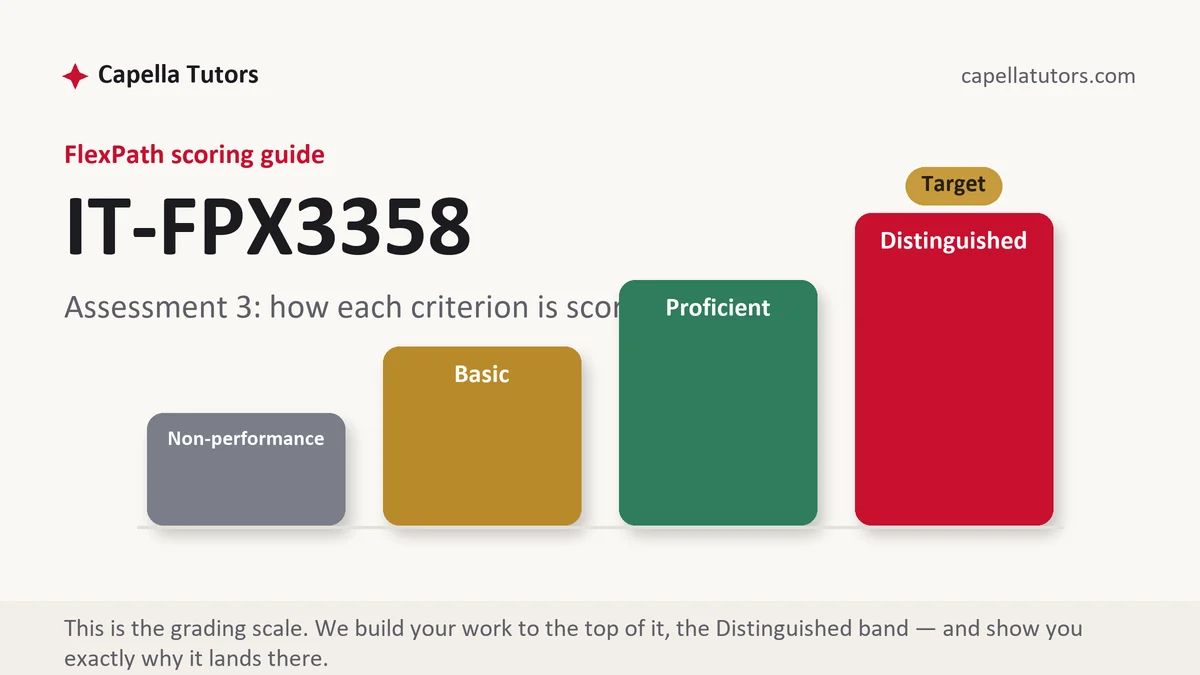
How IT FPX 3358 Assessment 3 is scored
Every criterion lands on one of four levels, and the level text tells you what to write:
| Level | What it means on a policy and response submission |
|---|---|
| Distinguished | Policy carries a scope, an owner, a review date, and consequences, response phases each name who acts, and recovery objectives come from what the business can actually tolerate. The paper says who has authority to accept what is left. |
| Proficient | Policy, phases, and objectives are all present and coherent. Complete, and still written as intentions rather than as obligations. |
| Basic | A statement of good practice nobody could audit, with a response section that ends at containment. The usual result when policy was drafted from a template. |
| Non-performance | A required element is absent, most often the review phase or the recovery objectives, so the criterion built on it has nothing to mark. |
Four words carry this deliverable and most drafts blur them. A policy says what the organization requires and who owns it, a standard fixes the specific setting, a procedure gives the steps, and a guideline is advice. Mixing them produces a document that cannot be enforced or audited, which is the fault an evaluator sees fastest.
The IT FPX 3358 Assessment 3 method, step by step
-
Map the criteria and pick the regime that applies
Set out the headings, then name the obligation that governs the scenario early, because it decides which controls are optional and which are not. A firm holding client tax records under engagement letters is not in the same position as one holding cardholder data, and the paper should say which rules it is writing against.
-
Write policy in the four parts that make it enforceable
Every policy statement needs a scope saying who and what it covers, an owner by position rather than by name, a review date, and a consequence for breach. Then check the verb. Staff should take care is advice; staff must not store client records on personal devices is a rule, and only the second one can be audited.
-
Build the response process phase by phase, with owners
Run it from preparation through detection and analysis into containment, eradication, and recovery, and finish on the review nobody schedules. Give each phase a named position that acts and a first action they take. An accounting firm in filing season needs a stated decision about who may take a working file server offline in March, and it needs that decision written down in February.
-
Derive continuity objectives from what the business can tolerate
Set a recovery time objective for how long a service can be down and a recovery point objective for how much work you can afford to lose, then justify both from the operation rather than from a preference. Four hours of downtime in filing season is a different sentence from four hours in July, and saying so is the analysis a criterion is looking for.
-
Keep any testing inside authorized bounds
Where your criteria ask for evidence of hands-on work, build it on hardware or virtual machines you own and control. Never scan, probe, or capture traffic on a network you do not administer, including an employer's, because written permission from someone able to grant it is the whole difference between coursework and an offense. If a prompt appears to require live testing, get the scope from your faculty member in writing and keep the reply.
-
State who accepts what remains, then self-score
Risk acceptance belongs to the business rather than to the analyst, so name the position that signs for anything untreated and the date the acceptance expires. Showing that you know that boundary is worth a criterion by itself. Then mark your own draft row by row and submit early inside the two business day evaluation window.
A structure that maps to the criteria
Word targets our tutors plan against for a governance deliverable at this level, not Capella rules; your scoring guide decides where the weight belongs.
| Section | What it must do | Guide |
|---|---|---|
| Organization and obligations | The firm, the data it holds, the season it works in, and the rules that govern all three. | ~200 words |
| Policy statements | Each statement with scope, owner by position, review date, consequence, and an auditable verb. | ~300 words |
| Standards and procedures | Where a specific setting or a step list belongs beneath a policy, and who maintains it. | ~200 words |
| Incident response | Every phase with the position that acts and the first action, ending on the post-incident review. | ~300 words |
| Continuity objectives | Recovery time and recovery point per service, justified by what the operation can tolerate. | ~250 words |
| Acceptance and sources | Who signs for untreated risk and when it expires, plus framework references in current APA. | as needed |
Annotated sample excerpt
A policy statement from a model our team produced, written so an auditor could test it rather than admire it.
Scope: this statement covers every device used to open, edit, or store client tax records, including personally owned laptops used during filing season, and it applies to seasonal preparers on the same terms as permanent staff.1 Requirement: client records must not be stored outside the firm's managed document system, and any file downloaded for offline work must be removed from local storage within twenty-four hours of the return being filed.2 Owner: the managing partner responsible for technology, reviewed each September before seasonal hiring. Consequence: a first breach is handled as a coaching conversation with a written note, and a repeat breach removes remote access until retraining is complete.3
- 1Names the awkward case in the scope line rather than leaving seasonal staff and personal laptops to be argued about later.
- 2Uses must rather than should and attaches a time limit, which is what turns an intention into something an auditor can test.
- 3Puts an owner by position, a review month tied to the business cycle, and a graduated consequence in one block. Enforceability is the criterion.
The full premium sample for your exact assessment, written fresh to your scoring guide and issue, is free to request. Study it, revise it into your own voice, and submit work you understand.
The five mistakes that cost Distinguished
- Policy written with should instead of must. Advice cannot be enforced or audited, and the criterion is checking for an obligation.
- Policy, standard, and procedure merged into one document. The reader cannot tell what is required from what is recommended, and the structure row suffers for it.
- A response process that stops at containment. Eradication, recovery, and the post-incident review are where the phases criterion usually lives.
- Recovery objectives with no basis in the operation. A number invented without asking the business is a number the business will not honor.
- Untreated risk with nobody signing for it. Acceptance is a business decision, and a paper that leaves it unassigned has skipped the accountability the guide wants.
Pre-submission checklist
- The governing obligation named early and used to sort required controls from optional ones
- Every policy statement carrying scope, owner by position, review date, and consequence
- Auditable verbs throughout, with should reserved for guidance that is labeled as guidance
- Response phases complete through the post-incident review, each with a position and a first action
- Recovery time and recovery point justified by what the operation can tolerate
- Untreated risk assigned to a signing position with an expiry, then self-scored per row
Policy and response plan due this week?
Send the organization in the case and the criteria that came with it. Policy comes back with scope, owners, review dates, and consequences, response phases come back owned, and continuity objectives come back justified, inside 24 to 48 hours. Revisions are free until the guide is met and the first premium sample is at no cost.