Send the scenario and the criteria for whatever this course is asking you to produce, and a premium original sample comes back inside 24 to 48 hours with every recommended control traced to a stated risk and mapped to a named framework, checked by a second reader before it reaches you. The catalog carries this one as IT FPX 3358, Information Security Concepts for the Information Technology Professional, an IT-FPX course that sits in elective and specialization-eligible territory rather than on every plan, taught in FlexPath inside a BS in Information Technology that asks for at least 90 program points with a minimum of 27 of them at the 3000 level or above. Read the point value and the requirement it clears off your own program evaluation, because that is the document the registrar goes by. In Capella's catalog the course code is written IT-FPX3358.
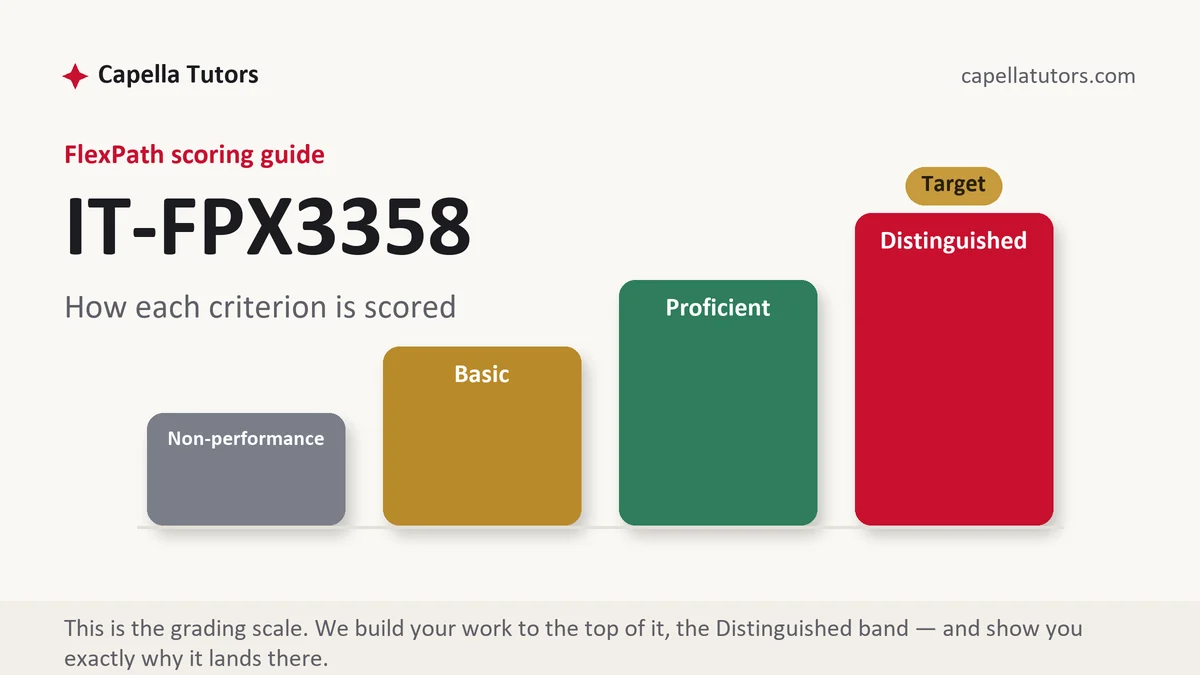
What IT FPX 3358 actually grades
Security at this level is a decision discipline, and the criteria are built to find out whether you treat it as one. A submission that lists products fails. A submission that begins with an asset, states what could go wrong with it, judges how likely and how damaging that is, and only then names a safeguard passes, because that sequence is the whole subject compressed into four moves. Confidentiality, integrity, and availability give you the vocabulary for what you are protecting, and the pair students skip, authenticity and non-repudiation, is what lets an organization prove after the fact who did something. Get the definitions apart and keep them apart: a threat is the actor or event, a vulnerability is the weakness it would use, risk is the combination of how likely that is and how much it would cost, and an exploit is the working method. Papers that use all four words as synonyms lose the analysis row before the recommendation section begins.
The technical middle of the course is where precision earns marks. Access control comes in families, and naming yours matters: discretionary control leaves permissions with the owner of the resource, mandatory control enforces labels the owner cannot override, role-based control attaches rights to a job rather than a person, and attribute-based control decides at request time from properties of the user, the resource, and the context. Least privilege and separation of duties are the principles those models implement, and the second one is why the person who creates a vendor should not be the person who approves its payments. Cryptography is graded on distinctions rather than on mathematics. Hashing is one way and encryption is reversible, so a stored password is salted and hashed with a deliberately slow function and is never encrypted, since anything encrypted can be decrypted by whoever holds the key. Symmetric algorithms are fast and leave you with the problem of getting the key to the other side, asymmetric pairs solve that exchange and are slower, and the transport protocols in daily use combine both. Encryption in transit and encryption at rest are separate controls that answer separate threats, and key management, not algorithm choice, is where real deployments fail.
The third strand is governance, and it is the part IT students underrate. A policy states what the organization requires and who owns it, a standard fixes the specific setting, a procedure gives the steps, and a guideline is advice. Confusing those four produces a document that cannot be enforced or audited, which is the most common structural fault in submitted work. Around them sit the incident response lifecycle, from preparation through detection and analysis into containment, eradication, and recovery, and finishing with the review nobody schedules; continuity planning with a recovery time objective for how long a service can be down and a recovery point objective for how much data you can afford to lose; and the regulatory driver behind the whole exercise, whether that is the security rule under HIPAA for health data, the payment card industry requirements for cardholder data, or the education records statute that governs a school. Name the regime that applies to your scenario early, because it decides which controls are optional and which are not.
How we help in this course
Security deliverables from us are built backwards from the scoring guide and forwards from the scenario. Assets get inventoried and valued, threats are named with a source rather than assumed, every risk statement carries a likelihood and an impact with the reasoning attached, each recommended control cites the framework reference it satisfies, and residual risk is stated instead of quietly left at zero. Policy language comes back in enforceable form, with a scope, an owner, a review date, and consequences, rather than as a paragraph of intentions. Tell us the organization in the case, the data it holds, and any regulation your faculty named, and the analysis will belong to that scenario.
Delivery terms hold across the studio. You get the work inside 24 to 48 hours, written at the Distinguished descriptor, after eight people have handled it: research pulls your scoring guide and the current framework revisions, a subject writer builds the risk analysis and the recommendations, a scoring-guide reviewer marks the draft criterion by criterion the way your evaluator will, an APA and originality pass reconciles the citations, and an editor takes the final read. Revision stays free until the guide is satisfied, faculty feedback comes back into the queue at no cost, and because an evaluated attempt can take two business days to come back, the cheapest schedule is always the one that gets a strong draft in early.
The assessments, one by one
Assessment 1
The opening deliverable in this course usually asks for analysis before advice: what the organization holds, what could go wrong with it, how likely and how damaging that is, and only then what to do. Read the full Assessment 1 manual.
Assessment 2
The middle deliverable in this course usually turns to safeguards, and it is graded on distinctions rather than on products: which access control model you chose and why, what encryption protects, and where hashing belongs instead. Read the full Assessment 2 manual.
Assessment 3
The later work in this course usually leaves technology behind and asks for governance: policy written so it can be enforced, an incident process with owners and phases, and continuity objectives expressed in time and data rather than in intentions. Read the full Assessment 3 manual.
How to actually write IT FPX 3358: where to begin
Read the scoring guide, then read the scenario twice with a highlighter, because the failure mode in this course is writing a competent essay about security in general when the criteria asked about one specific organization. Pull out of the scenario what a risk analysis needs: what data exists, where it lives, who touches it, what the organization does for money, what has already gone wrong, and what it is legally obliged to protect. Anything you cannot find, write down as an assumption in a short list at the front. Declared assumptions cost you nothing and undeclared ones look like invention.
Then practice the sentence this course exists to teach, which is a risk written so that a reader with no technical background can rank it against other risks. The weak version says the organization is vulnerable to a data breach and should improve its security posture. The version that reaches the top column says that fifty-two workstations in the billing office run with automatic updates disabled and no second authentication factor, that this office handles protected health information for roughly four thousand patients, that likelihood is moderate because two credential-phishing messages reached staff inboxes last quarter, that impact is high because notification duties change once a breach touches five hundred or more individuals and the practice would carry investigation and remediation cost on top, that the recommended controls are enforced automatic patching and phishing-resistant multifactor authentication for anyone reaching the billing application, that these map to the vulnerability management and access control families in the framework you are working from, and that residual risk falls to low-moderate because a stolen session token still bypasses the login. Nine facts, one recommendation, and a manager who has never configured anything can act on it.
Close the document the way a professional report closes, with implementation reality attached. Give each control an owner, a rough cost, a sequence, and a way to tell whether it worked, since a recommendation with no measure is a wish. Say which risks you are accepting and who has the authority to accept them, because risk acceptance is a decision that belongs to the business and not to the analyst, and showing you know that boundary is worth a criterion on its own.
| Section | What goes in it | What Distinguished looks like |
|---|---|---|
| Scope and assets | The organization, the data it holds, the systems in scope, and what is deliberately excluded. | Assets valued or ranked, with the exclusions justified rather than silently dropped. |
| Threats and weaknesses | Threat sources named, vulnerabilities identified, and the pairing between them made explicit. | Threats drawn from cited reporting for that sector, not from a generic list of hazards. |
| Risk analysis | Likelihood and impact for each pairing, the rating method stated, and the results ordered. | A stated scale, ratings a reader could reproduce, and the top risks defended over the rest. |
| Controls | Administrative, technical, and physical safeguards, each tied to the risk it reduces. | Controls mapped to framework references, layered on purpose, with residual risk named. |
| Policy and response | Policy language, incident handling phases, continuity objectives, and who owns each. | Enforceable wording with scope and consequences, and recovery objectives expressed in time and data. |
| Sources and format | Framework documents by revision, sector reporting by year, peer-reviewed work, current APA. | Primary standards cited directly, every figure dated, and the list reconciled both ways. |
Developing the analysis
The live argument in this field is how much of risk can honestly be counted, and settling it in your own words lifts the analysis criterion. The numeric school says put money on everything: value the asset, estimate the share a single event would destroy, multiply for the single loss expectancy, multiply again by how often you expect it in a year, and compare the annual figure against what a control costs. Work one through so the method is visible. A customer database valued at four hundred thousand dollars, an event that would compromise a quarter of that value, a single loss expectancy of one hundred thousand dollars, an expectation of one such event every five years, and an annual loss expectancy of twenty thousand dollars. A safeguard priced at thirty-five thousand a year fails that test on arithmetic alone unless it reduces several risks at once or a regulator requires it regardless. The skeptical school answers that every input above was a guess wearing a decimal point, and that ordinal ratings by people who know the environment are more honest. The graded move is to use both and say which one you trust for this decision, since a paper that shows the arithmetic and then admits what the arithmetic assumed is doing the thinking the criterion describes.
Citations that survive faculty review
Four source families carry a security paper. Standards and control catalogs come first, principally the special publication series from the National Institute of Standards and Technology covering risk assessment, security and privacy controls, and incident handling, together with the Cybersecurity Framework whose 2024 revision added a governance function to the five it already had, and the ISO and IEC information security management standards where your scenario is international. Regulation supplies obligation, so cite the rule text or the regulator's own guidance rather than a law firm summary of it. Sector reporting supplies scale, and the annual breach investigation and breach cost studies are usable if you name the publishing year in the sentence and treat the figures as a population average rather than as your client's expected loss. Peer-reviewed work retrieved through the Capella library carries any claim about human behavior, including why awareness training does or does not change click rates. Two habits keep a security reference list defensible. Cite the revision number of a control document, since these are living publications and an unversioned reference tells the evaluator you found it secondhand, and keep news coverage of an incident separate from the technical analysis of it. Then run current APA in both directions before you submit.
The mistakes that land Basic instead of Distinguished
- Controls recommended before any risk is stated. A shopping list with no analysis in front of it answers a question the guide did not ask.
- Encryption treated as one thing. At rest, in transit, and in use are different problems, and key custody is the one that decides all three.
- Hashing described as encryption. The two are not interchangeable, and the slip signals the reading was skimmed.
- Residual risk left unmentioned. No control removes a risk entirely, and pretending otherwise reads as inexperience.
- A framework cited with no revision or year. Versioned documents change, and an undated citation cannot be checked.
IT FPX 3358 questions students actually ask
Do I need a lab or hacking tools to pass this course?
Your scoring guide decides, and the wording in it is what you follow rather than anything you read on a forum. Work at this level is usually written around concepts, analysis, and documentation rather than around operating a toolset, so the artifacts tend to be risk write-ups, control recommendations, and policy language. Where a screen capture is required, build a virtual machine on your own hardware and use that, and never point a scanner at a network you do not own or administer, including your employer's, since permission is the only thing separating an academic exercise from an offense under computer misuse law. If an assessment appears to ask for live testing, message your faculty member and get the scope in writing before you touch anything.
Should my risk analysis be quantitative or qualitative?
Lead with a qualitative rating because it fits the evidence you actually have, then show the arithmetic once so the criterion for analysis has something to grade. A high, moderate, or low judgment is defensible when you say what put it there, meaning the threat activity you observed, the exposure you found, and the consequence you expect. The numeric version proves you know the method: state the asset value, the share of it a single event would destroy, the resulting single loss figure, the number of times a year you expect the event, and the annual expectation that comes out of multiplying them. Put the two side by side, note where they disagree, and explain which one you would take to a manager and why.
How current do my security sources have to be?
Current enough that nobody can point at a newer edition of the thing you cited. Foundational concepts do not expire, so an older text on access control models is fine, but a framework, a control catalog, or a top-risk list is a versioned document and citing a superseded revision as though it were in force is the error faculty catch fastest. Name the revision and the year in the citation itself, then say in the sentence which edition you are relying on. Anything describing threat activity or breach cost needs a year attached in the text, because a figure from a report published three years ago read as current makes every other number in the paper suspect.
Risk analysis due this week?
Send us the case organization and the criteria attached to it. Every risk comes back rated, every control mapped, residual risk stated. The first premium sample carries no fee.