This manual is for IT FPX 3249 Assessment 3, start to submission. The later work in this course usually asks for the human side of the design: personas with a basis, task flows before screens, low-fidelity wireframes, and an evaluation that produces findings rather than opinions. Method is what gets graded here, not taste, so the protocol you write down matters more than how the screens look. Below: the method, a structure aligned to the criteria, and an annotated excerpt from a model evaluation. Need it handled? Send the brief and a premium original sample arrives within 24 to 48 hours, revised without charge until the guide is satisfied. Capella's catalog lists the course as IT-FPX3249, and some courserooms print IT3249; both point to this same Assessment 3.
One honesty note before the manual: Capella revises courses and scoring guides over time, so always write to the exact scoring guide attached to your assessment in the courseroom. The course identity above is verified on capella.edu; the method and structure below are our tutors' approach to it, not Capella's official rubric text.
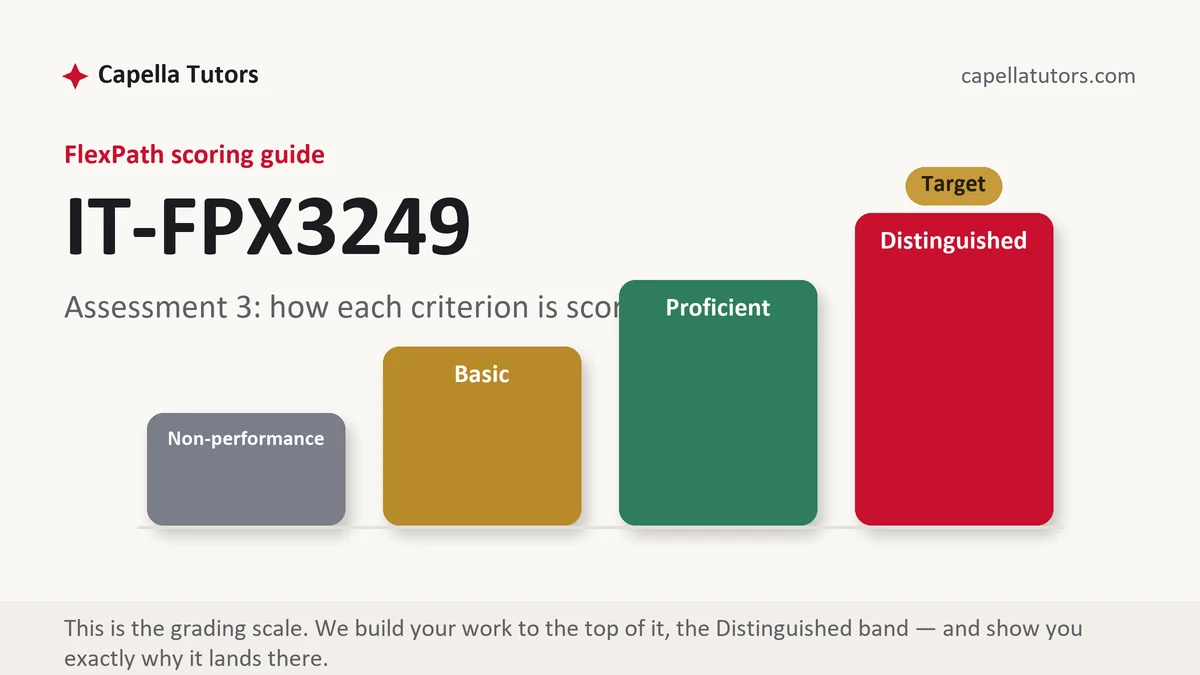
How IT FPX 3249 Assessment 3 is scored
Each criterion is marked at one of four levels, and none of those levels is a grade. Write to the wording of the one you want:
| Level | What it means on an experience design and evaluation submission |
|---|---|
| Distinguished | Personas rest on stated evidence, artifacts reference each other, and every finding carries the heuristic it breaks, a severity, and a fix. The protocol is written before the results, and it says who the participants were. |
| Proficient | Personas, flows, wireframes, and an evaluation are all present and internally consistent. Solid, with the method left implicit. |
| Basic | Screens that look considered, plus a list of complaints called an evaluation. This is where a design-by-instinct submission lands. |
| Non-performance | A required artifact is absent, most often the task flow or the severity ratings, so the criterion that pays for it has nothing to mark. |
Findings are the scoring surface in this deliverable, so give them a shape and repeat it. Observation, heuristic broken, severity with a reason, remedy. Four short parts per finding, laid out in a table, and an evaluator can mark the row without reconstructing your thinking, which is the whole game.
The IT FPX 3249 Assessment 3 method, step by step
-
Turn the criteria into headings, then decide the artifact list
Write the criteria out as headings and note beside each one which artifact answers it. If no artifact answers a criterion, that is the gap to close first, and it is usually the flow rather than the screen.
-
Build personas on something you can name
A persona needs a source, so use interview notes, help desk tickets, survey answers, or published research, and cite it. For a university housing portal that means a first-year student choosing a roommate under time pressure and a housing officer resolving the pairs nobody chose, each with a goal, a constraint, and a stated basis. A character invented to justify your screens is decoration.
-
Write the task flow before you draw a single screen
Set out the steps a student takes from opening the portal to a confirmed match, including the branch where no match is found. Then check each step has somewhere to happen. Wireframes drawn before the flow tend to produce a handsome screen for step two and nothing at all for the branch where the process fails.
-
Keep wireframes low fidelity on purpose, and say why
Boxes, labels, and hierarchy only, with no color or type decisions, because the criterion is about structure and priority rather than about finish. State the choice in the document: fidelity is deliberately low so review comments arrive about the flow instead of about the font, and raising fidelity too early is how teams end up defending decoration.
-
Run the evaluation against a named heuristic set
Pick a published set, name it, and check each screen against every item rather than noting what happens to annoy you. Where you run a small usability session instead, write the tasks as goals before recruiting, decide in advance what counts as failure, and report who the participants were and how you found them. Five people is the working number, and honesty about who they were reads better than a sample you oversell.
-
Rate severity with a reason, then self-score and submit
Severity comes from impact and frequency together, not from irritation, so give each finding a rating and a sentence explaining it. Order the findings by severity, put the fixes beside them, then mark yourself against every row and upload early enough that a two business day evaluation leaves room for one revision.
A structure that maps to the criteria
Word targets our tutors use when planning an experience deliverable at this level, not Capella requirements; weight the sections the way your own guide does.
| Section | What it must do | Guide |
|---|---|---|
| Users and evidence | Each persona with a goal, a constraint, and the source the description came from. | ~250 words |
| Task flows | The steps to the primary outcome, including the branch where the task cannot be completed. | ~250 words |
| Wireframes and rationale | Low-fidelity screens with the structural priority of each explained in a line or two. | ~250 words |
| Accessibility decisions | Contrast, focus order, target size, and text alternatives treated as design choices rather than a final check. | ~200 words |
| Evaluation and findings | The protocol, then findings as observation, heuristic, severity with a reason, and remedy. | ~350 words |
| Sources | The heuristic set named, human factors research cited for behavior claims, current APA both ways. | as needed |
Annotated sample excerpt
One finding from a model evaluation written by our team, in the four-part shape that makes an evaluation row easy to mark.
Three of five participants stopped at the second step because the only forward control read Continue and gave no sign that a binding roommate confirmation came next.1 This breaks visibility of system status in the heuristic set used here, since the interface never tells the student where they are in a four-step process or what the next step commits them to.2 Severity is high: the task cannot be finished without guessing, and a wrong guess produces a pairing the housing office then has to unpick by hand.3 Remedy: a labelled step indicator naming the current step, and a forward control that reads Review match rather than Continue.
- 1Reports what participants did rather than what they said, and attaches a count. Behavior with a number is evidence; a paraphrase is an impression.
- 2Ties the observation to a named item in a named set, which is precisely what a heuristic evaluation criterion checks for.
- 3Justifies the severity with consequence and cost instead of asserting it, then hands over a fix specific enough to build.
The full premium sample for your exact assessment, written fresh to your scoring guide and issue, is free to request. Study it, revise it into your own voice, and submit work you understand.
The five mistakes that cost Distinguished
- Personas assembled from imagination. A user invented after the screens exist is there to agree with you, and the evidence row scores accordingly.
- Wireframes produced before any flow. Screens designed without a path through them leave the failure branch undrawn, which is the branch users hit.
- Findings with no severity and no remedy. A list of complaints is not an evaluation, and it will be marked as the list it is.
- High fidelity too early. Color and type invite comments about polish, and the criterion is asking about structure and priority.
- Accessibility parked in an appendix. Contrast, focus order, and text alternatives are design decisions, and moving them to the back reads as an afterthought.
Pre-submission checklist
- Every persona carries a goal, a constraint, and a named source
- A task flow exists for the primary outcome and for the branch where it fails
- Wireframes kept low fidelity, with the reason stated in the document
- The heuristic set named, and every screen checked against every item
- Each finding written as observation, heuristic, severity with a reason, and remedy
- Findings ordered by severity, self-scored per row, submitted early in the week
Evaluation due and the findings read as opinions?
Send the scenario, the criteria, and any screens you have drawn. You get personas with a stated basis, flows that include the branch where the task fails, and findings shaped so an evaluator can mark them, inside 24 to 48 hours with free revision until the guide is met. The opening premium sample is free.