This manual is for IT FPX 3249 Assessment 1, start to submission. The first deliverable in Software Architecture and User Experience Design usually asks you to describe a system before designing it: who uses it, what they are trying to finish, and what the software has to be good at, written so a reader could test each claim. That last part is where the marks live, because an adjective is not a requirement and a measure is. Here you get the method, a structure aligned to the criteria, and an annotated excerpt from a model. Prefer support? Send the scenario and a premium original sample returns inside 24 to 48 hours, rewritten free until the guide is met. Capella's catalog lists the course as IT-FPX3249, and some courserooms print IT3249; both point to this same Assessment 1.
One honesty note before the manual: Capella revises courses and scoring guides over time, so always write to the exact scoring guide attached to your assessment in the courseroom. The course identity above is verified on capella.edu; the method and structure below are our tutors' approach to it, not Capella's official rubric text.
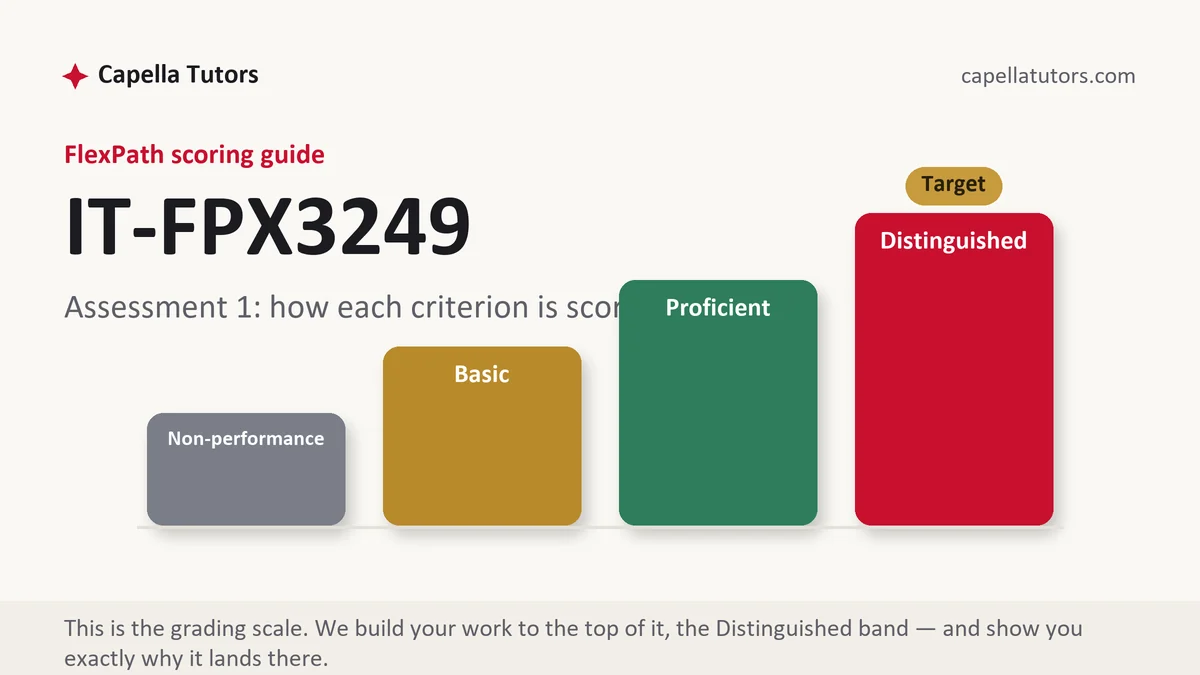
How IT FPX 3249 Assessment 1 is scored
FlexPath grades criterion by criterion with four levels and no letter grade. The level wording is your specification, so read it before you write:
| Level | What it means on a requirements and users submission |
|---|---|
| Distinguished | Users are described from evidence, the primary task is named, and every quality attribute carries a condition and a number. The two requirements that conflict are identified before any design exists. |
| Proficient | The system, its users, and its requirements are all present and correct. Complete, with the attributes still sitting as adjectives. |
| Basic | A description of the software with users assumed and requirements written as goals. The commonest first attempt in a design course. |
| Non-performance | A required element is missing, most often the quality attributes or the task analysis. Missing outranks weak, and it puts the row on the floor. |
The test to apply to your own draft is whether a reader could disagree with a sentence. Nobody can argue with the claim that a system should be fast. Anyone can check whether a search returns in under two seconds for a file of thirty thousand records, which is why the second sentence scores and the first does not.
The IT FPX 3249 Assessment 1 method, step by step
-
Make the criteria your headings before anything else
Paste each criterion into an empty document as a heading with its top-level wording underneath, then write only inside those headings. Design deliverables lose marks for coverage far more often than for judgment, and a criterion with no heading is a criterion with no answer.
-
Read the case for its people, not its technology
Go through the scenario twice and list every person who touches the system, what they want out of it, and what stops them today. A two-site dental practice whose front desks keep two separate spreadsheets has three distinct users at least: the clerk booking appointments, the hygienist who needs an accurate history, and the office manager reconciling duplicates at month end.
-
Name one primary task and rank the rest under it
Systems get designed around a single task done thousands of times, and everything else is secondary. Say which one it is, in a sentence, and then rank the others. If the primary task is finding the right patient record on the first attempt, then merge tooling, reporting, and configuration are all support work, and the design should show that priority.
-
Turn every adjective into a scenario with a measure
Take each quality word in your draft and rewrite it in five parts: the source of the stimulus, the trigger, the condition the system is in, the response, and the number that says the response was good enough. Reliable becomes a stated recovery window. Usable becomes a task completion rate for a named user. Three scenarios written this way give the architecture something to be judged against.
-
Find the two requirements that fight, and say which wins
Every real system contains a pair that cannot both be maximized, and naming it is the single move that lifts an analysis criterion. One authoritative record conflicts with letting each site keep working when the link between them drops. Say which one your design favors, name the cost you accepted, and state the condition under which you would reverse the decision.
-
Self-score, then submit with days in hand
Mark your own draft against each row as D, P, B or N, and be strict about anything you cannot point at in the text. Rewrite everything below the top level once. Then submit early in the week, since evaluation can take two business days and a late-week upload can idle over the weekend.
A structure that maps to the criteria
The word counts below are planning targets our tutors use for a requirements document at this level, not Capella rules; follow your own guide wherever it asks for more.
| Section | What it must do | Guide |
|---|---|---|
| System in brief | The software in one paragraph, what it replaces, and the boundary of what you are designing. | ~150 words |
| Users and tasks | Each user with a goal and an obstacle, the primary task named, and the rest ranked beneath it. | ~300 words |
| Functional requirements | What the system must do, one numbered statement per capability, each traceable to a user. | ~250 words |
| Quality attribute scenarios | Three or more attributes written with source, trigger, condition, response, and a measure. | ~300 words |
| Conflicts and constraints | The pair that cannot both be satisfied, the choice you made, and the budget or hosting limits behind it. | ~200 words |
| Sources | Standards for quality vocabulary, research for any claim about people, current APA reconciled both ways. | as needed |
Annotated sample excerpt
A model excerpt from our team, showing what a measurable requirement reads like when it is written to the top of the guide rather than to a word count.
When a clerk searches by surname at either site during opening hours, the system returns one merged record per patient rather than two, within two seconds, across a file of thirty thousand patients.1 Availability is stated separately: if the link between the two sites drops, each site continues viewing and booking its own appointments, and queued changes reconcile within fifteen minutes of the link returning.2 These two requirements conflict, because a single merged view wants one authoritative store while offline booking wants local writes, and this design accepts a fifteen minute window in which the second site can show an appointment that has already moved.3
- 1Five parts in one sentence: who acts, what triggers it, the state the system is in, the response, and the number. A criterion can mark every clause.
- 2Keeps two attributes apart instead of bundling them into one paragraph about reliability, which is how measures get lost.
- 3Names the conflict and the cost accepted, in the requirements section, before a single component has been drawn. One sentence, and it is the one dividing the top two columns.
The full premium sample for your exact assessment, written fresh to your scoring guide and issue, is free to request. Study it, revise it into your own voice, and submit work you understand.
The five mistakes that cost Distinguished
- Attributes left as adjectives. Fast, secure, and scalable are ambitions until a condition and a number are attached to each of them.
- Users invented after the design was decided. A persona built to agree with a diagram you already drew is decoration, and evaluators recognize it.
- Every requirement marked as essential. Uniform priority tells a reader that no ranking happened, and ranking is what the criterion asks for.
- The obvious conflict left unmentioned. A design with no sacrifice in it has not made an argument yet, and the analysis row is where that shows.
- Requirements with no user behind them. A capability nobody in the scenario needs is scope you invented, and it costs you the traceability row.
Pre-submission checklist
- Each criterion has its own heading and nothing is written outside those headings
- Every user carries a goal, an obstacle, and a task drawn from the scenario
- One primary task named in a sentence, with the others ranked beneath it
- At least three quality attributes written with a condition and a number
- The conflicting pair identified, the choice made, and the cost stated
- Self-scored against every row, sources reconciled in current APA, submitted early in the week
Requirements due and the scenario is thin?
Send the case, the criteria, and any constraint your faculty attached. You get users drawn from the evidence in front of us, attributes written as scenarios with measures, and the conflict named rather than avoided, inside 24 to 48 hours. Revision is free until the guide is met, and the first premium sample costs nothing.