This manual is for HRM FPX 5960 Assessment 4, start to submission. At this stage of the capstone the work is presented to somebody who can approve or refuse it, as an executive package, a briefing deck or both, and the writing job changes completely: the recommendation goes first, the reasoning goes behind it, and every number on the page keeps its denominator because a skeptical reader asks for that before anything else. Your scoring guide decides the exact format and how much implementation detail it wants. Below sits the method our tutors use, a criterion-keyed structure, and an annotated excerpt. Rather hand it over? A premium original sample is with you within 24 to 48 hours, then reworked at no charge until the descriptors are met. Capella's catalog lists the course as HRM-FPX5960, and some courserooms print HRM5960; both point to this same Assessment 4.
One honesty note before the manual: Capella revises courses and scoring guides over time, so always write to the exact scoring guide attached to your assessment in the courseroom. The course identity above is verified on capella.edu; the method and structure below are our tutors' approach to it, not Capella's official rubric text.
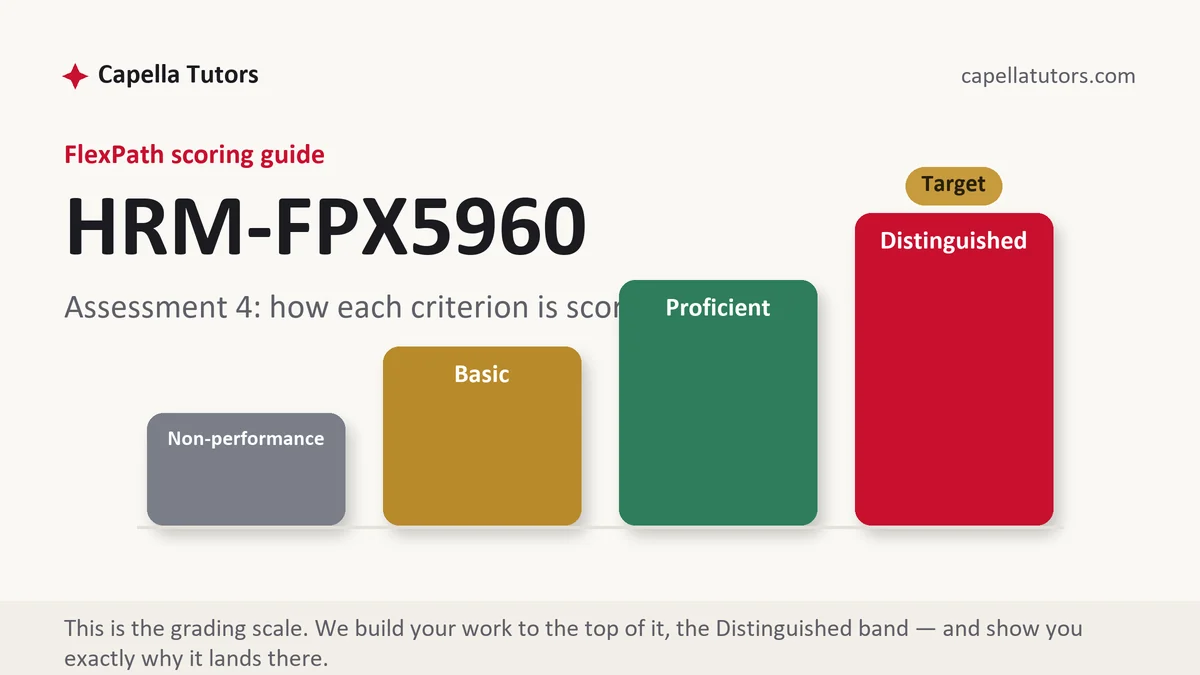
How HRM FPX 5960 Assessment 4 is scored
The four levels apply criterion by criterion here as everywhere else, and on an executive package they come out this way:
| Level | What it means on an executive package |
|---|---|
| Distinguished | The first page states the ask, the cost, the timing and the decision required, the cost is built the way payroll would actually run it, the limitations that bear on the decision are in the package rather than hidden in an appendix, and the professional register never slips into student prose. |
| Proficient | A clear, well-organized document that reaches the recommendation reliably. It builds toward the ask instead of opening with it, which costs the criterion that grades audience judgment. |
| Basic | The paper compressed. An executive summary that summarizes, numbers without windows, and a decision the reader has to infer from the conclusion. |
| Non-performance | A required component is missing, most often the decision itself or the cost, and a package that never says what it wants has failed at the one job it has. |
The argument does not change between the analysis and the package; the order does. A written analysis is allowed to build, while an audience deciding whether to keep listening needs the recommendation in the first thirty seconds and the defense afterwards.
The HRM FPX 5960 Assessment 4 method, step by step
-
Write the first page as four lines
What you are asking for, what it costs, when it happens, and what decision is required from the reader today. Approve a night differential of $3.75 an hour for the 34 overnight pharmacy technicians, effective the first pay period of the quarter, at about $107,600 a year, decision needed by the fifteenth. Everything else in the package exists to defend those four lines, and if it does not defend them it belongs in an appendix.
-
Cost the decision the way payroll will run it
The visible cost is the differential itself: 34 technicians at 1,872 night hours each is 63,648 hours, and the $1.65 increase is about $105,000. The cost most proposals miss is the overtime uplift, because under the Fair Labor Standards Act a shift differential is remuneration that enters the regular rate. In a 44-hour week with 36 night hours the regular rate moves from $28.52 to $29.87, adding roughly $0.68 of half-time premium to each overtime hour, so the department's 3,800 overtime hours add about $2,600.
-
Answer the equity question before it is asked
Evening technicians currently receive $1.40, and widening the night gap to $3.75 gives them a comparison to make on the day the change is announced. Take a position in the package: hold evenings, state the reason as the vacancy concentration rather than the value of the people, commit to a review at two quarters, and price what moving evenings would cost if the decision goes the other way. A reader who can see you anticipated the follow-up question stops looking for the ones you missed.
-
Cut the evidence to what carries the claim
Two or three findings do the work; the rest goes behind. Keep the internal figures that show the vacancy pattern and the market data that shows where the differential sits, and drop the general literature on compensation satisfaction, which will not move this decision. Each surviving number keeps its window and its source on the slide or the page, since the presenter who has to look one up loses the room.
-
Put the load-bearing limitations in the package
The ones worth writing are the ones that bear on the decision: the vacancy data covers nine months rather than a year, the market comparison uses a metropolitan wage series rather than direct competitors, and the retention effect will not be visible until two quarters after the change. Naming those does not weaken the ask, it is the reason a senior reader believes the rest of it.
-
Rehearse the two questions you least want
They are almost always what this costs in other people's time and how you will know it worked. Have both answered in one sentence each, with the source named, then reconcile the whole package against the criteria and against your earlier submissions so the scope sentence, the baseline and the metric definitions still agree. Submit early in the week; an attempt can sit two business days before it is read.
A structure that maps to the criteria
The targets below are our tutors' planning ranges for a package of this kind rather than Capella instructions; adjust to whatever weighting your own guide applies.
| Section | What it must do | Guide |
|---|---|---|
| The ask | Recommendation, cost, effective date and the decision required, on the first page, before any reasoning. | ~150 words |
| Cost as payroll computes it | The direct cost and the second-order cost, including overtime effects, with every input shown. | ~300 words |
| Internal equity | Who will compare themselves to whom, the position taken, and what the alternative would cost. | ~250 words |
| Evidence behind the claim | The two or three findings that carry the causal argument, each with its window and its source. | ~300 words |
| Timeline and ownership | Sequence, who does what by when, the systems and communications work, and the point of no return. | ~250 words |
| Limitations and references | The limits that bear on the decision, the review date, then current APA with internal artifacts named. | ~250 words |
Annotated sample excerpt
Original model work from our team, published so the register of an executive page is visible rather than described. Take the shape and fill it with your own decision.
Recommendation: raise the overnight pharmacy technician differential from $2.10 to $3.75 an hour for all 34 budgeted night positions, effective the first pay period of the coming quarter, with a decision required by the fifteenth so payroll configuration can be completed in time.1 Annual cost is approximately $107,600, being $105,000 on 63,648 night hours and about $2,600 in additional overtime premium, since the differential enters the regular rate used to calculate overtime.2 Six of the 34 positions have been vacant for more than 90 days and are currently covered by overtime and two contracted technicians; the proposal is judged unsuccessful if vacancies are not below three within two quarters, and evening differentials are deliberately unchanged pending review at that same point.3
- 1The ask, the population, the effective date and the deadline for the decision, before any reasoning. A reader could act on this sentence alone.
- 2Both cost layers shown, including the overtime consequence most proposals leave out. Volunteering the second-order cost is what buys trust in the first.
- 3States the failure condition and the equity position on the first page rather than waiting to be asked about either.
The full premium sample for your exact assessment, written fresh to your scoring guide and issue, is free to request. Study it, revise it into your own voice, and submit work you understand.
The five mistakes that cost Distinguished
- An executive summary that summarizes. The first page exists to state the ask, the cost and the decision, and a synopsis of the paper wastes the only page most readers finish.
- A differential costed without its overtime effect. Additional pay generally enters the regular rate, so the true cost is higher than the headline and a reviewer in payroll will find the gap.
- The comparison group ignored. Somebody always gets compared to somebody, and a package that has not decided its position on that will have the decision made for it in the room.
- Every finding included. An audience deciding whether to keep listening cannot absorb nine exhibits, and the two that carried the argument get buried with the rest.
- Limitations exiled to the appendix. The limits that bear on the decision belong beside the ask, because the reader who discovers them later stops trusting the parts they already accepted.
Pre-submission checklist
- Ask, cost, effective date and required decision all on the first page
- Direct and second-order costs both shown, with the payroll mechanics stated
- A position taken on internal equity, and the alternative priced
- Evidence cut to what carries the claim, every figure keeping its window and source
- Load-bearing limitations in the package itself, with a review date
- Scope sentence, baseline and metric definitions still identical to your earlier submissions
Package due and the deck has to hold up in the room?
Send the criteria, the recommendation you intend to make and the cost inputs you can share. Our eight-person pipeline returns a premium original sample inside 24 to 48 hours with the ask on page one, the second-order costs computed, the equity position taken and the limitations placed where a senior reader expects them.