This manual is for HRM FPX 5960 Assessment 3, start to submission. This stage of the capstone is the intervention itself and the design that will judge it: what changes, for whom, at what cost in money and in other people's hours, against what comparison, and by what result you would agree it had failed. Your scoring guide decides the format, and the criterion that decides the grade is nearly always the one asking how you would know the effect was yours rather than the calendar's. Below sit our tutors' method, a structure that maps to the criteria, and an annotated sample excerpt. Prefer it built with backup? A premium original sample arrives inside 24 to 48 hours and is revised free until the criteria clear. Capella's catalog lists the course as HRM-FPX5960, and some courserooms print HRM5960; both point to this same Assessment 3.
One honesty note before the manual: Capella revises courses and scoring guides over time, so always write to the exact scoring guide attached to your assessment in the courseroom. The course identity above is verified on capella.edu; the method and structure below are our tutors' approach to it, not Capella's official rubric text.
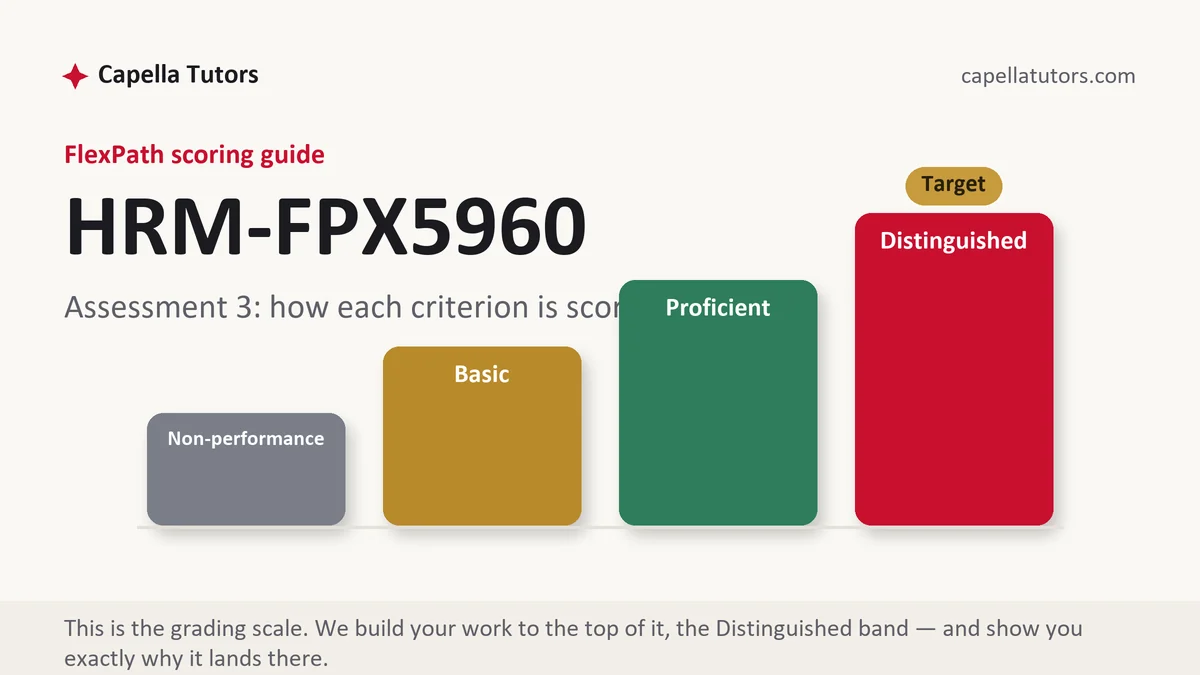
How HRM FPX 5960 Assessment 3 is scored
Every criterion lands somewhere on the same four-level ladder, and on an intervention and measurement design the rungs read like this:
| Level | What it means on an intervention and measurement design |
|---|---|
| Distinguished | Components are priced individually, the case is run at a conservative benefit as well as a central one, the input the whole conclusion rests on is named, and the comparison is chosen with its remaining confound stated. There is also a sentence saying what result would end the initiative. |
| Proficient | A well-argued intervention with a credible total cost and a sensible measurement approach. The sensitivity work is missing, and without it the reader has to do the stress testing themselves. |
| Basic | A programme described enthusiastically, a single return figure with no visible components, and before and after as the entire evidence design. |
| Non-performance | A required element never appears, usually the cost or the comparison. A missing measurement design floors the criterion no matter how strong the intervention sounds. |
Be skeptical of return figures here, starting with your own. A human resource return calculation is largely decided by which costs the author chose to count and whether the benefit was measured or assumed, so show the components and let the reader disagree with one of them without discarding the rest.
The HRM FPX 5960 Assessment 3 method, step by step
-
Break the intervention into components with prices
Six preceptor stipends at $6,000 is $36,000, tuition support for twenty at $5,000 is $100,000, and a retention payment at eighteen months for twenty-four people at $3,000 is $72,000, so the annual cost is $208,000. A single total invites the reader to accept or reject the whole thing; a component list lets them cut one line and keep the argument, which is how proposals actually survive a budget meeting.
-
Price the thing you are replacing
Twenty-two contract nurses working 40 hours a week for 46 weeks is 1,840 hours each, 40,480 hours in total. Billed at $94 an hour that is $3.81 million, against a loaded employed cost of $56 an hour, or $2.27 million, so the premium the organization pays for the arrangement is about $1.54 million a year. That premium, not the gross agency invoice, is the number your intervention is competing with.
-
Compute the break-even before the benefit
Each contract position converted to a permanent hire avoids 1,840 hours of the $38 premium, which is $69,920. Dividing the $208,000 programme cost by that figure gives 2.98, so the initiative pays for itself at three conversions. A break-even stated in units a manager recognizes is more persuasive than any return percentage, because the reader can judge for themselves whether three is plausible.
-
Run the conservative case and name the load-bearing input
At nine conversions the premium avoided is $629,280 and the net is $421,280; at five it is $349,600 and $141,600. Then say the quiet part: the entire conclusion rests on the conversion count and on those hires staying past eighteen months, and the saving only materializes if the hours are still needed, since a fall in census removes the benefit without touching the cost.
-
Choose a comparison and write the falsification sentence
A before and after on one unit contains everything else that happened on that unit. Stagger instead: two units receive the change in the first quarter and the third in the fourth, so the third acts as a comparison until it converts. Then commit in writing, for example that if agency hours on the first two units have not fallen at least 15 percent by the end of quarter three while the comparison unit holds flat, the initiative will be judged unsuccessful.
-
Check the pay practice before you promise a payment
A retention payment with a clawback is a compensation design, not a poster. Structure repayment as a separate agreement rather than as a deduction from a final paycheck, because under the Fair Labor Standards Act a deduction that pushes a nonexempt employee below minimum wage in the pay period is unlawful, and several states restrict deductions from final wages further. Say who reviewed the wording and when.
A structure that maps to the criteria
These are the planning ranges our tutors work to on an intervention of this size, not Capella rules; expand any section your own scoring guide weights more heavily.
| Section | What it must do | Guide |
|---|---|---|
| The intervention specified | Components, eligibility, who delivers each one, the start date and the owner by role. | ~250 words |
| Cost build-up | Each component priced separately, plus the hours borrowed from managers and educators, with inputs visible. | ~250 words |
| The alternative priced | What the organization currently spends on the workaround, expressed as the premium rather than the invoice. | ~250 words |
| Break-even and sensitivity | The unit that makes it pay, the conservative case, the central case, and the input the conclusion depends on. | ~300 words |
| Measurement design | The comparison chosen, why, the window, the analysis, and the result that would count as failure. | ~300 words |
| Risks and references | Pay practice review, census assumptions, implementation risks, then current APA with sources named. | ~200 words |
Annotated sample excerpt
An original model excerpt from our team, showing what the top of the guide sounds like on a costed proposal. Study the moves and rebuild them from your own figures.
The three units currently cover 40,480 hours a year through 22 contract nurses billed at $94 against a loaded employed rate of $56, so the premium being paid for the arrangement is roughly $1.54 million, and it is the premium rather than the $3.81 million invoice that this proposal competes with.1 Each position converted to a permanent hire removes 1,840 hours of that $38 premium, $69,920, so the $208,000 programme breaks even at three conversions, returns a net $141,600 at five and $421,280 at nine.2 The conclusion therefore rests almost entirely on the conversion count and on retention past eighteen months, and it disappears altogether if census falls, since avoided premium is only avoided when the hours were still required.3
- 1Compares like with like by isolating the premium. Quoting the gross invoice would inflate the case and lose the first finance reader who noticed.
- 2Gives the break-even in whole positions, a unit an operating manager can judge, then shows the range rather than one flattering point estimate.
- 3Names the load-bearing assumption and the condition that would void the saving. Volunteering the weak point is what makes the strong points credible.
The full premium sample for your exact assessment, written fresh to your scoring guide and issue, is free to request. Study it, revise it into your own voice, and submit work you understand.
The five mistakes that cost Distinguished
- The gross invoice quoted as the saving. The organization would still pay to have the work done, so only the premium above employed cost is available to recover.
- A single point estimate. One flattering number with no conservative case reads as advocacy, and a reader who cannot see the range will invent a worse one.
- Before and after presented as evidence. Everything else that happened in the period is inside that difference until a comparison takes it out.
- Benefits assumed rather than measured. If the effect size came from a vendor brochure rather than from your own baseline, say so in the sentence that uses it.
- A payment designed without a pay-practice check. Clawbacks, stipends and differentials all touch wage rules, and a compensation idea that cannot be administered lawfully is not a proposal.
Pre-submission checklist
- Every cost component priced separately, with the hours borrowed from other roles counted
- The status quo priced as a premium over employed cost, not as a gross figure
- A break-even stated in units the operating side recognizes
- A conservative case run beside the central case, and the load-bearing input named
- A comparison group or staggered rollout chosen, with the surviving confound stated
- A written falsification condition with a date, and the pay-practice review recorded
Business case due and the arithmetic has to survive finance?
Send the criteria, the spend you are competing with and the components you have in mind. Our eight-person pipeline returns a premium original sample in 24 to 48 hours with the premium isolated, the break-even computed, the conservative case run and the falsification condition written, so every figure on the page can be rebuilt in front of a sponsor.