This manual is for HRM FPX 5960 Assessment 1, start to submission. The first stage of the capstone is where you commit: one human resource practice, one population, one measure, stated narrowly enough to finish inside a final quarter and consequentially enough that somebody would notice if it worked. Your scoring guide decides the format, and the criterion that quietly decides the grade is scope, because a topic instead of a scope produces a literature review with a recommendation stapled to it. What follows is our tutors' method for it, a structure that maps to the criteria, and an annotated sample excerpt. Prefer to hand it over? A premium original sample comes back in 24 to 48 hours, revised free until the criteria clear. Capella's catalog lists the course as HRM-FPX5960, and some courserooms print HRM5960; both point to this same Assessment 1.
One honesty note before the manual: Capella revises courses and scoring guides over time, so always write to the exact scoring guide attached to your assessment in the courseroom. The course identity above is verified on capella.edu; the method and structure below are our tutors' approach to it, not Capella's official rubric text.
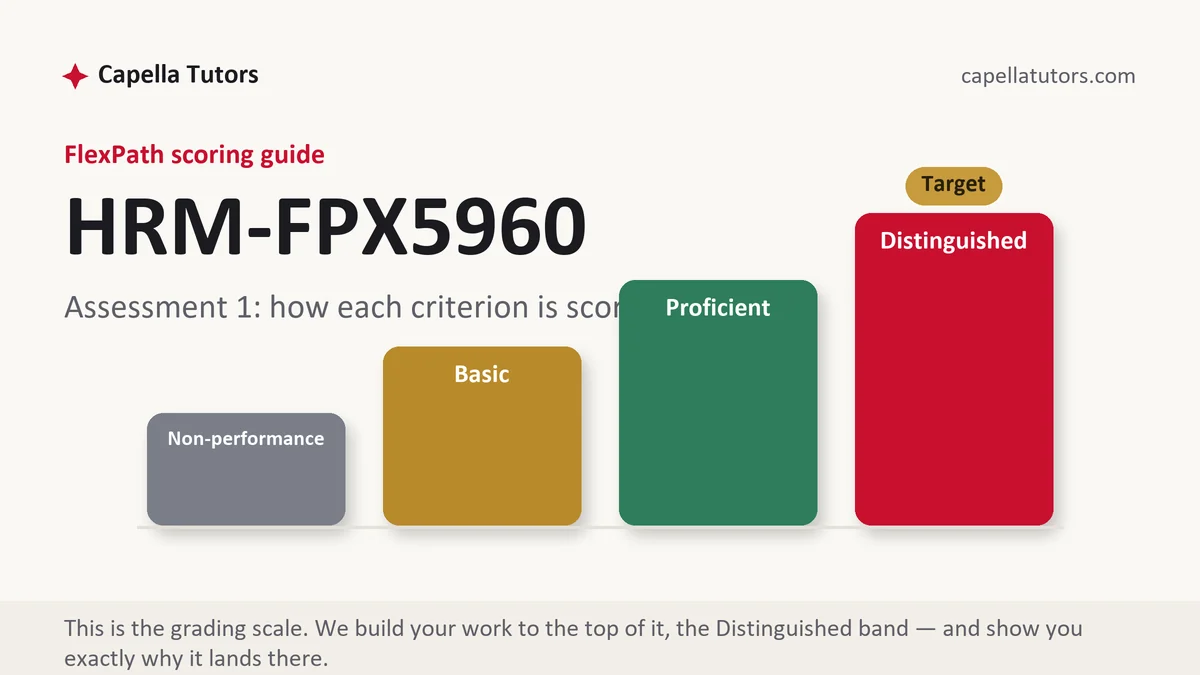
How HRM FPX 5960 Assessment 1 is scored
FlexPath grades criteria, not papers, and each one lands on one of four levels. On a capstone scoping and problem definition deliverable they read like this:
| Level | What it means on a scoping and problem definition |
|---|---|
| Distinguished | The scope names a date, a population, a behavior and a measure, the problem is priced in figures the writer computed, and the account says which adjacent systems the change will disturb. The extra move is written into each criterion, and in this one it is nearly always specificity you could be held to. |
| Proficient | A defensible problem, well justified, with a sensible boundary around it. The commercial consequence stays qualitative, and qualitative is where the top column stops paying. |
| Basic | An interesting subject with a plan to improve it. No population, no measure, no date, so nothing in the document could later be judged true or false. |
| Non-performance | A required element never arrives, most often the measurable statement of the problem. What is missing floors the criterion regardless of how well the rest reads. |
Integration is the quality this course exists to assess, so the scoping stage is also where you show it. A change to one practice touches reward, legal exposure, the work of people who do not report to you, and the story employees tell about fairness, and a capstone that traces that chain from the first submission outranks one that discovers it in the last.
The HRM FPX 5960 Assessment 1 method, step by step
-
Write one scope sentence and keep it on screen
The working form names the date, the population, the behavior, the measure and the movement: by the end of the third quarter, the credentialing team will reduce median days from complete file to payer enrollment for newly hired clinicians at the two largest sites from 84 to 60, measured on the enrollment tracker. Everything in the capstone then attaches to that line, and whatever will not attach belongs to a paper you are not writing.
-
Scope by the decision, not by the subject
Improving credentialing is a subject with no edge. Shortening the interval between a complete file and a billable clinician at two named sites is a project with a start, a finish and somebody accountable. Test your own boundary by asking who would have to change what they do on a Tuesday; if the answer is nobody in particular, the scope has not closed yet.
-
Price the problem in the organization's own currency
Ninety-six clinician files were processed last year at a median of 84 days, and 23 of them ran past 120. A clinician who cannot bill averages 14 encounters a day at roughly $118 in net collections, about $1,652 a day, so 23 files carrying 30 excess days each is 690 days and near $1.14 million. Then be honest about the accounting: Medicare permits limited retrospective billing while most commercial contracts do not, so part of that figure is deferred and part is forgone, and saying which is which is what a finance director will trust.
-
Take the baseline from a report that already exists
Use the enrollment tracker, the position control report, the payroll extract, whatever the organization already runs. Write down the definition before anything changes: what counts as a complete file, whether the clock stops for missing primary source verification, and how a withdrawn application is treated. A new dashboard is a reason to delay, and a definition invented after the fact is a finding nobody can check.
-
Name the systems the change will disturb
Compress the credentialing interval and you touch onboarding sequencing, the start dates in signed offers, and the third-party background report that sits inside the same chain, which brings the Fair Credit Reporting Act with its pre-adverse-action notice and waiting period. Moving a start date also has wage payment consequences in some states. List these collisions in the scoping document and price the ones you can, because a capstone that finds them early looks like judgment and one that finds them late looks like rework.
-
Reconcile the draft to the guide, then submit early
Turn each criterion into a heading, paste the top-level wording beneath it, and check that a reader could find your answer in seconds. Mark each criterion yourself against the four levels and rewrite anything below the top. An attempt can hold for two business days, and in a final quarter with linked deliverables a lost week costs more than it would anywhere else in the program.
A structure that maps to the criteria
These word targets are the planning ranges our tutors start from on a capstone scoping deliverable, not Capella rules; expand whichever section your guide weights most heavily.
| Section | What it must do | Guide |
|---|---|---|
| Organization and practice | The setting, the function, the practice under examination, and the reason it is worth a quarter of your attention. | ~200 words |
| The scope sentence | Date, population, behavior, measure and movement in one line, then the boundary stated as what is excluded. | ~200 words |
| The problem, quantified | The current state in figures, with the arithmetic shown and deferred consequences distinguished from forgone ones. | ~350 words |
| Baseline and definition | The source report, the metric formula, the period covered and the edge cases decided in advance. | ~250 words |
| Systems disturbed | The adjacent practices, legal obligations and other people's work the change will reach, priced where possible. | ~250 words |
| Feasibility and references | Access, sponsor, what could stop the work, then current APA with internal artifacts named by title and date. | ~250 words |
Annotated sample excerpt
An original model excerpt from our team, included so the graded moves are visible rather than described. Take the pattern and rebuild it on your own practice.
By the end of the third quarter, median days from complete file to payer enrollment for newly hired clinicians at the Riverside and Eastgate sites will fall from 84 to 60, measured on the enrollment tracker using the definition recorded in Appendix A.1 Last year 96 files were processed and 23 exceeded 120 days; at 14 encounters a day and $118 in average net collections, each idle clinician day is about $1,652, so the 690 excess days represent roughly $1.14 million of billing that did not occur when it could have.2 Of that, the portion attributable to Medicare enrollment is largely recoverable through retrospective billing while the commercial portion is not, and the two are reported separately rather than summed into a single headline figure.3
- 1A scope sentence with a date, a population, a measure, a movement and a definition filed where a reader can inspect it. Nothing here is unfalsifiable.
- 2The problem is priced with every input visible, so a finance reader can rebuild the number rather than accept it.
- 3Deferred revenue separated from forgone revenue. Refusing the flattering total is what makes the rest of the capstone credible.
The full premium sample for your exact assessment, written fresh to your scoring guide and issue, is free to request. Study it, revise it into your own voice, and submit work you understand.
The five mistakes that cost Distinguished
- A subject where a scope belonged. Improving a process has no population, no measure and no date, and none of the later criteria can be satisfied without all three.
- A problem described in adjectives. Significant delays tells a reader nothing; 23 files past 120 days tells them where to look.
- A total that flatters. Summing deferred and forgone revenue into one number invites the first reader who understands payer rules to distrust everything else.
- A baseline invented after the fact. If the definition was written once results existed, the measure records the writer's hopes rather than the organization's behavior.
- Three practices changed at once. A capstone with several measures and several sponsors is a program, and it will not finish in a quarter with one person on it.
Pre-submission checklist
- One scope sentence carrying a date, a population, a behavior, a measure and a movement
- The boundary stated as what the capstone excludes, not only what it covers
- The problem priced with every input shown, and the arithmetic reproducible from the page
- Baseline drawn from a named existing report, with the metric definition and edge cases written first
- Adjacent systems and legal obligations listed, with the statute named where one applies
- Each criterion answerable in seconds, self-scored against all four levels, submitted early in the week
Scoping the capstone and it keeps growing?
Send the criteria, the practice you intend to change and whichever reports you can actually obtain. Our eight-person pipeline returns a premium original sample in 24 to 48 hours with the scope sentence written, the problem priced and the definitions filed, then holds all three consistent across the rest of your sequence at no extra charge.