This manual is for HRM FPX 5403 Assessment 3, start to submission. The closing deliverable in HRM FPX 5403 asks for synthesis: an evaluation and sustainment plan that says how you will know the experience actually changed, who keeps it running once attention moves on, and what the plan does for the individual whose situation the general rule does not fit. Your scoring guide decides the format, and the criterion that separates the columns is nearly always the one asking what result would count as failure. The method our tutors use follows, with a structure keyed to the criteria and an annotated excerpt. Want it built with backup? A premium original sample lands inside 24 to 48 hours, with free reworking until each criterion is answered. Capella's catalog lists the course as HRM-FPX5403, and some courserooms print HRM5403; both point to this same Assessment 3.
One honesty note before the manual: Capella revises courses and scoring guides over time, so always write to the exact scoring guide attached to your assessment in the courseroom. The course identity above is verified on capella.edu; the method and structure below are our tutors' approach to it, not Capella's official rubric text.
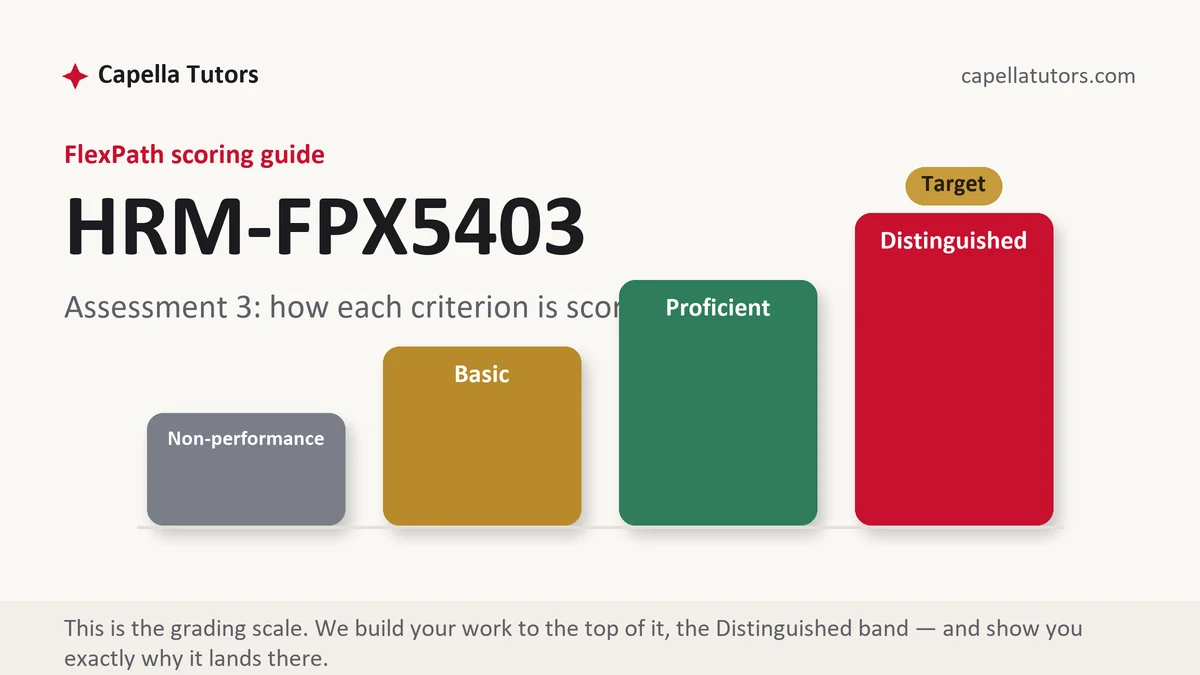
How HRM FPX 5403 Assessment 3 is scored
Each criterion is judged on its own against four levels, and on an evaluation and sustainment plan the levels come out like this:
| Level | What it means on an evaluation and sustainment plan |
|---|---|
| Distinguished | Each measure carries a written definition, a source report and a cohort, the comparison is named along with the confound it fails to remove, and the plan states the result that would make the writer abandon the change. That last sentence is usually the whole difference between the top two columns. |
| Proficient | Sensible measures, a credible owner and a defensible cadence. The plan can demonstrate success and has no honest route to demonstrating failure. |
| Basic | Measurement described as monitoring: dashboards, check-ins, ongoing review. Nothing in it has a denominator, a window or a name against it. |
| Non-performance | A required element is absent, most often the sustainment half, since a plan that ends at go-live has answered only the easy question. |
Because this is the synthesizing deliverable, the criteria also read backwards. An evaluator will check whether the group, the baseline and the metric definitions still match the ones you printed earlier in the course, and a definition that drifted between submissions costs more than a definition that was always modest.
The HRM FPX 5403 Assessment 3 method, step by step
-
Write the failure sentence first
Before any measure is chosen, finish this line: I will conclude the change did not work if ___. Ninety-day attrition among newly licensed technologists remains above 25 percent across the next two hiring cohorts is a falsifiable answer. Staff feel more supported is not, because nothing could ever contradict it. The whole plan then gets built to be capable of returning that verdict.
-
Print the definition next to the number
Across three imaging sites, 41 newly licensed radiologic technologists were hired over 18 months and 12 left within 90 days, which is 29.3 percent. Say which report produced the 41, whether transfers count as departures, whether the 90 days run from hire date or from the end of orientation, and what happens to a person who resigns on day 92. A metric defined in writing before the intervention is the one number nobody can renegotiate later.
-
Split the finding until it points at something
The pooled 29.3 percent hides the finding. Site A lost 4 of 11 and Site B lost 6 of 17, roughly 36 and 35 percent, while Site C lost 2 of 13, about 15 percent. Site C ran two preceptors for 13 hires; Site B ran one for 17. The plan now has a mechanism to test rather than a mood to improve, and preceptor capacity is a number a director can fund.
-
Choose the comparison you can actually get
You will not randomize. You can usually get one of three cheaper designs: the site that did not receive the change, the prior hiring cohort measured the same way, or a staggered start where the later site holds as a comparison until its turn. Pick one, say why, and name the confound it leaves behind, which here is that Site C also has the shortest commute and the newest equipment.
-
Build the individual route beside the general rule
A protected preceptor block helps the cohort and does nothing for the technologist who needs a fixed start time around a treatment schedule. Name the route: a request goes to human resources rather than to the shift lead, the Americans with Disabilities Act requires an individualized interactive conversation instead of a blanket answer, and where the absence is intermittent the Family and Medical Leave Act may be the instrument rather than the schedule. Say who runs it and how it is recorded.
-
Name the owner, the cadence, and what stops
Each measure gets a role that owns it, a report it comes from and an interval it is reviewed on, and the plan states what the site stops doing to free the preceptor hours. Then read the draft against the guide criterion by criterion, marking each level yourself. Submit early in the week, since an attempt can sit two business days before anyone looks at it.
A structure that maps to the criteria
The targets below are our tutors' planning ranges for a plan of this type rather than Capella instructions; expand whichever section your own criteria weight hardest.
| Section | What it must do | Guide |
|---|---|---|
| What changed and why | The intervention in two paragraphs, carried forward with the finding it answers and the population it covers. | ~200 words |
| Measures and definitions | Each measure with its formula, its cohort, its window, and the existing report it will be pulled from. | ~300 words |
| Comparison and inference | The design chosen, why that one, what it removes, and the confound it does not remove. | ~250 words |
| Failure and revision | The result that would end the change, the point at which it is judged, and who makes that call. | ~200 words |
| Individual accommodation route | How a person whose needs the rule does not fit is handled, by whom, under which obligation, and with what record. | ~250 words |
| Sustainment and references | Owners by role, review cadence, what is being stopped, then current APA with internal reports named. | ~300 words |
Annotated sample excerpt
Original model work from our team, published so the graded moves are visible rather than described. Learn the sequence and write your own from your own cohort data.
Ninety-day attrition is defined as voluntary separations occurring within 90 calendar days of hire date divided by all newly licensed technologists hired in the same calendar quarter, drawn from the monthly position control report, with internal transfers excluded and counted separately.1 The baseline is 12 of 41 across 18 months, 29.3 percent pooled, and 36 percent at Site A against 15 percent at Site C, the site already running one preceptor for every six hires.2 Site B receives the protected preceptor block in the first quarter and Site A in the third, so Site A serves as the comparison until it converts, which removes seasonal hiring effects but not the difference in equipment age between the two sites.3
- 1The formula, the source report and the edge cases appear before the number does, so the metric cannot be redefined once results arrive.
- 2The pooled rate is split until it points at a fundable mechanism. A ratio a director can change beats a percentage a director can only regret.
- 3A staggered rollout used as its own comparison, with the surviving confound named in the same sentence. Naming it is what makes the rest believable.
The full premium sample for your exact assessment, written fresh to your scoring guide and issue, is free to request. Study it, revise it into your own voice, and submit work you understand.
The five mistakes that cost Distinguished
- Monitoring instead of measurement. Ongoing review with no formula, cohort or window is a promise to look, not a plan to know.
- A pooled rate left pooled. Three sites averaged together can hide a fivefold difference and every actionable mechanism inside it.
- A metric redefined after the results. Whoever adjusts the definition mid-stream will find the answer they were hoping for, and an evaluator can see it happening.
- The general rule offered as the answer to an individual request. An accommodation is an individualized conversation with a record, and a blanket policy response is the wrong instrument.
- No sustainment owner. A change with nobody accountable after the writer's attention moves reverts to whatever saved somebody time last month.
Pre-submission checklist
- A falsification sentence stating the result that would end the change, with the date it is judged
- Every measure carrying a written formula, a cohort, a window and a named source report
- Rates disaggregated by site or cohort, not left pooled
- A comparison design chosen with a reason, and the remaining confound named
- An individual accommodation route with an owner, an obligation named, and a record
- Owners by role, a review cadence, one activity stopped, and every definition consistent with your earlier submissions
Need the measurement half to hold up?
Send the criteria, the cohort data you can pull and the change you have already argued for. Our eight-person pipeline builds the definitions, the comparison and the failure condition into a premium original sample inside 24 to 48 hours, then checks it against your earlier submissions so no metric quietly changes meaning between deliverables.