This manual is for HRM FPX 5403 Assessment 2, start to submission. The middle deliverable in HRM FPX 5403 turns a diagnosis into a proposal: a specific change to how work is scheduled, supervised or resourced, written as a rule somebody could apply on a Monday, with its cost, its owner and its legal route attached. Your scoring guide sets the exact form, and the criterion that decides the grade is usually the one asking whether the intervention reaches the cause you identified. Below sits our tutors' method for it, a structure that maps to the criteria, and an annotated sample excerpt. Rather hand it off? A premium original sample comes back inside 24 to 48 hours, rewritten free until every criterion clears. Capella's catalog lists the course as HRM-FPX5403, and some courserooms print HRM5403; both point to this same Assessment 2.
One honesty note before the manual: Capella revises courses and scoring guides over time, so always write to the exact scoring guide attached to your assessment in the courseroom. The course identity above is verified on capella.edu; the method and structure below are our tutors' approach to it, not Capella's official rubric text.
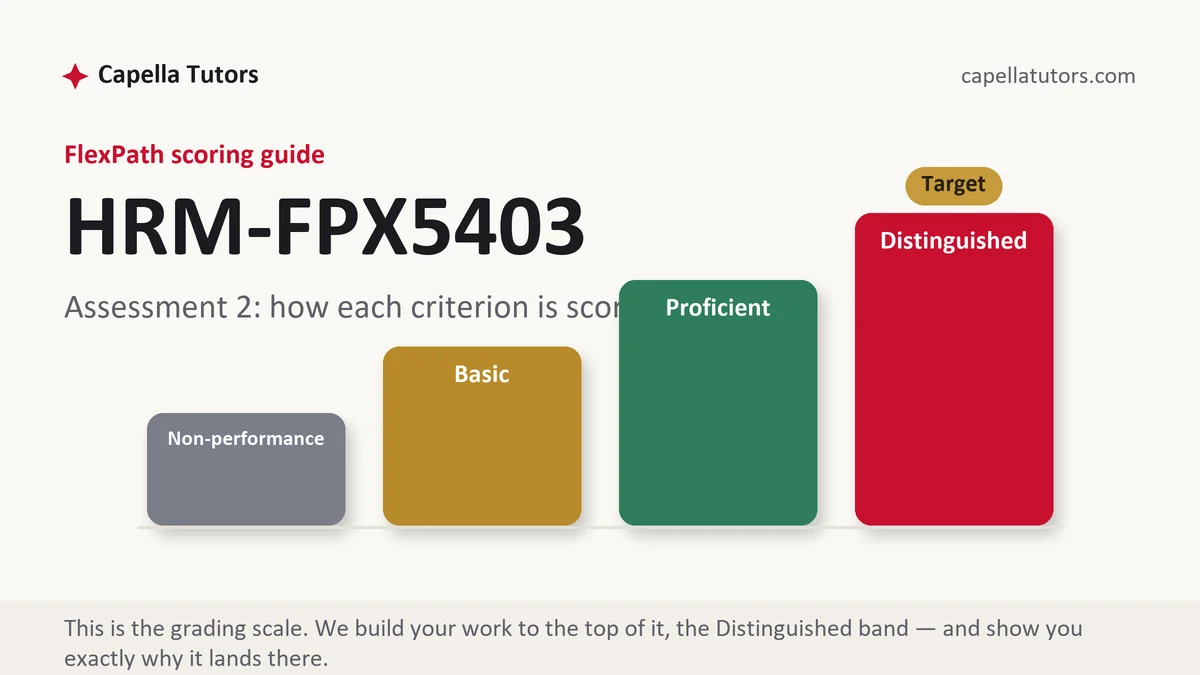
How HRM FPX 5403 Assessment 2 is scored
There is no curve and no letter grade. Your evaluator places each criterion on one of four levels, and on a proposed change package the levels read this way:
| Level | What it means on a proposed change package |
|---|---|
| Distinguished | The change is specified as a rule with an owner and a start date, its cost is calculated by the writer rather than left for the reader to discover, and the elements that must be negotiated are sequenced before the elements that can be implemented. Each criterion carries a move of that size; make it deliberately. |
| Proficient | A sound intervention proposed and justified from the evidence. Costs and constraints are acknowledged in general terms, and general terms are what the top column declines to credit. |
| Basic | A recommendation shaped like a wish: better communication, more recognition, improved culture. Nothing in it tells anyone what to do differently on the next shift. |
| Non-performance | A required component is missing outright, most often the cost or the implementation route. Absence sinks a criterion faster than weakness does. |
The quiet test running under every criterion is proportionality. An intervention aimed at coping when the driver sits in workload or scheduling is not a small error of emphasis, it is a mismatch between the diagnosis and the response, and the guide is written to notice it.
The HRM FPX 5403 Assessment 2 method, step by step
-
Read the proposal back against the diagnosis
Put the ranked findings from your evaluation on one side of the page and your proposed change on the other, and draw the line between them. If a finding has no line, say why you are leaving it alone. If a change has no line, it belongs to somebody else's paper. That single page is also the outline the criteria will be graded against.
-
Write the change as a rule, not as an aspiration
Compare two sentences. Improve scheduling fairness commits nobody. No employee is assigned more than 28 weekend shifts in a rolling year, and self-scheduling requests are locked eight weeks ahead with a published tie-break order, can be audited by a scheduler who has never met you. A rule has a subject, a threshold and a date, and a criterion asking for a specific intervention is asking for exactly those three things.
-
Distribute the burden with arithmetic
On a 44-bed rehabilitation unit, eight positions have to be covered on each weekend day, which is 832 weekend shifts a year spread over 31 staff, an even share of 26.8 each. Last year the eight most heavily rostered people worked an average of 34, carrying 272 shifts, so 26 percent of the staff absorbed 33 percent of the weekend work while eleven others sat at 19 or fewer. That gap is the intervention's target, and once it is on the page nobody argues about whether the schedule feels unfair.
-
Route the bargaining subjects before the start date
Where the unit is represented, scheduling rules, shift length and differentials are mandatory subjects under Section 8(d) of the National Labor Relations Act, so a change to any of them is a proposal rather than an initiative. Put the discussion in the timeline before implementation, name the representative as a participant in the design, and keep motive out of the description entirely. The criteria are testing whether you understand the framework, not whether you can be diplomatic about it.
-
Price it in money and in other people's time
Every change costs somebody an hour they were already spending on something else. Count the scheduler hours to run a locked cycle, the premium hours a cap on weekend assignments will push into incentive pay, and the supervisor time the new tie-break conversation consumes each month. A number you calculated yourself, with its inputs shown, is trusted; a claim that the change is cost neutral is inspected.
-
Attach a measure that could embarrass you
Choose measures the organization already produces and that could show the change failing: the spread between the highest and lowest weekend counts, unplanned absence on Saturdays, incentive-pay hours, and the proportion of self-scheduling requests granted first time. Then write the sentence almost nobody writes, naming what the unit will stop doing to make room, since a team already carrying four initiatives absorbs a fifth by quietly dropping one.
A structure that maps to the criteria
These word targets are the planning ranges our tutors use for a change proposal of this scale, not Capella rules; stretch whichever section your guide weights most.
| Section | What it must do | Guide |
|---|---|---|
| The problem restated | One paragraph carrying the finding forward with its numbers intact, so the proposal has something to be proportionate to. | ~150 words |
| The change specified | The rule itself, in operational language, with thresholds, effective date and the person by role who owns it. | ~250 words |
| Burden and distribution | Who currently carries the work, what the change moves, and the arithmetic that shows the redistribution. | ~300 words |
| Legal and bargaining route | Which elements are mandatory subjects, who must be consulted, at what point, and what happens if agreement is slow. | ~250 words |
| Cost, owners and measures | Money, hours borrowed from other roles, the measures drawn from existing reports, and what is being stopped. | ~350 words |
| References | Current APA, internal reports and the labor agreement named by title and date, citations matched both ways. | as needed |
Annotated sample excerpt
An original model excerpt from our team, showing the register that reaches the top of the guide. Take the moves, not the words, and rebuild it on your own unit.
Effective with the October cycle, no employee on the rehabilitation unit is scheduled more than 28 weekend shifts in a rolling twelve months, self-scheduling closes eight weeks ahead, and remaining gaps fill in published seniority order rather than by the manager's discretion.1 Holding the cap redistributes roughly 48 shifts a year away from the eight most heavily rostered staff, which the model absorbs at 22 additional incentive hours per quarter, about $2,400 annually at the current differential, and 1.5 scheduler hours per cycle.2 Because the cap and the fill order alter scheduling practice in a represented unit, both are taken to the labor management committee in August as proposals, with the unit representative inside the design group rather than briefed after it.3
- 1A rule with a threshold, a start date and a tie-break order. Any scheduler could apply it, and any auditor could check whether it was applied.
- 2The writer prices the change, in premium hours and administrative time, before the reader has to ask. Calculated cost is the difference between a proposal and a suggestion.
- 3Sequences the obligation ahead of the start date and puts the representative in the design. Procedurally accurate beats diplomatic wording every time.
The full premium sample for your exact assessment, written fresh to your scoring guide and issue, is free to request. Study it, revise it into your own voice, and submit work you understand.
The five mistakes that cost Distinguished
- A recommendation with no threshold. Improve fairness cannot be implemented or audited; a numeric cap with an effective date can be both.
- Coping offered where the cause is structural. Resilience content and an application on a phone do not change how many weekend shifts one person is assigned.
- Bargaining subjects implemented rather than proposed. Scheduling rules and differentials in a represented unit go to the table first, and a plan that skips that step creates a second problem.
- Costs left for the reader to discover. Premium hours, scheduler time and supervisor minutes are all real, and the writer who counts them keeps control of the argument.
- Measures that can only confirm success. If no result in your measurement plan would count as failure, the plan is advocacy wearing a table.
Pre-submission checklist
- Every proposed change traced back to a numbered finding, and every unaddressed finding explained
- The intervention written as a rule with a threshold, an effective date and an owner by role
- Redistribution shown arithmetically, with the before and after counts printed
- Mandatory subjects identified, the statute named, and consultation placed before implementation
- Cost stated in money and in hours borrowed from other roles, inputs visible
- At least one measure that could show failure, and one named activity being stopped to make room
Proposal due and the numbers are not built yet?
Send the criteria, the unit, the schedule extract and the representation status. Our eight-person pipeline, analyst through double QA, returns a premium original sample aimed at the Distinguished column in 24 to 48 hours, with the redistribution arithmetic worked out and the bargaining route sequenced so you can defend both as your own.