This manual is for HRM FPX 5403 Assessment 1, start to submission. The opening deliverable in HRM FPX 5403 is a diagnosis: you take one defined group of clinical or clinical support staff, describe what their working week actually contains, and evaluate the experience they currently have against data your organization already holds. Your scoring guide decides the format, and the graded skill sits in the measurement, because a favorability percentage with no response rate and no respondent count beside it is decoration rather than evidence. Below is the method our tutors use for it, a structure keyed to the criteria, and an annotated excerpt. Prefer to hand it over? A premium original sample written to this exact assessment lands in 24 to 48 hours, with revisions free until the guide is answered. Capella's catalog lists the course as HRM-FPX5403, and some courserooms print HRM5403; both point to this same Assessment 1.
One honesty note before the manual: Capella revises courses and scoring guides over time, so always write to the exact scoring guide attached to your assessment in the courseroom. The course identity above is verified on capella.edu; the method and structure below are our tutors' approach to it, not Capella's official rubric text.
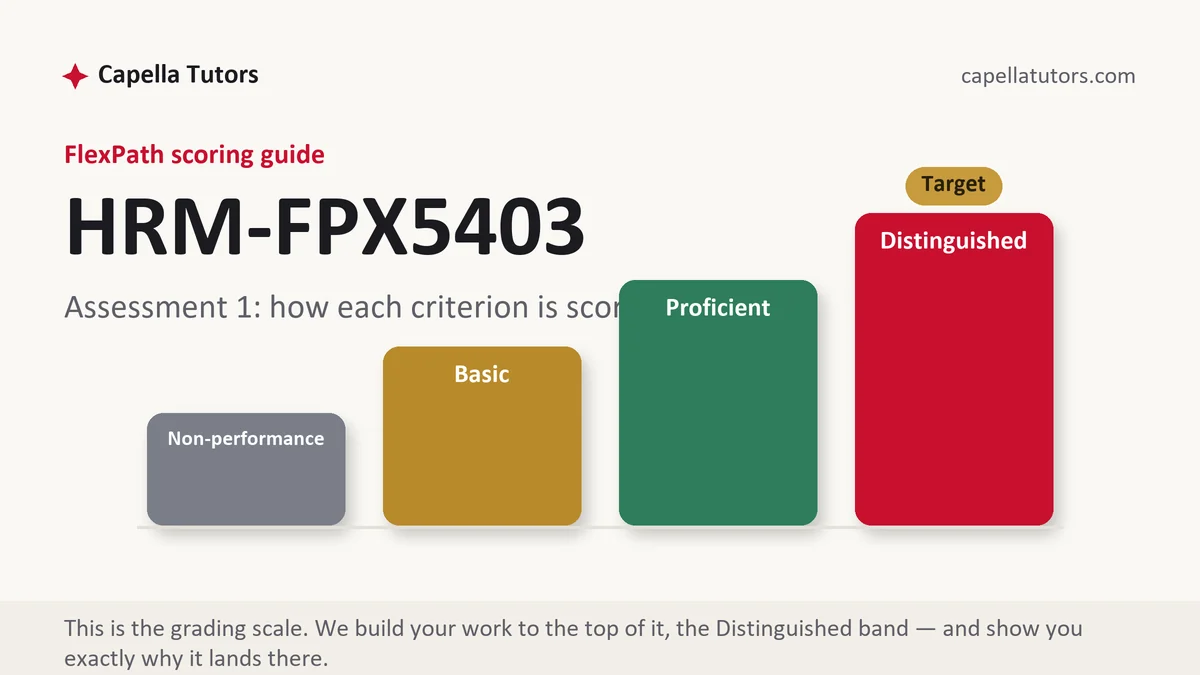
How HRM FPX 5403 Assessment 1 is scored
FlexPath awards no letter grades. Each criterion on your scoring guide lands on one of four levels, and on a diagnosis of the current employee experience the levels translate like this:
| Level | What it means on an experience diagnosis |
|---|---|
| Distinguished | Each figure carries its denominator and its window, a falling response rate is handled as a finding rather than as an apology, and the diagnosis says which part of the experience the employer actually controls. Every criterion hides one move of that kind; find it and make it where the evaluator cannot miss it. |
| Proficient | The group is described and the data reported accurately. The measurement caveats stay in the writer's head, and reasoning left unwritten earns nothing from the top column. |
| Basic | A survey summary retold, with adjectives standing in for arithmetic. This is where most first attempts at a diagnosis land. |
| Non-performance | A required element never appears, most often the evaluation itself, because a description of a department is not an assessment of it. The guide floors what is absent before it judges what is thin. |
Treat this deliverable as the foundation the rest of the course stands on. The population you define and the baseline you print here are what any later proposal gets measured against, so a number you cannot defend now is a number you will have to defend twice.
The HRM FPX 5403 Assessment 1 method, step by step
-
Name the group, then walk its week
Pick one role in one department, not a hospital and not a profession. Write down the headcount, the shift pattern, the days off, who assigns the work and who covers a call-out, then trace a single shift from badge-in to handover and mark where it stops running smoothly. A diagnosis of a group you can count is gradable; a diagnosis of clinicians in general is not.
-
Set the criteria out as headings before you write a sentence
Copy each criterion into your outline as a heading and paste its top-level description underneath. Anything you write that does not sit under one of those headings is unpaid labor. Doing this first also tells you which criterion wants an evaluation rather than a description, and that distinction is where the middle column usually stops.
-
Compute every rate twice, on both denominators
Take each survey figure back to a count of people, then express it against respondents and against the whole population. The two versions frequently point in different directions, and reporting both, with the one you would defend to staff named, is a Distinguished move that costs you four lines. State the reporting threshold too, since a small group cannot be broken out without exposing who said what.
-
Convert one friction point into money and a statute
Take the automatic meal deduction. Thirty minutes come off every shift, and relief into the decontamination area is documented on 62 percent of second-shift assignments. Fourteen technicians working four shifts a week for 47 weeks produce 2,632 shifts, so about 1,000 of them carry a deduction taken while the technician was still working, roughly 500 hours a year, about $12,300 at $24.60 an hour. Under the Fair Labor Standards Act a meal period is unpaid only where the employee is completely relieved from duty, so this is a pay exposure and not only a morale one.
-
Separate what the employer controls from what the work imposes
Acuity, census and the emotional weight of the work are conditions. Relief coverage, instrument turnaround targets, equipment reliability and the behavior of the shift lead are decisions. Sort your findings into those two columns in the paper itself, because a diagnosis that blames conditions has nothing to recommend, and one that blames individuals has misread the evidence the criteria are built on.
-
Score your own draft, then submit early in the week
Read the draft one criterion at a time and mark it yourself against the four levels, honestly, before an evaluator does. Anything short of the top gets one more pass, usually a missing denominator or a claim wider than its source. An attempt can sit for two business days, so a Thursday submission is a Monday result.
A structure that maps to the criteria
The word targets below are the planning ranges our tutors start from on a diagnosis of this kind, not Capella requirements; widen any section your own guide weights harder.
| Section | What it must do | Guide |
|---|---|---|
| Scope and population | The department, the role, the headcount, the shift pattern, and why this group rather than another. | ~150 words |
| The working week | The shift walked from arrival to handover, with the friction located at named points rather than described as climate. | ~250 words |
| Evidence and its limits | Survey results, absence and turnover extracts, and what each instrument does and does not license you to claim. | ~300 words |
| The diagnosis | The ranked account of what is wrong, each item carrying its frequency and its cost to the person and to the payroll. | ~350 words |
| Ownership and constraint | Which findings sit inside management discretion, which are bargaining subjects, and which are conditions of the work. | ~200 words |
| References | Current APA, the internal reports named by title and date, every citation matched both ways. | as needed |
Annotated sample excerpt
Original model work from our team, printed here so the graded moves sit in view rather than in a description. Read the pattern, then rebuild it from your own department's figures.
Second shift holds 14 of the sterile processing department's 38 technicians, and last cycle 26 of the 38 returned the engagement survey, a response rate of 68 percent.1 Favorability on the workload item read 54 percent, which is 14 people. This cycle 19 answered, a rate of 50 percent, and favorability reads 63 percent, which is 12 people, so the score climbed nine points while two fewer technicians were willing to say it.2 Measured against the whole department the two cycles read 37 percent and 32 percent, and the seven technicians who stopped answering are the finding this evaluation is built on, since second shift alone falls under the vendor's reporting threshold and cannot be broken out without identifying the people in it.3
- 1Establishes the population and the response rate in the first sentence, so every percentage that follows can be converted back into people by the reader.
- 2Converts both cycles into counts and states the contradiction plainly. A rising score on a shrinking sample is the arithmetic this course is built to catch.
- 3Recomputes on the stable denominator, treats non-response as evidence, and names the anonymity constraint rather than working around it.
The full premium sample for your exact assessment, written fresh to your scoring guide and issue, is free to request. Study it, revise it into your own voice, and submit work you understand.
The five mistakes that cost Distinguished
- A percentage with no denominator. Favorability without the response rate and the respondent count cannot be checked, and an unverifiable number is treated as an unsupported one.
- A population too wide to grade. Nurses at a health system is a category; 14 second-shift technicians in one department is a group with a schedule you can read.
- Non-response written as a caveat. People who stopped answering the survey did not stop having a view, and the drop belongs in the findings rather than in the limitations.
- A burnout figure the instrument does not support. Report the dimension scores and their spread; the standard research inventory was not built to certify a share of staff as burned out.
- Diagnosis that slides into recommendation. The proposal is a later deliverable, and a paper that jumps to fixes usually leaves the evaluation criterion half answered.
Pre-submission checklist
- One department, one role, headcount and shift pattern printed in the first section
- Every rate expressed as a count of people and against both denominators
- Response rates, respondent counts and the reporting threshold stated once each, without apology
- One friction point costed in hours and dollars, with the statute or policy it touches named
- Findings sorted into employer decisions, bargaining subjects and conditions of the work
- Self-scored against every criterion, internal reports cited by title and date, submitted early in the week
Want the diagnosis built with backup?
Send the scoring guide, the department, the shift pattern and whatever survey summary you are allowed to share. A team of eight, including a research analyst and two QA reviewers, returns a premium original sample aimed at the top descriptors in 24 to 48 hours, with a dedicated pass on the arithmetic so no percentage reaches your evaluator without its denominator.