This manual is for HRM FPX 5120 Assessment 3, start to submission. Later work in Global Human Resource Practice usually asks for a plan rather than an analysis, and the plan our tutors are handed most often is a succession design for a plant leadership team in a market where the senior roles are still held by people sent from headquarters. It is a good test of the whole course, because it forces work authorization, cross-border talent data, reward comparability and a defensible readiness measure into one document with dates on it. The method, the section map and one annotated excerpt come next. Want the draft done for you? A premium original sample is with you in 24 to 48 hours and revised free until the criteria clear. Capella's catalog lists the course as HRM-FPX5120, and some courserooms print HRM5120; both point to this same Assessment 3.
One honesty note before the manual: Capella revises courses and scoring guides over time, so always write to the exact scoring guide attached to your assessment in the courseroom. The course identity above is verified on capella.edu; the method and structure below are our tutors' approach to it, not Capella's official rubric text.
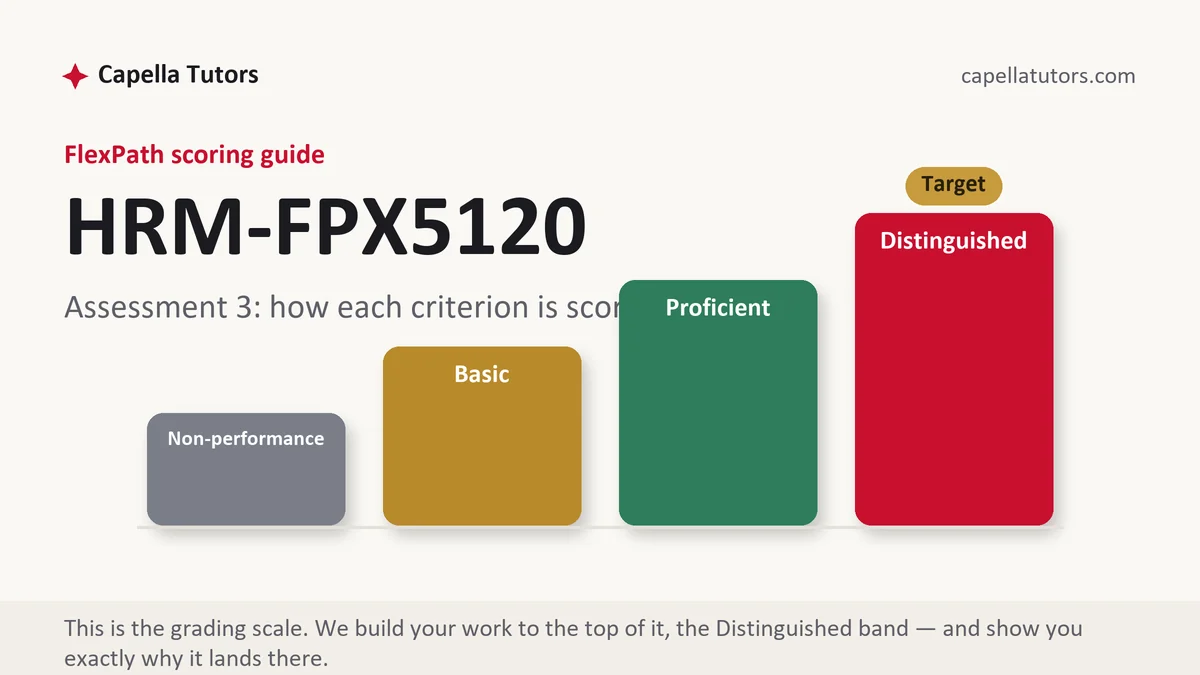
How HRM FPX 5120 Assessment 3 is scored
Each criterion resolves to one of four levels. The top level sentence is a specification, and the gap between it and the level below is usually one identifiable move:
| Level | What it means on a succession and localization plan |
|---|---|
| Distinguished | Readiness is measured with a stated method and its limits, coverage is reported as a ratio with the denominator named, every transition carries a date and a cost, and the immigration and data constraints are handled as parts of the plan rather than as caveats. |
| Proficient | A sensible plan with successors identified and development described. Solid, and short of the arithmetic that would let a reader fund it. |
| Basic | A list of high potential employees with development activities attached, no readiness definition and no cost. |
| Non-performance | A required element is absent, most often the roles with no successor at all or the legal position on who may lawfully hold the job. |
The HRM FPX 5120 Assessment 3 method, step by step
-
Define readiness before you assess anybody
Write the definition down: ready now means able to hold the role unsupported within 90 days; ready in one to two years means one named capability gap with an agreed plan; not ready means no viable internal path on this horizon.
-
Report coverage as a ratio with its denominator
The plant leadership team is nine roles: plant manager, operations, quality, maintenance engineering, supply chain, environment health and safety, human resources, finance and continuous improvement. Three have a ready now successor and four have someone in the one to two year band, so named coverage is seven of nine, or 78 percent, while ready now coverage is three of nine, or 33 percent. Quote both.
-
Say what your measurement instrument cannot do
Grid placements and potential ratings are produced by managers who see the current job, and agreement between raters on the potential axis is modest, which is why a rating tends to track present performance more closely than future capability. Calibrate across a panel, record the evidence behind each placement, and describe the method's limits in one sentence.
-
Name the legal constraint on who may hold the role
Work authorization is part of the plan, not a footnote. An assignment from a United States entity into the host market runs on the host country's permit regime, several markets cap the proportion of foreign nationals on site or require the employer to demonstrate that no local candidate was available, and a return move into the United States sits under the Immigration and Nationality Act of 1952. Then handle the talent file itself: readiness assessments on named individuals are personal data, so the plan states the lawful basis for holding them and the mechanism covering any transfer to headquarters.
-
Cost the localization and show the payback
An expatriate plant manager costs 289,000 dollars fully loaded against 132,000 for a local appointment, a saving of 157,000 a year. Development for the internal candidate is 46,000, and a six month overlap adds 66,000 in local salary before the incumbent leaves, so the investment is 112,000 and the simple payback is 8.6 months. Then risk adjust it honestly: at a seventy percent probability that the candidate reaches readiness on schedule, the expected annual saving is 109,900 and the payback moves to about twelve months.
-
Close the two uncovered roles, then self-score
Quality and maintenance engineering have no internal path because both require a certification with a 14 month lead time, so the plan either starts two people on it this quarter or accepts an external hire and says so. Name the choice. Then mark each criterion yourself and rewrite anything sitting below the top column.
A structure that maps to the criteria
Drafting targets for a graduate succession plan, not Capella rules; lengthen whatever your guide weights most.
| Section | What it must do | Guide word target |
|---|---|---|
| Scope and business case | The site, the roles in scope, why localization is being considered now, and what the plan is for. | ~200 words |
| Readiness method | The definition of each band, the evidence required, the calibration process and the method's limits. | ~250 words |
| Bench position | Role by role coverage with both ratios, the gaps named, and the reason each gap exists. | ~300 words |
| Legal and data constraints | Work authorization and any local content requirement, plus the lawful basis and transfer route for talent data. | ~250 words |
| Transition economics | Cost of the current arrangement, cost of the localized one, investment, overlap and risk adjusted payback. | ~300 words |
| Plan and governance | Dated moves, owners by role, review cadence, and the trigger for reverting to an external hire. | ~250 words |
| References | Current APA, instruments and permit rules dated, vendor and survey data labeled with its method. | as needed |
Annotated sample excerpt
One original paragraph from our team, showing how a bench figure should be reported.
Coverage looks adequate on the measure the site currently reports and thin on the measure that matters: seven of the nine leadership roles have a named successor, which is 78 percent, but only three have someone who could hold the role unsupported within 90 days, which is 33 percent.1 The two roles with no internal path, quality and maintenance engineering, are the two that require a certification with a 14 month lead time, so the gap is a scheduling failure rather than a talent shortage.2 Both figures rest on placements made by five managers in a single calibration session, and inter-rater agreement on the potential axis is the weakest part of any such exercise, so the bands should be re-evidenced against observed performance in the stretch assignments before the plan is funded.3
- 1Two ratios, both with their denominator visible, and the contrast between them carries the finding.
- 2The gap is diagnosed rather than reported.
- 3The measurement's weakness is stated with a remedy attached.
The full premium sample for your exact assessment, written fresh to your scoring guide and issue, is free to request. Study it, revise it into your own voice, and submit work you understand.
The five mistakes that cost Distinguished
- Readiness left undefined. Without a written definition of each band the whole assessment is unfalsifiable, and the criterion asking for justification cannot be met.
- Coverage quoted as a single flattering number. Named successors and ready successors are different populations, and reporting only the larger one misleads the board that funds the plan.
- Work authorization treated as an administrative detail. Whether a person may lawfully hold the role is a precondition of the plan.
- Talent assessments moved across borders with no lawful basis stated. A readiness file is personal data about a named individual.
- A payback figure with no probability attached. Plans depend on people reaching readiness.
Pre-submission checklist
- Readiness bands defined in writing before any individual is placed in one
- Coverage reported as two ratios, each with its denominator named
- The limits of the assessment method stated, with a re-evidencing step attached
- Work authorization and any local content requirement addressed inside the plan
- Lawful basis and transfer mechanism stated for the talent data the plan holds
- Costs, investment, overlap and a risk adjusted payback shown, current APA verified both ways
Succession plan due?
Send the criteria, the roles in scope, the location and whatever cost or bench data you are permitted to share. Eight people work the file and the premium original sample returns in 24 to 48 hours with the readiness method defined and the payback built.