This manual is for HRM FPX 5120 Assessment 2, start to submission. Once the course has established that the employment relationship is constituted differently in each place, the next deliverable usually asks you to design something that has to work in all of them, and reward is where that pressure is sharpest. The version our tutors handle most often is a total rewards redesign for a population split across two markets: one set of elements the organization intends to hold common, another set that local law and local practice will not allow to be common, and a funding argument a finance director can check. What follows is the working method, the section map and a model excerpt. Rather not write it yourself? A premium original sample reaches you inside 24 to 48 hours, with free revisions until the guide is satisfied. Capella's catalog lists the course as HRM-FPX5120, and some courserooms print HRM5120; both point to this same Assessment 2.
One honesty note before the manual: Capella revises courses and scoring guides over time, so always write to the exact scoring guide attached to your assessment in the courseroom. The course identity above is verified on capella.edu; the method and structure below are our tutors' approach to it, not Capella's official rubric text.
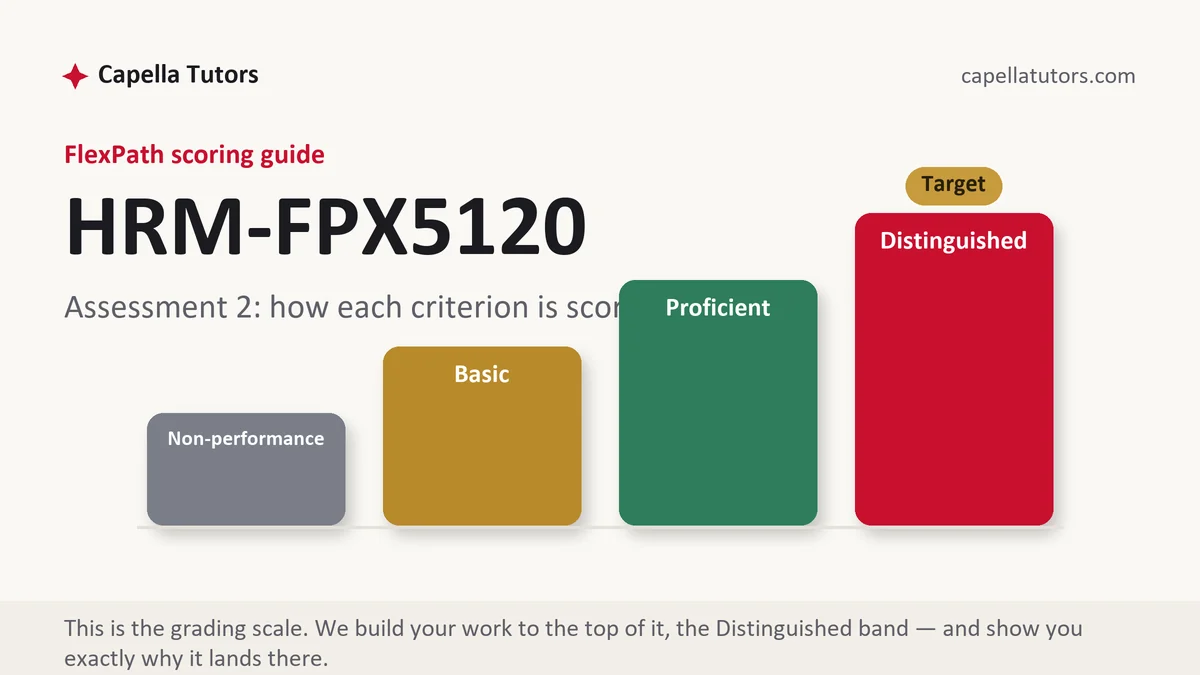
How HRM FPX 5120 Assessment 2 is scored
Four levels per criterion, and the top level wording is the design brief for the section beneath it:
| Level | What it means on a reward design deliverable |
|---|---|
| Distinguished | Each element is priced per head, the layers the organization is standardizing are separated from the ones it cannot, the statutory constraints are cited to the instrument, and the proposal states where its funding comes from. |
| Proficient | A coherent design with the legal constraints correctly identified. Credible work whose numbers are illustrative rather than built. |
| Basic | A list of reward components with market practice described, no per head cost, and standardization argued as a general preference. |
| Non-performance | A required element is missing, most often the funding position or the pay equity analysis the design is supposed to resolve. |
The word design carries an obligation the word discuss does not. If the guide asks for a design, the reader should be able to implement what you wrote without asking you a question.
The HRM FPX 5120 Assessment 2 method, step by step
-
Price the current position per head before proposing anything
Across 640 employees, 410 in the United States and 230 in a European market, the current spend is 74,200 dollars of base, 12,100 in employer taxes and mandated contributions, 9,400 in health and welfare, 4,900 in retirement, 6,800 in variable pay and 1,300 in recognition and learning, which totals 108,700 a head.
-
Split the design into layers and say which one you are standardizing
Philosophy and the definition of what the organization pays for can be common everywhere. Job architecture and grade structure usually can. Benefit design frequently cannot, because a mandated contribution in one market duplicates a voluntary plan in the other. Timing often cannot, because it collides with a local bargaining cycle.
-
Measure the pay gap properly, then admit what the measure hides
Within one job category the mean hourly rate is 42.10 dollars for men and 39.85 for women, a gap of 2.25 dollars, or 5.34 percent. Set against a category midpoint of 86,000 dollars, the compa-ratios are 1.022 and 0.945, a spread of 7.7 points. Then say the honest thing: an unadjusted mean confounds level, tenure and hours, so the defensible figure is the residual gap after those are controlled, and the unadjusted number is a trigger for that analysis rather than a conclusion from it.
-
Cite the constraints that make this a legal question
In the United States the Equal Pay Act of 1963 and Title VII of the Civil Rights Act of 1964 govern pay discrimination, exempt classification runs on the Fair Labor Standards Act of 1938, and a growing list of state statutes require posted salary ranges. In the European market, Directive (EU) 2023/970 on pay transparency requires employers to act where an unexplained gap of at least five percent in a category of workers cannot be justified, and the national transposition sets the reporting mechanics. Cite both layers.
-
Fund the redesign from inside the envelope
Closing the gap for the 84 affected employees costs 2.25 dollars an hour across 2,080 hours, which is 393,120 dollars, plus a 23.4 percent roll-up of taxes and wage-driven benefits, or 485,120 in total. Retiring a voluntary benefits stack used by 14 percent of the population releases 2,200 dollars a head, or 1,408,000. The remediation is therefore self-funded with 922,880 left to move into base and a defined variable plan, and the proposal is cost neutral in year one.
-
Write the transition and self-score
Say what happens to an employee whose current benefit is being withdrawn, whether any element is protected by contract or by a collective agreement, and how the change is communicated where a representative body has standing. Then mark yourself criterion by criterion and rewrite anything below the top column before you submit.
A structure that maps to the criteria
Planning targets for a graduate reward design, not Capella rules; expand the section your guide weights most.
| Section | What it must do | Guide word target |
|---|---|---|
| Population and baseline | Headcount by location, the current spend broken into elements, and the per head total. | ~250 words |
| Reward philosophy | What the organization is paying for, stated tightly enough to rule options out rather than in. | ~200 words |
| Layers and localization | Which layers are common, which are local, and the reason each local element cannot be standardized. | ~300 words |
| Equity analysis | The gap measured, the adjustment named, the affected population counted and the remediation priced. | ~300 words |
| Legal constraints | Pay equity, transparency and classification rules cited to their instruments in each market. | ~250 words |
| Funding and transition | Where the money comes from, what is withdrawn, who is protected and how the change is consulted. | ~250 words |
| References | Current APA, instruments dated, vendor benchmark data labeled with its method. | as needed |
Annotated sample excerpt
A model paragraph from our writers, pitched at the level a reward proposal has to reach.
The proposal asks the business for no new money in year one, and the arithmetic showing that is the first thing the finance director will test.1 Withdrawing the voluntary benefits stack, which 14 percent of the population uses, releases 2,200 dollars a head across 640 employees, or 1,408,000 dollars; the pay equity remediation consumes 485,120 of it once the 23.4 percent roll-up is applied, leaving 922,880 to move into base and the new variable plan.2 Two cautions belong on the same page. The released figure assumes the current utilization rate holds until the withdrawal date, and the remediation figure is calculated on an unadjusted mean, so a regression that controls for level and tenure could move the affected population up or down by roughly a dozen people and the cost with it.3
- 1The paragraph opens on the question the audience actually has.
- 2Every figure is traceable from a stated input.
- 3The soft inputs are named and one of them is given a range.
The full premium sample for your exact assessment, written fresh to your scoring guide and issue, is free to request. Study it, revise it into your own voice, and submit work you understand.
The five mistakes that cost Distinguished
- A design with no baseline.
- An unadjusted pay gap reported as the gap. The raw mean is a trigger for analysis.
- A benefit standardized across a market that already mandates it.
- Transparency rules mentioned but not applied. Posted ranges and reporting duties change what the design must be able to explain, not merely what the employer publishes.
- Funding left to the reader. A redesign that does not say where the money comes from will be read as a request for new money and refused on that basis.
Pre-submission checklist
- Current spend itemized by element with a per head total for each location
- The standardized layer named explicitly, with a reason for every local exception
- Pay gap measured, the adjustment method stated, and the affected population counted
- Equity, transparency and classification rules cited to their instruments and dated
- Funding shown inside the existing envelope, with the released amount traced
- Transition, protected entitlements and consultation covered, current APA verified both ways
Reward design deliverable due?
Send the criteria, the population by location and any cost data you are permitted to share. Eight people work the file and the premium original sample returns in 24 to 48 hours with every element priced and the funding position built.